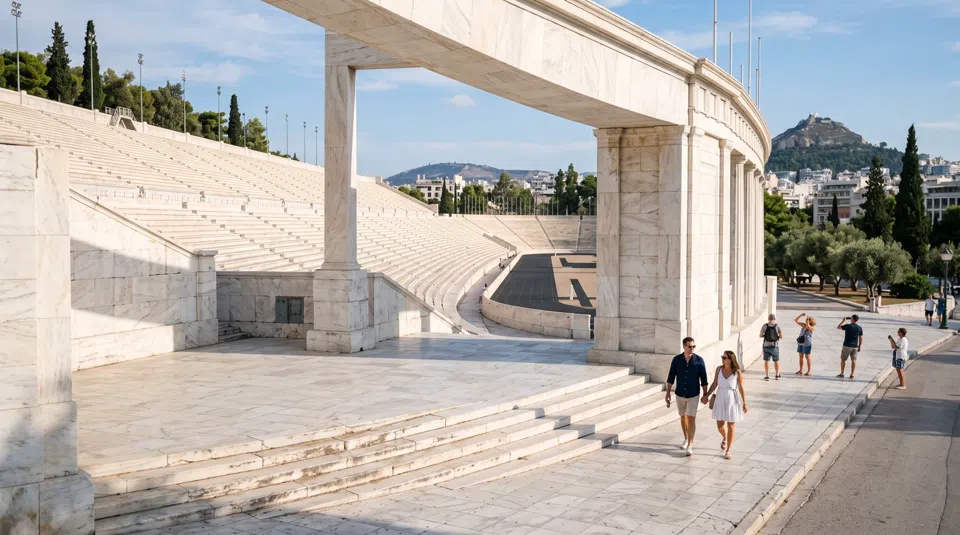

Most visitors climb the rock first and reach the museum tired, which is the wrong order. The Acropolis Museum is where sculpture that was once bolted high onto the Parthenon now stands at eye level, in the arrangement it was carved for, with the temple itself framed in the window behind it. Give it a morning rather than the leftover hour of a long day, and the hill a few hundred metres uphill starts to make sense.
What replaced the old museum on the rock
For most of the twentieth century the finds from the Acropolis were kept in a small building on the summit itself, tucked behind the Parthenon and long since outgrown by its own collection. The Acropolis Museum (Makriyianni, at the foot of the south slope) opened in 2009 to replace it, designed by Bernard Tschumi with Michael Photiadis, and unlike the old building it has the space, the daylight and the sightline back to the temple the sculpture came from.

The layout is simple and worth understanding before you walk in, because it saves you doubling back. The building rises on pillars over an archaeological site, and the route runs upward in rough chronological order: the slopes of the Acropolis on the entrance ramp, the Archaic city on the first main level, then the top floor given entirely to the Parthenon. The upper gallery is rotated out of alignment with the rest of the building so that it sits parallel to the temple uphill. That twist is why the frieze can be hung in the orientation it was carved for, north on the north side, south on the south, so you read it walking the same way an ancient visitor would have.
If you have searched for "old Acropolis Museum" and found confusing results, that is why: the original museum closed when this one opened, and the collection moved downhill.
The excavation under your feet
You start on glass. The entrance ramp and parts of the ground floor are laid over an excavated Roman-era neighbourhood that was found when the foundations went in, and rather than bury it the architects left it visible below the walkway. You can see street lines, house walls, bath floors, drains and cisterns: a dense, ordinary quarter of the city that lived in the shadow of the sanctuary for centuries.
It takes about ten minutes, and most people hurry past it towards the marbles, which is a mistake. It is the only part of the visit that tells you the Acropolis was not a monument standing alone on a hill but the top of a working city, and it is also the clearest reminder that the ground anywhere in central Athens is three or four cities deep. There is an outdoor section of the same dig alongside the building, which you can look down into from the forecourt without a ticket at all.
Working up through the galleries
The Slopes gallery, on the ramp, holds the small, domestic material: pottery, votive offerings, objects from the sanctuaries on the flanks of the rock rather than its summit. It is a short warm-up.
The Archaic Gallery above it is the room that surprises people. It is a single open hall with no walls between the exhibits, lit from the sides, and you walk among the sixth-century statues rather than filing past them in cases. The korai, the standing female figures dedicated on the Acropolis, are arranged so you can circle each one and see the back of the hair, the paint traces still clinging to a hem, the slow sequence by which these figures loosened up over a century. The Calf-Bearer and the Kritios Boy are here, and so is the moment Greek sculpture stops standing to attention and shifts its weight onto one leg. Photography is banned in this gallery, which in practice makes it the calmest room in the building.
On the way up you pass the Caryatids from the Erechtheion, five of the original six, displayed on an open balcony where you can see them from several levels and angles. The empty place in the line is left empty, the sixth being held in a museum overseas, and the museum makes no speech about it.
The Parthenon gallery at the top
The top floor is a glass box the size and shape of the Parthenon's own colonnade. The frieze runs round a central core at eye level, the metopes sit between the outer pillars where they belong, and the pediment sculptures are grouped at the two ends. Where original blocks are missing, plaster casts stand in. They are a lighter, chalkier colour, and nobody has tried to disguise the difference. Walking the full circuit, you get the procession as a continuous narrative for the first time, which is impossible either on the building or in photographs.
The glass walls do the rest. Look out and the Parthenon is right there, in the same orientation, so you can match a block in front of you to the gap it came from on the architrave uphill. On a bright afternoon the light in here is strong and even; in the hour before closing it goes gold and the room empties out. Photography is not permitted at the pediment sculptures, so check the signage as you move round rather than assuming the whole floor is fair game.
Allow 2 to 3 hours for the building as a whole if you want to read labels and take the top gallery slowly. A brisk, honest circuit that still sees everything important takes 75 to 90 minutes.
Tickets, queues and whether to book ahead
Full admission is €20 and the reduced rate is €10, which covers visitors aged 65 and over and non-EU citizens under 26. Entry is free for EU citizens under 26, and free for everyone on a short list of set days: 6 and 25 March, 18 May and 28 October. Those free days are genuinely busy, so if your trip overlaps one and you dislike crowds, pay the €20 on a different morning instead.
This is a separate ticket from the archaeological site on the hill; the museum is not included in the Acropolis entry. Door queues here move far faster than the queues at the site gates, and outside the first hour of a summer morning you can usually walk up and buy a ticket in a few minutes. Booking a timed entry online removes even that, and is worth doing if you are working to a tight plan with a tour, a train or a cruise departure.
Guided options exist and the museum accommodates them properly: licensed guides are admitted, pre-booked group slots are available, and audio-guide headsets can be hired at the desk. Bookable guided visits that include the museum run seven days a week and start from around 37 USD per person. There are 16,160 traveller reviews across the bookable experiences attached to this attraction, with the top-rated one at 5.0 out of 5 from 3,615 reviews, so the guided route works for most people, though the building is labelled well enough to visit alone. A guide earns their fee mainly in the Archaic Gallery, where the sequence of styles is what you have come to see and the labels can only say so much.
Rules, bags and access
Large bags must go to the cloakroom before you enter the galleries, so build five minutes in on arrival rather than being turned back at the top of the ramp. Photography is prohibited in the Archaic Gallery and at the pediment sculptures; elsewhere, follow the posted signs.
The building is unusually easy to get around. Floors are flat and wide, lifts reach every level, and the route has no steps you cannot avoid, in contrast with the uneven, polished marble of the hill itself. Visitors who find the climb to the Acropolis too much can still see almost all of its surviving sculpture here in comfort, sitting down when they need to. Groups work well in the building too: school parties and pre-booked groups are admitted, and the open-plan galleries absorb a crowd of thirty far better than a corridor museum would.
Coffee and lunch above the galleries
The Acropolis Museum Restaurant (Makriyianni, second floor of the museum) is worth knowing about even if you never go into the galleries. You can ask at the ticket desk for a free pass that takes you up to the restaurant and its terrace without paying museum admission at all, which is useful if someone in your party has already seen the galleries, or if you simply want the view with a coffee. Coffee starts around €3.80, a Greek breakfast is about €15, and mains are mid-range for the location.
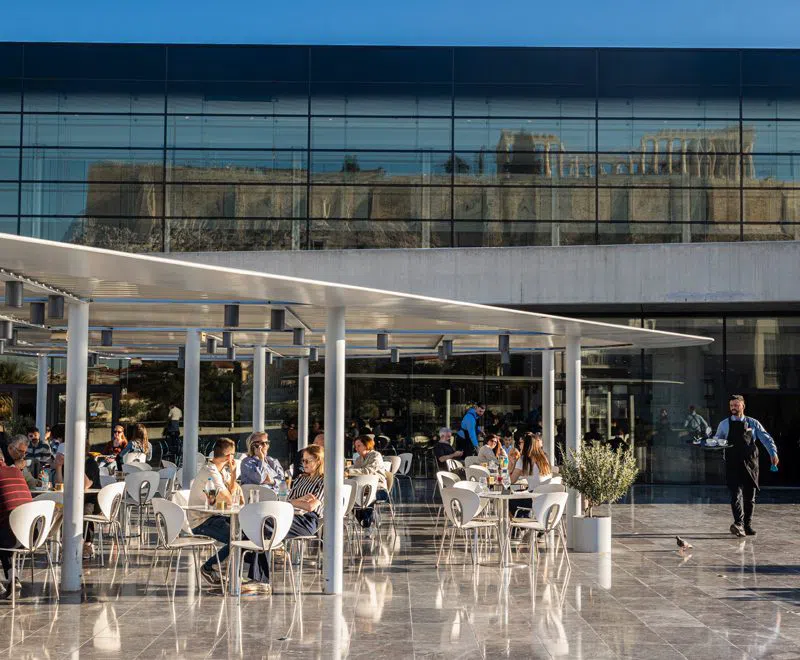
The hot kitchen only opens at noon, so an early arrival gets pastries and coffee rather than a cooked plate. On Friday and Saturday the restaurant serves until midnight, which makes the terrace one of the better-value evening views in the city. Terrace tables are first-come, with one exception: groups can reserve on +30 210 9000 915, though not on Sundays.
Two rooftops within a few minutes
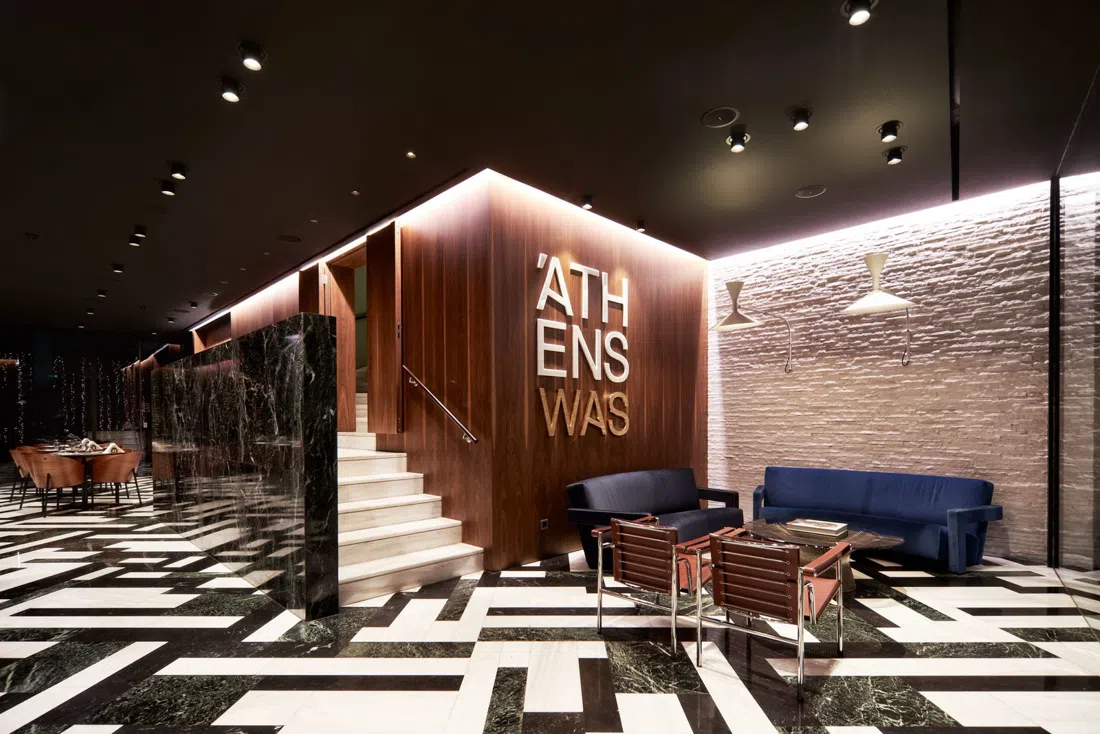
For a special-occasion dinner, Sense Rooftop Restaurant (Makriyianni, at the AthensWas hotel, about four minutes' walk up the pedestrianised street the museum sits on) serves Michelin-listed tasting menus by Alexandros Charalabopoulos at €100 and up per head. It is reservation-only and the room is small, which makes it right for couples and small private groups and wrong for a party of ten. It is also the only one of these views you reach by lift.
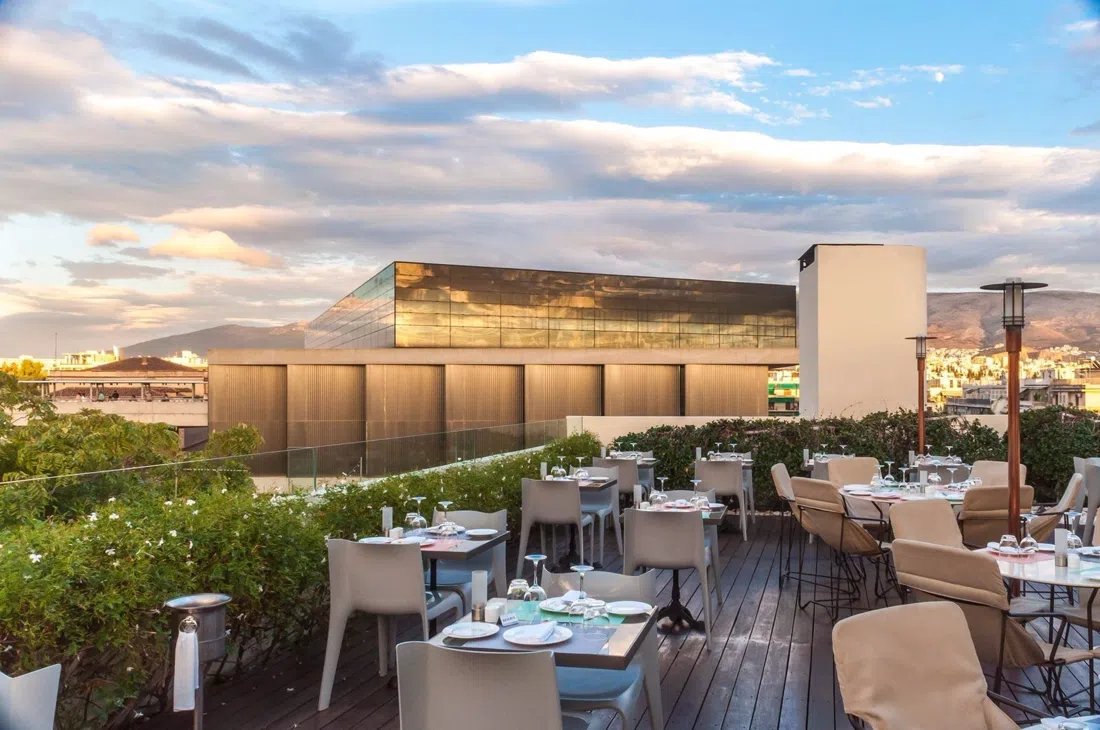
Point A Roof Garden (Makriyianni, on top of the Herodion hotel, roughly five minutes from the museum doors) is the only terrace nearby that looks down on the museum as well as up at the Parthenon. Cocktails run €14 to €18 and mains €25 to €40. The bar opens at 17:30, the kitchen serves 18:30 to 23:00, and the restaurant runs Monday to Saturday. The dress code is elegant-casual and they mean it: no shorts, no beachwear. The roof season also runs roughly May to October, so confirm it is open before building a winter evening around it. Reservations go through the hotel by phone or online, and small groups are fine.
Eight minutes to something entirely different
If someone in your party has reached their limit with antiquity, walk eight minutes to EMST — National Museum of Contemporary Art Athens (Kallirrois Avenue, in the old Fix brewery on the Koukaki edge). Admission is €8 full and €4 reduced, it opens Tuesday to Sunday 11:00 to 19:00 with Thursdays to 22:00, and entry is free on the first Thursday evening of the month from 18:00 to 22:00 except in July and August. Pre-booked guided visits and school programmes run regularly, so it handles groups as comfortably as the Acropolis Museum does. The change of register is total, which is why it is the best single pairing in the area for a mixed group.
Best time to go
Two windows beat all others: the first hour after opening, and after 17:00. Mid-morning to mid-afternoon is when coach parties, school groups and cruise passengers overlap, and the top gallery is the first place that shows it. The late window also gives you the best light through the Parthenon Gallery glass, and the restaurant terrace is pleasant by then rather than baking.
By day of the week, any weekday beats a weekend. Friday and Saturday evenings are the exception worth planning for, because the museum restaurant stays open to midnight on those nights even if your gallery visit was earlier in the day.
Seasonally, this is an indoor visit that works all year and the galleries are climate-controlled, which makes high summer afternoons tempting. The trade-off is company. In July and August, do the rock at opening, then come down here when the heat peaks and accept a fuller building. From November to March the museum is markedly quieter and the whole area is calmer, but check rooftop opening before you count on an outdoor drink afterwards. Note those free admission days again (6 and 25 March, 18 May, 28 October), which are wonderful if you want atmosphere and frustrating if you want space.
Is it worth it
Yes, with one condition: see it on the same trip as the hill, ideally before you climb. The €20 buys you the only place where the Parthenon's sculpture can be read as a single composition, at the height your eyes work best, next to a window showing the building it was cut for. Nothing on the summit does that.
It suits almost everyone: first-time visitors, families with children who need somewhere cool and open to walk around, anyone with limited mobility who would struggle on the rock, and specialists who come for the Archaic Gallery alone. It suits one group less well, the travellers who dislike museums on principle and were only ever going to enjoy the view. They should take the free restaurant pass, have a coffee on the terrace, and let the rest of the party go up.
Practical notes
Acropolis station on Metro Line 2 sits two minutes from the entrance, which makes this the easiest major sight in Athens to reach without a car; from the central squares it is about fifteen minutes on foot along pedestrianised streets. Staying within walking distance genuinely changes the day, because the early and late windows both become easy. The surrounding streets of Makriyianni and Koukaki are full of small hotels and apartments, and you can compare rates through Athens hotel search. For context on the rest of the city, see our broader Athens guide.
Cards work everywhere mentioned here, including the museum desk and both rooftops, but carry €20 to €30 in cash for coffee, taxis and tips. Budget per person for a straightforward day: €20 museum admission, €8 if you add EMST, €3.80 for a coffee or about €15 for a Greek breakfast on the terrace, €14 to €18 a cocktail at the Herodion roof, and €100 upwards if you book the tasting menu. A guided visit that includes the museum starts from around 37 USD per person. Block out 2 to 3 hours for the galleries, five minutes for the cloakroom, and keep the hour after 17:00 free, because it is the best hour in the building.
Questions
How much is a ticket to the Acropolis Museum, and is it included with the Acropolis site ticket?
Admission is €20 full and €10 reduced, which covers visitors aged 65 and over and non-EU citizens under 26. EU citizens under 26 go free, and entry is free for everyone on 6 and 25 March, 18 May and 28 October. The museum needs its own ticket; it is not included in entry to the archaeological site on the hill.
How long do you need inside the Acropolis Museum?
Allow two to three hours to read the labels and take the Parthenon Gallery at the top slowly. A brisk circuit that still covers the glass-floor excavation, the Archaic Gallery, the Caryatids and the full frieze takes 75 to 90 minutes. Add five minutes on arrival for the cloakroom, since large bags are not allowed into the galleries.
Can you visit the museum restaurant and terrace without paying admission?
Yes. Ask at the ticket desk for a free pass to the second-floor Acropolis Museum Restaurant and its terrace. Coffee starts around €3.80 and a Greek breakfast is about €15, but the hot kitchen only opens at noon. On Friday and Saturday it serves until midnight. Terrace tables are first-come; groups can reserve on +30 210 9000 915, though not on Sundays.
Can you take photographs in the Acropolis Museum?
Partly. Photography is banned in the Archaic Gallery and at the pediment sculptures in the Parthenon Gallery, and posted signs mark where else it applies. The ban keeps the Archaic Gallery the quietest room in the building, so go in expecting to look rather than photograph.
Is a guided visit worth it, or is the audio guide enough?
The building is well labelled, so visiting on your own works fine, and you can hire an audio-guide headset at the desk. A guide is worth the fee mainly in the Archaic Gallery, where the century-long shift in sculptural style is easy to walk past unexplained. Licensed guides and pre-booked group slots are admitted, and guided visits that include the museum run seven days a week from around 37 USD per person.
First published on theathenstravel.com, the Athens guide.