The rain arrives in Hanoi as a change in sound before it is a change in light: a flat hiss on corrugated tin, then the slap of plastic ponchos being hauled over handlebars at the junction. Twenty minutes later the lane off Hàng Bạc is running ankle-deep and the pavement kitchens have shifted a foot and a half back under their awnings without anyone appearing to have decided it. Then it stops, the water goes somewhere, and the street picks up mid-sentence. That reflex is the subject here. Hanoi did not learn to tolerate water; it was built around it, and the wettest weeks of the year are the weeks when that logic is legible.
Reading the season before you book anything
The wet stretch runs from May into September, with July and August carrying the heaviest totals, and late-season typhoon remnants can push serious rain into October. Two different weather patterns hide inside that single label, and they call for different planning.
Most of it is convective. Mornings are clear or hazy, cloud stacks through the middle of the day, and then thirty to ninety minutes of very heavy rain lands in the late afternoon or early evening, often with thunder behind it. That is a timetable, not a disruption. You can plan against it: courtyards, streets and markets in the morning, something roofed from about two o'clock onwards.
The other pattern is a tropical system sitting offshore, and it does not negotiate: two or three days of steady grey rain, standing water in the low lanes, and ride-hail drivers quietly cancelling motorbike jobs. You cannot time your way around those days, only pick indoor venues with enough substance to hold three or four hours without becoming a corridor you are pacing.
The booking consequence of both patterns is the same: proximity. In the wet months, base yourself inside the Old Quarter or the French Quarter so that an abandoned afternoon costs you a four-minute walk rather than a car you cannot summon. A Hanoi hotel search sorted by location rather than by photograph is the useful move here, and the rest of the Hanoi guide covers how the two districts differ in noise and walkability.
One more scheduling note matters more in the rain than at any other time of year. Everything capacity-capped in this city gets harder between May and September, because wet afternoons push every visitor indoors at the same hour. Book the constrained things first and let the flexible things fill the gaps around them.
The art form that needs the water
Thang Long Water Puppet Theatre (Nhà hát Múa rối Thăng Long, 57B Đinh Tiên Hoàng, on the eastern edge of Hoàn Kiếm lake in the Old Quarter) makes the argument on its own. It performs an art form invented by Red River delta farmers who staged shows in flooded paddy fields, standing waist-deep behind a bamboo screen and working the figures on rods below the surface.
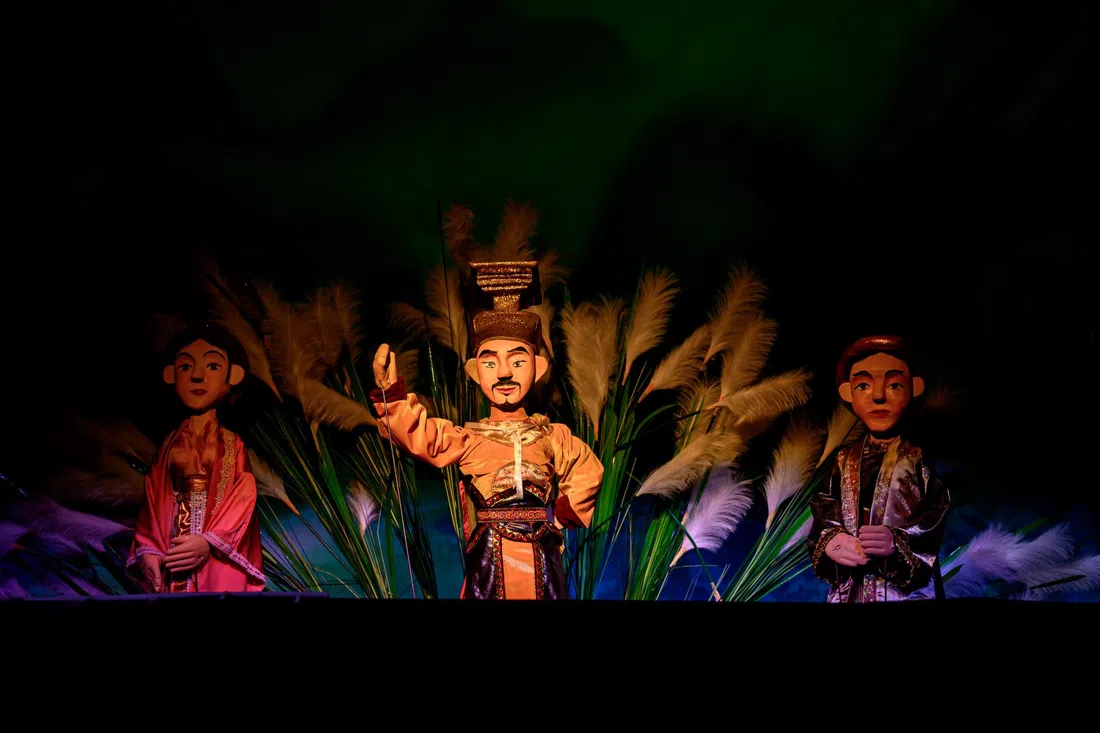
The water is the mechanism, not set dressing. It conceals the puppeteers, carries the figures across the stage, lets a dragon surface instead of merely arriving, and bounces the lantern light back up into the audience. Farmers made theatre out of the flood because the flood was the one thing they reliably had. Watching it during a downpour, with rain on the roof as the undertow to the live ensemble singing and drumming at the side of the stage, is the least abstract version of this city's relationship with water you will get in fifty minutes.
Practically: seven shows daily Monday to Saturday, eight on Sunday, and tickets run 100,000 to 200,000 VND depending on seating tier, roughly US$4 to US$8. The run is fifty minutes with no interval. Saturday evening and Sunday afternoon sell out two to three days ahead, so if those are your only windows, buy early. The weekday 13:45 and 15:00 shows take walk-ins, which is the information you want at one o'clock when the sky closes over.
The room has limits worth knowing. Block bookings for tour parties are standard and the auditorium is built for them. This is a good hour for families, for mixed-age groups and for anyone needing fifty roofed minutes at short notice. It is not a quiet, contemplative evening.
Two roofed hours that are about something
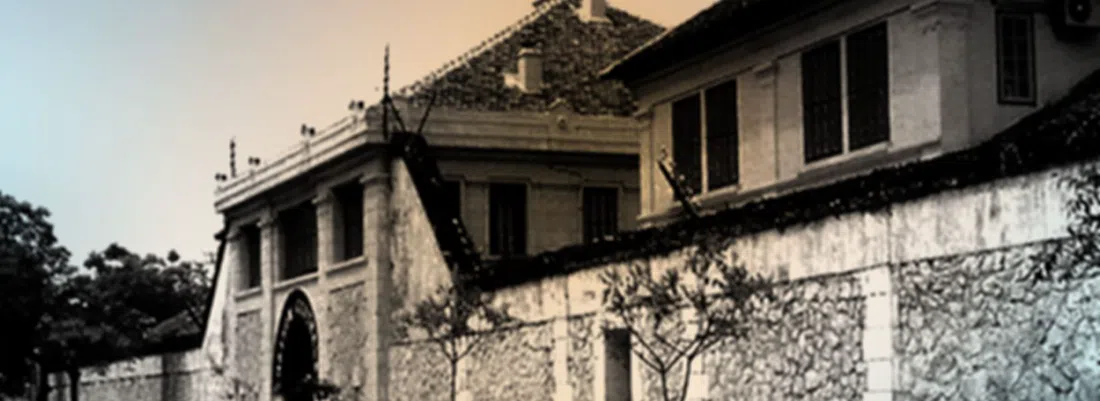
Hỏa Lò Prison Relic (Di tích Nhà tù Hỏa Lò, Hoàn Kiếm district, on the street that took the prison's name) is entirely under cover, which makes it the obvious wet-afternoon default, though that undersells it. The French built the prison in the 1890s to hold Vietnamese political prisoners, and part of it later held captured American pilots. The site now does its work through actors, lighting and sound rather than wall-mounted placards, and it is the best-designed museum experience in the city by some distance. It is also heavy going, deliberately so, and not an afternoon to schedule immediately before a celebratory dinner.
Day entry is 50,000 VND and takes any group size. The evening programme, Đêm Thiêng Liêng, is a different proposition: capacity-capped, priced at roughly 399,000 to 499,000 VND, and bookable only by phone or by Facebook message. You cannot buy it online or through a marketplace, and walking up does not work. Through 2026, people enquiring have been told that dates two months out were already full. Treat four to six weeks of lead time as the floor and six to eight as realistic in the wet months. If the night tour matters to you, book it first, ideally before flights are inconvenient to move.
Ten minutes away, the Vietnamese Women's Museum (Bảo tàng Phụ nữ Việt Nam, on Lý Thường Kiệt in the French Quarter) is the one I would send a rain-soaked reader to if they only had one museum in them. Four floors absorb numbers easily, so groups work here, and the building has just come out the other side of a long refresh: a 3D interactive space opened at the end of June 2026 and the building works finished that August. Entry is about 40,000 VND, around US$1.60, and it opens daily 08:00 to 17:00 with last entry at 16:30.

The reason it belongs in a piece about rain is the street-vendor floor. It is the clearest account anywhere of how Hanoi's informal economy physically copes with water: what a vendor carries, what she can abandon in thirty seconds, where she goes when the lane floods, and how a business with no premises survives a season of afternoon storms. You will walk out and read the pavement outside differently, which is a fair return on a dollar and a half.
A thousand-year drainage diagram you can walk through
The Temple of Literature & Imperial Academy (Văn Miếu – Quốc Tử Giám, in Văn Miếu, Đống Đa) is usually sold as the country's first university, founded in 1070 and given its academy six years later. True, and beside the point for this week. Look at it instead as water management you can walk through.
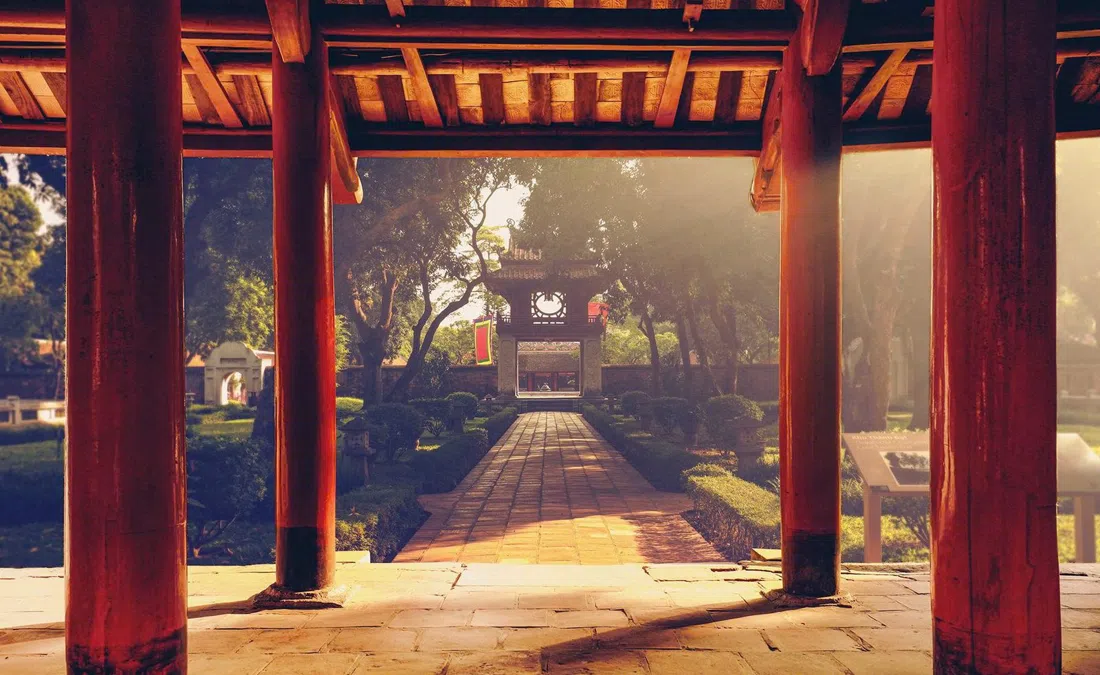
The layout is five courtyards strung along a single north-south axis, with a reflecting well on that axis as both a composition device and a holding basin. The walkways are raised. The colonnades are covered and continuous enough that you can cross most of the site in heavy rain, moving between roofed stretches rather than sprinting across open ground. That is a thousand-year-old answer to the question every Hanoi building eventually has to answer, and it still works better than a good deal of what has been built since.
Tickets are 70,000 VND for adults, 35,000 VND for Vietnamese students, and free for under-16s, bought at a cash-only window at the Văn Miếu gate, so bring notes. Allow ninety minutes. The five courtyards swallow crowds, so guided groups come through constantly without the place feeling overrun. There is also a separate night opening, 18:30 to 22:00, which is the better call in the wet season: the storm has usually passed by then, the stone is wet, and the lighting has something to work with.
Two dinners solving two different problems
If the afternoon has been washed out, the evening is where you recover it, and the choice depends entirely on how many of you there are.
For two to four people, Gia (Văn Miếu, directly across the street from the Temple of Literature) is the most articulate reading of northern produce in the city. It holds one Michelin star, serves an eleven-course tasting menu and nothing else, and Chef Sam Tran's menu moves with the season, which in these months means it reads as a direct account of what the rain is doing to the delta. The stated design brief is the temple over the road, and the room reflects that: restrained, quiet, deliberate.
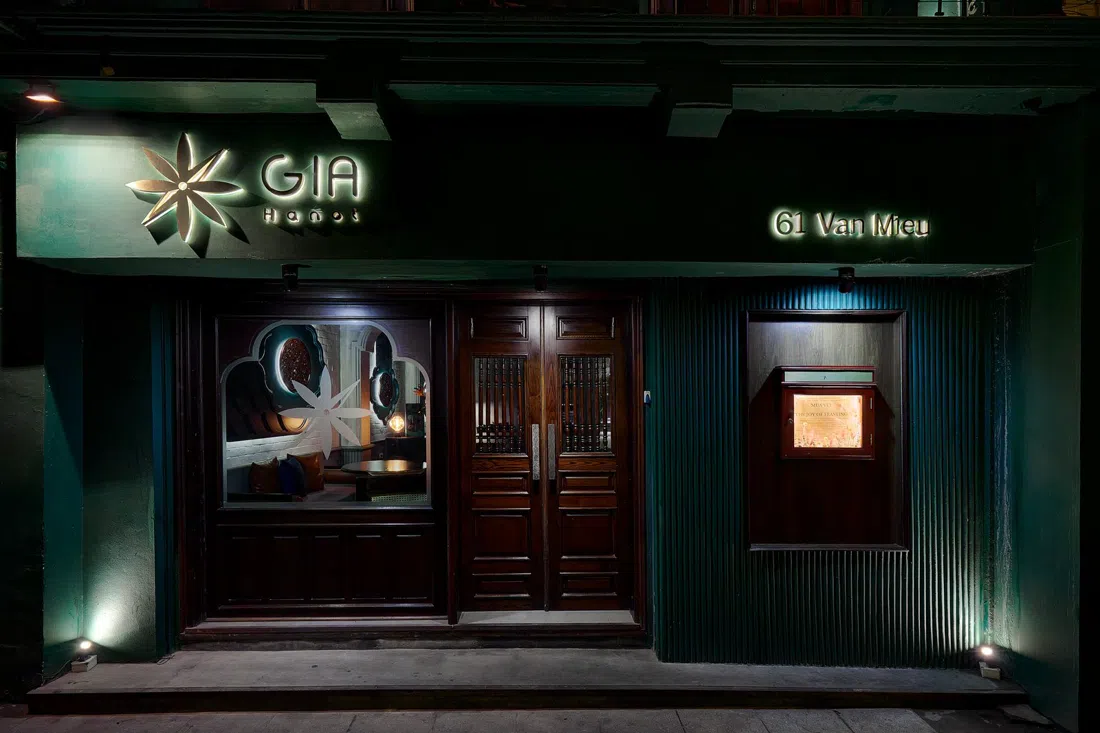
The constraint is hard and worth stating plainly. There are fourteen tables. Large parties do not fit, small groups need to book well in advance, holiday dates go weeks out, and walk-ins essentially never work. Service runs lunch Friday to Sunday 11:30 to 13:30, and dinner Tuesday to Sunday 18:00 to 21:00. Note the gap, and note that the Friday-to-Sunday lunch is the civilised way to spend a grey midday. Pricing sits in the fine-dining band; confirm the current figure when you book rather than trusting any number you read online, including mine.
For seven people or seventeen, go to Luk Lak Vietnamese Restaurant (French Quarter, 4A Lê Thánh Tông). It is the best large-group room on this list, and the specifics earn that: three floors, around 200 covers, private rooms sized for parties of seven or eight, and a kitchen under Madame Bình carrying twenty-five years of five-star hotel technique. It has held a Michelin Bib Gourmand three years running to 2026, which is the relevant signal, because you are not trading food quality for the ability to seat a group. Reckon on roughly 300,000 to 800,000 VND a head depending on how you order. Booking is essential, particularly for a wet Friday or Saturday when every group in the district is looking for an indoor table at the same moment. It opens at 07:30 and runs to 22:00, so it works for a rainy breakfast or a long lunch as well as dinner.

One roof and a whole afternoon
For the days when the rain simply does not stop, Complex 01 (Đống Đa, at number 29 in lane 167 Tây Sơn) is the single best use of four hours. It is a 4,000 m² adaptive reuse of a defunct printing works: cinema hub, library, art space, gaming club and a string of cafés, all under one continuous roof, reached down a lane that itself feels like a small discovery. Entry is free, you spend as you go, and individual tenants keep their own hours within the 08:00 to 23:00 envelope, so a mid-afternoon arrival is safer than an early one.

Structurally it is the contemporary version of the same idea as a stilt house: accept that the ground will be wet, lift the activity, and put a roof over all of it. Groups do well because people can split up and regroup, cinema for some and a long coffee and a book for others, without anyone having to agree on a single plan in the rain. It suits teenagers, mixed groups and anyone whose outdoor day has collapsed.
Practical notes for a wet week
Ride-hail apps are the default for getting around. In heavy rain, motorbike supply collapses and car fares rise, so budget for cars during the storm hours and expect a wait. Inside the Old Quarter, walking is genuinely viable through burst rain because the awnings are close to continuous; the real obstacle is kerb-level water at junctions, not the rain itself. Buy a poncho from any street stall for a few tens of thousands of dong, and get the shop-bought kind with the cover for the handlebars even if you are on foot, because it is the better design. Sandals outperform trainers by a wide margin; wet trainers stay wet for two days in this humidity.
Carry cash in notes of 10,000 to 100,000. The Temple of Literature window is cash-only, and the Hỏa Lò night programme is arranged entirely by phone or message rather than any online payment page. Cards are fine at Gia and Luk Lak and at most cafés inside Complex 01.
A single wet day works like this: Temple of Literature from 08:30 while the sky is still open, lunch at Gia if it is Friday to Sunday, the 13:45 or 15:00 puppet show when the first cloud stacks up, the Women's Museum or Hỏa Lò if the rain holds off a little longer, and a booked table at Luk Lak for the evening. Swap the whole middle of that for Complex 01 on a genuine all-day washout.
On budget, entry across the puppets, one museum and the Temple of Literature comes in at roughly 200,000 to 300,000 VND per person. Add 300,000 to 800,000 for a Bib Gourmand dinner. The two line items that change the shape of the day are the Hỏa Lò night tour at 399,000 to 499,000 and a tasting menu at Gia, both worth it and both needing to be locked in weeks before you arrive rather than decided over breakfast.
Lead times, in order: Hỏa Lò night tour first, four to six weeks minimum. Gia next. Luk Lak a week out, more for a weekend group. Weekend puppet shows two to three days out. Everything else can be decided from a café doorway while you wait for the rain to pass, which is the local method anyway.
Questions
When exactly is Hanoi's rainy season, and how much of the day does it actually rain?
The wet stretch runs May into September, with July and August the heaviest, and typhoon remnants sometimes pushing rain into October. Most days follow a convective pattern: a dry or hazy morning, then thirty to ninety minutes of very heavy rain in the late afternoon or early evening. The exception is a tropical system sitting offshore, which brings two or three days of steady rain you cannot time around.
How far ahead do I need to book the Hỏa Lò night tour?
Four to six weeks is the floor, and six to eight weeks is realistic in the wet months. The Đêm Thiêng Liêng programme is capacity-capped and bookable only by phone or Facebook message, with no online checkout. Through 2026, enquirers have been told that dates two months out were already full. The day visit, at 50,000 VND, needs no booking and takes any group size.
Can I get water puppet tickets on the day if it starts raining?
Often, yes. The weekday 13:45 and 15:00 shows at Thang Long Water Puppet Theatre take walk-ins, which makes them the reliable short-notice option. Saturday evening and Sunday afternoon are the sessions that sell out two to three days ahead. Tickets are 100,000 to 200,000 VND by seating tier and the show runs fifty minutes with no interval.
Where can a group of eight or more eat well on a wet evening?
Luk Lak Vietnamese Restaurant on Lê Thánh Tông. Three floors, around 200 covers and private rooms sized for parties of seven or eight, with a Michelin Bib Gourmand held three years running to 2026, so the group capacity does not cost you the food. Book ahead, especially for a rainy Friday or Saturday. Gia, by contrast, has fourteen tables and cannot take large parties at all.
Is it worth visiting Hanoi during the monsoon months at all?
Yes, if you plan the day in two halves (outdoors in the morning, roofed from mid-afternoon) and stay inside the Old Quarter or French Quarter so a cancelled plan costs you a short walk. Crowds are thinner and prices are softer, and the venues that explain the city best (water puppetry, the Temple of Literature's colonnades, the Women's Museum street-vendor floor) are all about water. Carry a street-stall poncho and wear sandals, not trainers.
First published on hanoigetaways.com, the Hanoi guide.