The lift to the 41st floor takes under a minute and your ears pop on the way up. The doors open onto a glass-walled tube slung between two towers, 170 metres above a park that was a racecourse until the early 1990s, and the city tilts away under your feet. In October that view comes with a condition attached. By mid-afternoon the cloud stacks up over the valley, and the thing you came up to see becomes weather.
What standing in the sky actually involves
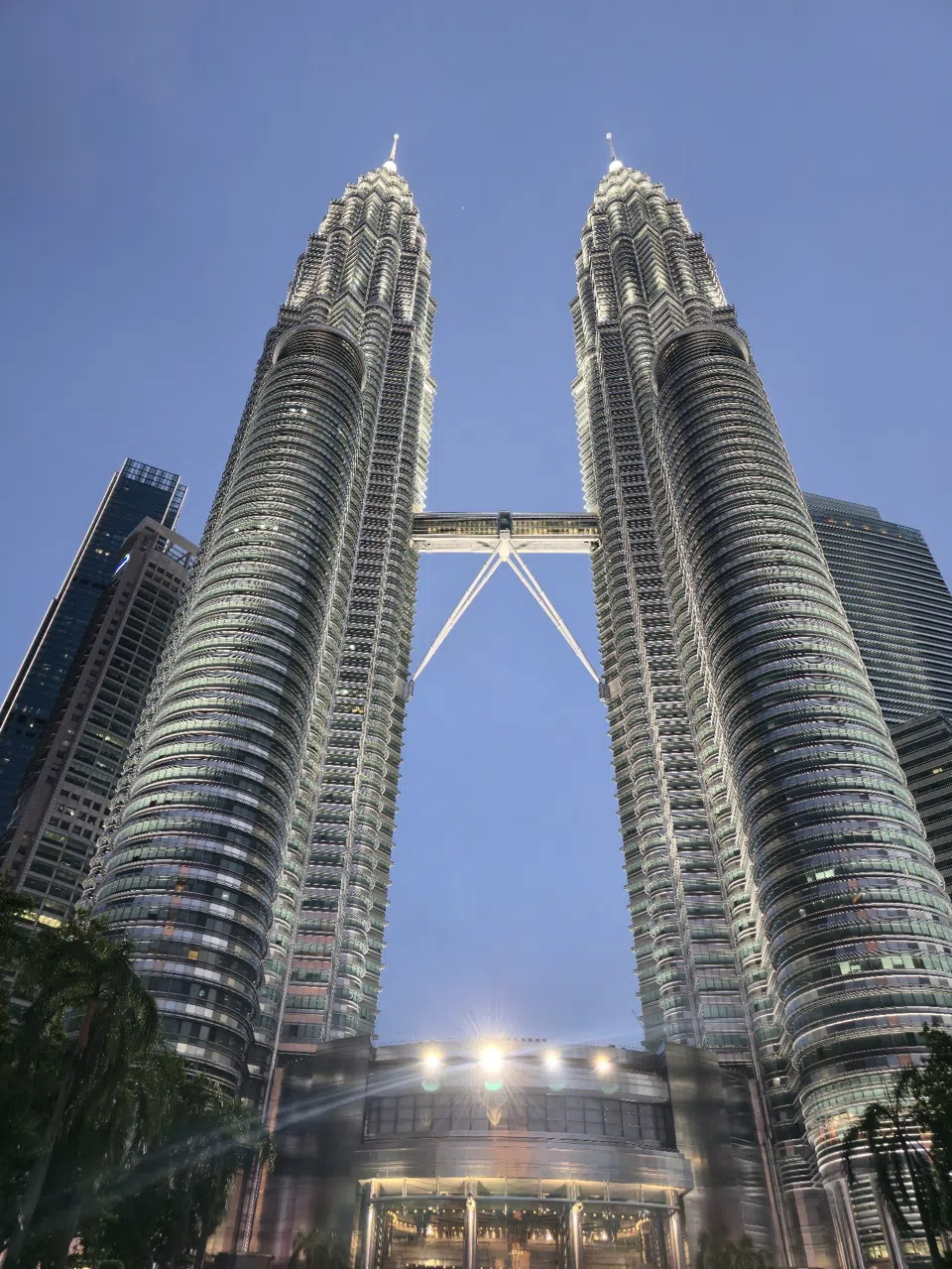
The PETRONAS Twin Towers Skybridge & Observation Deck (KLCC, inside the towers themselves) is two viewpoints in a fixed order rather than one open-ended visit. First comes the Skybridge, the double-decker link joining the two towers at levels 41 and 42. It isn't rigidly bolted at both ends. It is engineered to slide, because the towers sway independently in the wind, and a guide will usually tell you that before you walk out. You get a few minutes there, glass to the floor, the park directly below, the mall roof and the mosque dome looking like architectural models.
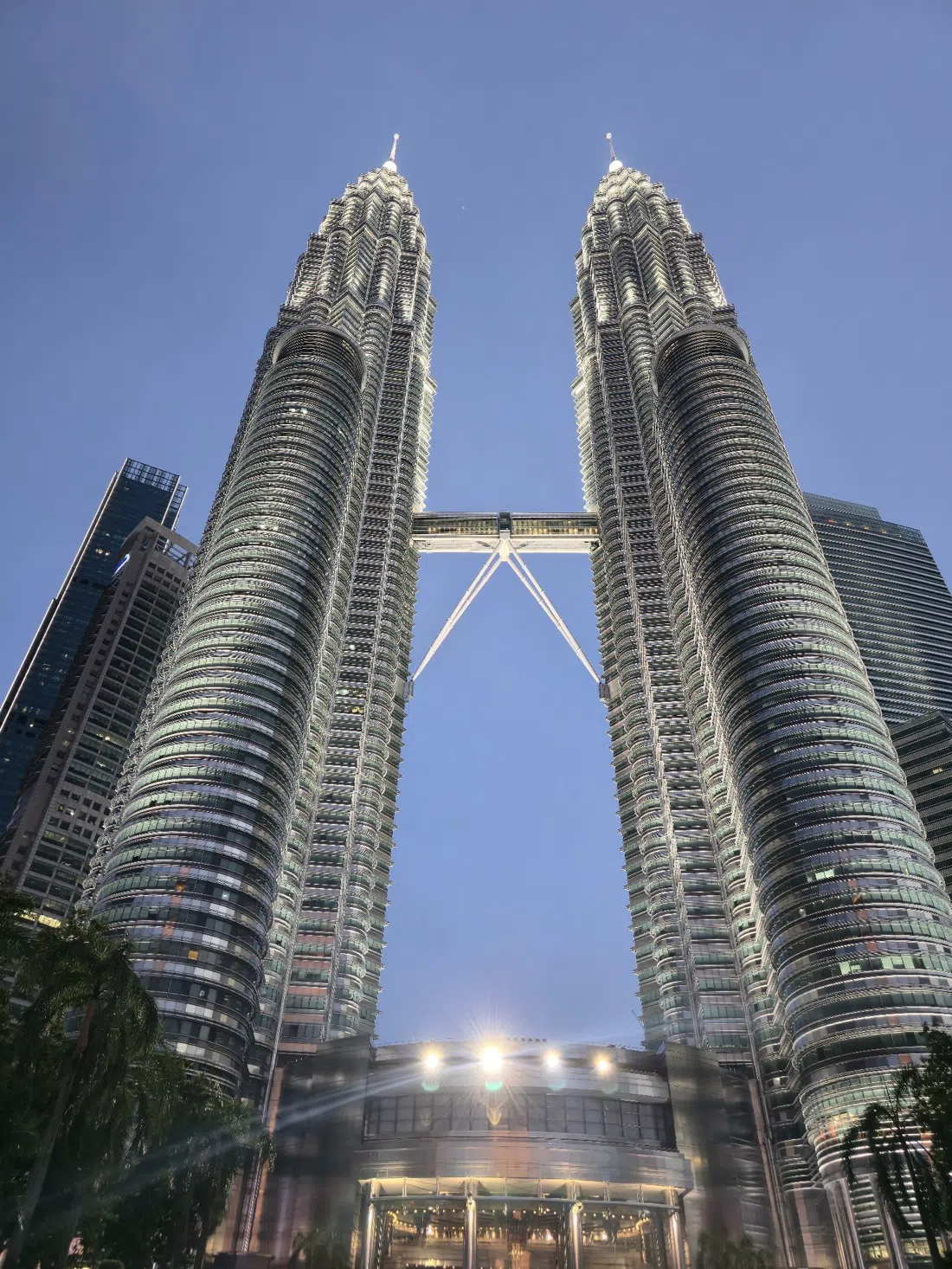
Then a second lift takes you to level 86, the observation deck proper: a glazed ring near the top of the occupied floors where you can walk the full circuit. This is where the geography resolves. West, the Klang Valley spreads flat toward the coast in a haze of low white rooftops; north, the limestone hills stand up out of the suburbs; and south-west, the older colonial core and the Bukit Nanas forest reserve read as a dark green smudge among the newer towers. The eight-pointed star floor plan, drawn from Islamic patterning, is why the window bays step in and out instead of curving smoothly, and why every few metres you get a slightly different frame.
It is short and tightly run. Entry is in timed batches and staff keep you moving: budget 45 minutes to an hour above ground level, or about 90 minutes door to door once you add the ticket hall, the bag check and the lifts. Standard admission is RM100 for an adult and RM43 for a child aged three to twelve. Premium sky-access tiers sit around RM230-280 and buy you a quieter slot and more time, not a different building. The towers, completed in 1998 to César Pelli's design, held the world's-tallest title until 2004, and they still feel like the organising fact of the city rather than one entry on a list.
Slots, the ticket hall and the Monday problem
The counter is at the lower ground and concourse level of Suria KLCC (KLCC, the mall at the foot of the towers), open 10:00 to 22:00 daily. That counter is where unprepared visitors discover the day has gone. Entry is sold in fixed time slots, and slots routinely go days ahead, so turning up on the morning you want to go up is the one plan I would not build a day around.

Opening hours are Tuesday to Sunday, roughly 09:00 to 21:00, with last admission at 20:30. Most Mondays the whole attraction closes for maintenance. That single fact has wasted more mornings in this precinct than anything else, because the mall underneath is open, air-conditioned and busy, and gives no hint that the lifts aren't running. If your only free day is a Monday, plan the ground-level and indoor options below instead and don't fight it.
Booking the ticket yourself is the cheap route. A guided option is the other, and its value is logistical rather than educational: operators pre-hold slots, so your party isn't living off whatever is left. Private sightseeing itineraries that pair the deck with the cave temples north of the city start from 110 USD per person and run six days a week, Tuesday through Sunday, which mirrors the towers' own closure pattern. The best-reviewed of them holds 4.9 out of 5 across 1,175 reviews, so the format works for people who want the driving, the timing and the entry handled in one go. Whether that justifies the gap over a RM100 ticket depends on how much of your day you want organised, not on how good the view is.
One group reality: every person needs their own slot, and the Skybridge holds a capped number at a time, so a large party gets split across consecutive slots. Six friends will not necessarily stand on the bridge together, and nobody tells you that at the point of purchase.
The best time to go in October
October sits in the wetter half of the year here and the daily pattern is consistent enough to schedule against: bright or hazy mornings, cloud building from early afternoon, and a serious thunderstorm somewhere between 15:00 and 18:00 that can empty the streets for forty minutes and then stop as though switched off.
That leaves two good windows. The first slots of the day, 09:00 to about 10:30, give the cleanest visibility and the thinnest crowd, and you are back at ground level before the heat peaks. An evening slot from about 19:00 gives you the city lit, and with last admission at 20:30, a 19:30 or 20:00 entry really is available rather than theoretical. The deck glass picks up less reflection after dark than most people expect, though you will still want to shoot with a lens hood or a cupped hand against the pane.
The hours I would avoid if I had a choice are 14:00 to 17:00, which is when you are most likely to pay RM100 to look at the inside of a cloud. Weekdays beat weekends at every hour. And if the forecast is grim on your only available day, take the earliest slot rather than the latest, because mornings fail less often than evenings in this month.
The free half of the precinct
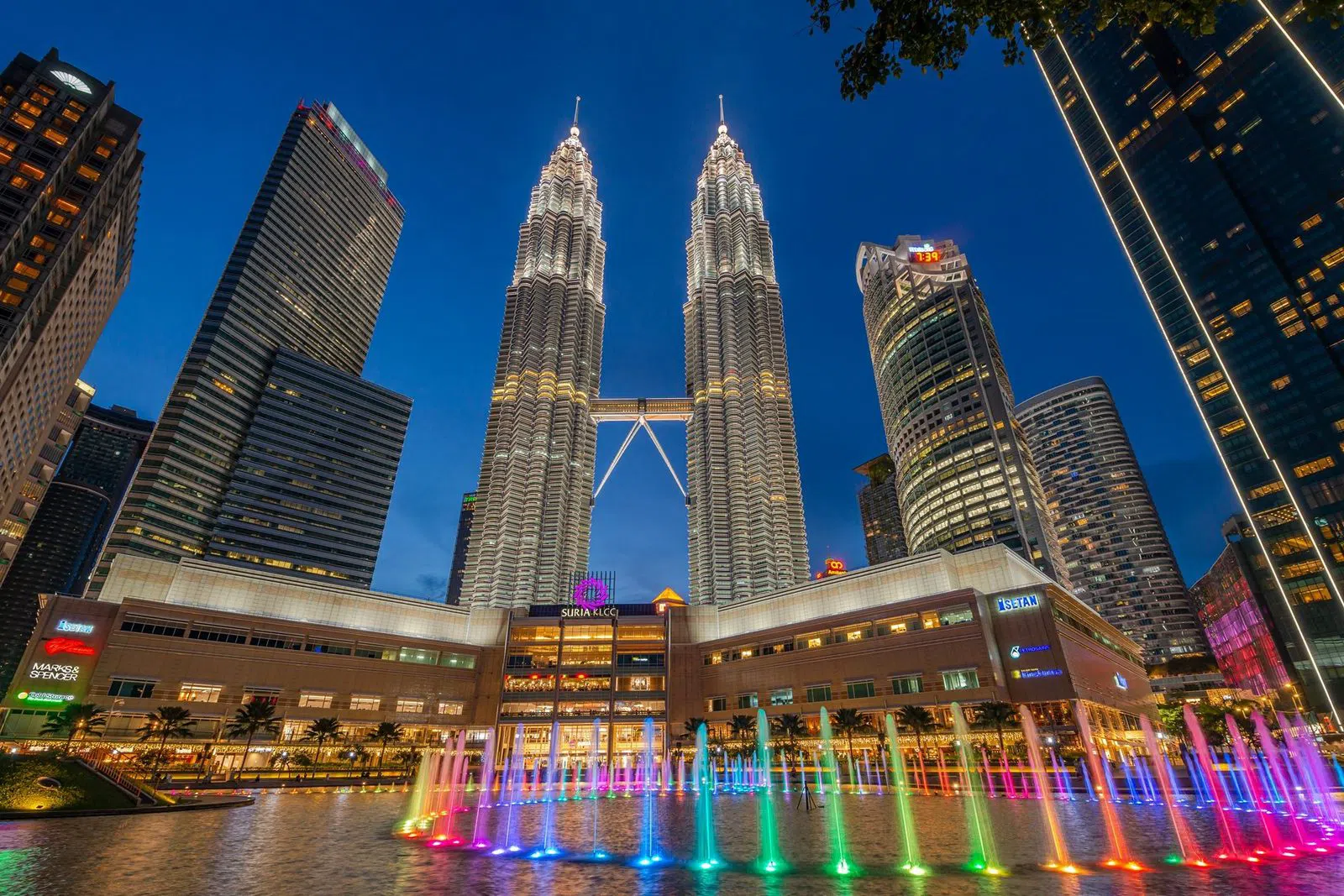
KLCC Park & Lake Symphony (KLCC, directly below the towers) is free, unticketed and has no door policy at all, which makes it the default meeting point for any group and the place the classic ground-level photograph of the towers is actually taken. The Lake Symphony light-and-water shows run on the half hour through the evening, roughly 20:00 to 22:10, and they pair neatly with a late deck slot: go up, come down, watch the fountains, walk to dinner. In October the park is also the first thing to close down in a downpour, so keep the mall entrance in view.
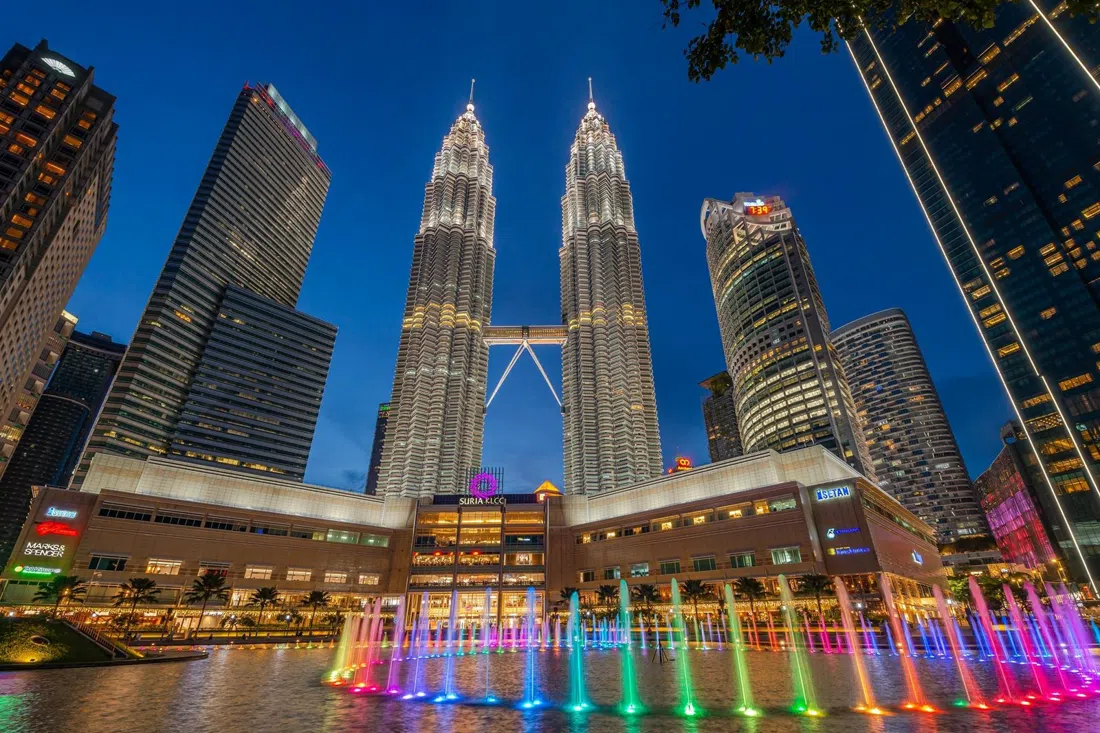
Masjid Asy-Syakirin (KLCC, north side of the park) is the quiet counterweight to all the glass and retail, and the north side of the park gives the best framed shot of the towers anywhere at ground level. Non-Muslim visitors are welcomed outside prayer times, robes and headscarves are lent at the entrance, and guided introductions are available, which makes it workable for a group provided you arrive between prayers. Shoulders and knees covered, free, donations welcome, open roughly 05:00 to 22:00. Visit in daylight.
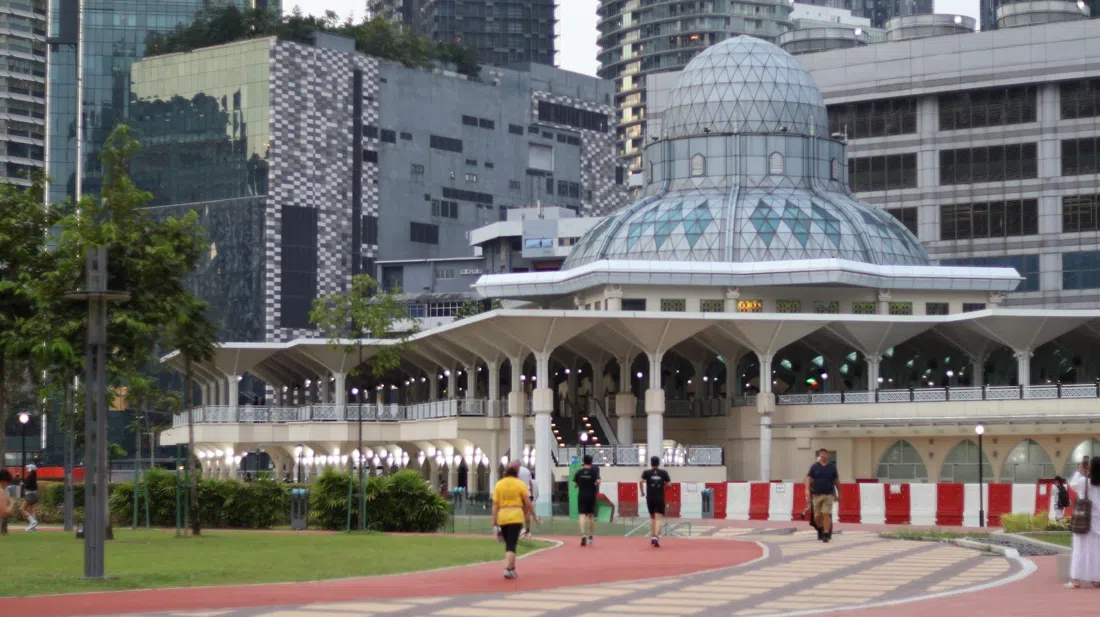
Ombak KLCC (KLCC, completing the ring of buildings around the park) is the newest thing here, opened on 21 August 2026. Free, mall hours, with a rooftop garden and a walk-in art gallery. GALERI PETRONAS has moved across from Suria and is currently showing a 'First Glimpse' preview, with the full gallery slated for late 2027, so forty minutes is about the right allowance and a museum day is not. For the wider picture of how this precinct fits the rest of the city, the Kuala Lumpur guide covers the districts either side of it.

When October closes the sky in
Petrosains, The Discovery Centre (KLCC, inside the towers) is the only properly indoor rainy-afternoon option within the building itself, and it is a real science museum rather than a gift shop with exhibits. Around RM30-45 for an adult and less for children. It runs a timed-entry system with roughly fourteen slots a day and a capped headcount per slot, so school and tour groups have to pre-book; otherwise it is relaxed. Tuesday to Sunday, 09:30 to 17:30, longer at weekends and school holidays, and Mondays only on the 2nd and 4th of the month.

Aquaria KLCC (KLCC, five minutes through the tunnel from Suria) is the reliable filler when your tower slot is hours away or the sky has gone the colour of wet concrete. RM45-66 depending on the resident or tourist rate and peak timing, open daily, 10:00 to 20:00 on weekdays and 09:00 to 21:00 at weekends. It takes groups readily; under-13s must be with an adult; book ahead at weekends. Failing that, the Suria food court does a proper meal for RM15-30 and the sit-down restaurants start around RM60.

Finding a Petronas Twin Towers bar worth the markup
Searching for a Petronas Twin Towers bar turns up a dozen rooftops at wildly different altitudes, and altitude is the whole decision. Too high and you are looking across at the towers' midriff; too low and you lose the skyline behind them.
Marini's on 57 (KLCC, level 57 of Tower 3) is the closest you get to standing level with the towers rather than inside them. Reservations are essential and a smart dress code is enforced at the lift lobby, not at the table. Cocktails run RM60-90, dinner upwards of RM250 a head. Opens 17:00 and runs late; the window tables are the only ones worth the booking effort, so ask specifically. Small groups are fine, big ones need the lounge or a buyout.
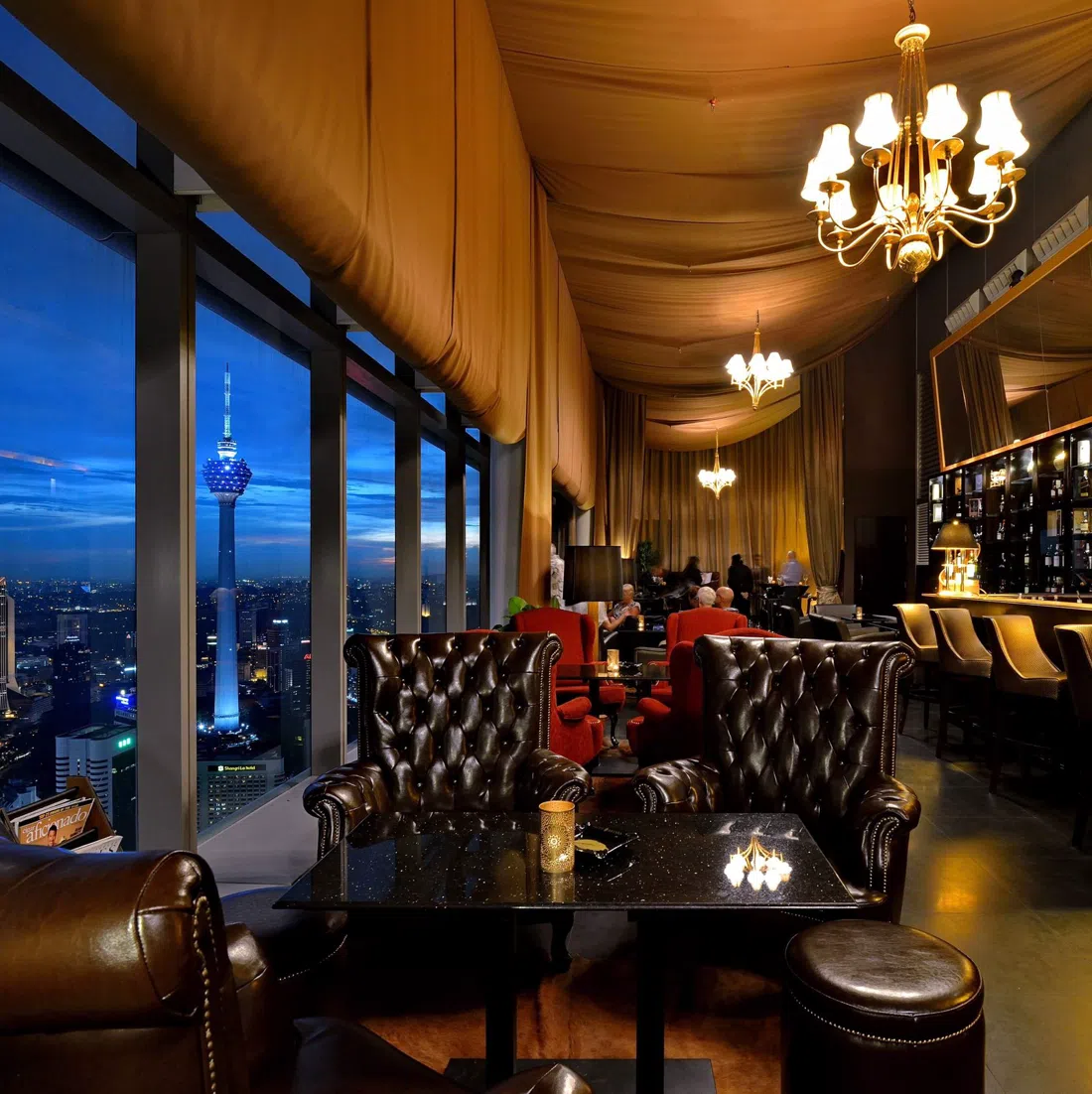
SkyBar at Traders Hotel Kuala Lumpur (KLCC, across the park) was refreshed in early 2026 with a new layout and cocktail list, and it remains the single most photographed tower view in the city, because the pool-side window bays line up the towers head-on. Walk in earlier; book after 19:00. Cocktails RM45-70 and in practice a one-drink minimum. No swimwear, smart-casual. If the window bay matters, arrive before sunset.
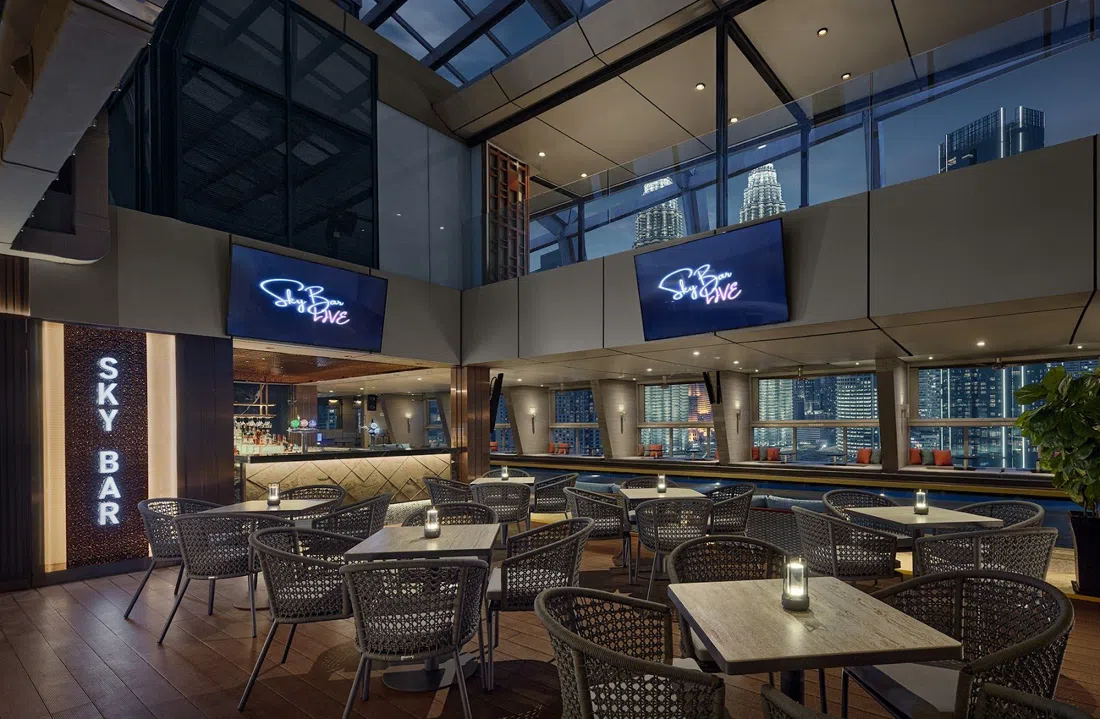
Troika Sky Dining (KLCC, Persiaran KLCC) is one operator running several separate dining rooms on a single floor, which makes it unusually good for splitting a larger party without losing everyone. Mains RM80-180, cocktails RM50-70, reservations and dress code apply. The lower altitude is the point: at 23 floors you see the towers whole instead of craning at them.

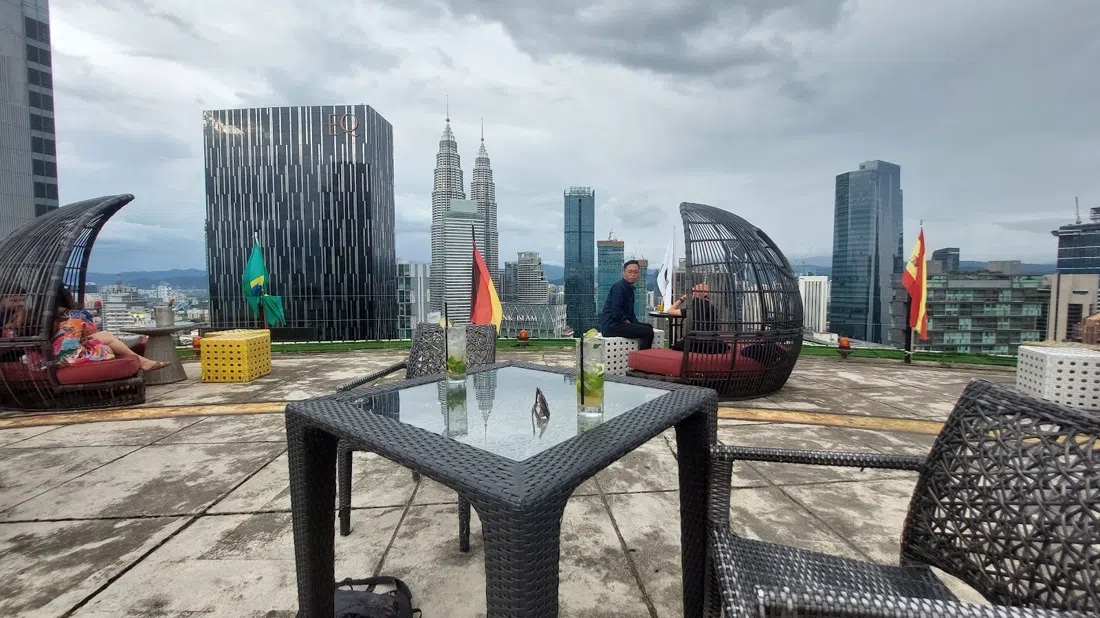
Heli Lounge Bar (off Jalan Sultan Ismail, on a working helipad) is the raw version: no railings of the usual kind, a genuine open edge, and the city at your feet. Entry is around RM50-70 including two drinks and the pad opens to guests somewhere between 17:00 and 18:00, weather permitting. Not for anyone nervous of heights or travelling with small children, closed shoes are sensible, and the pad shuts without notice in a downpour, which in October is a real possibility rather than a disclaimer.
Photographing the twin Petronas towers from outside
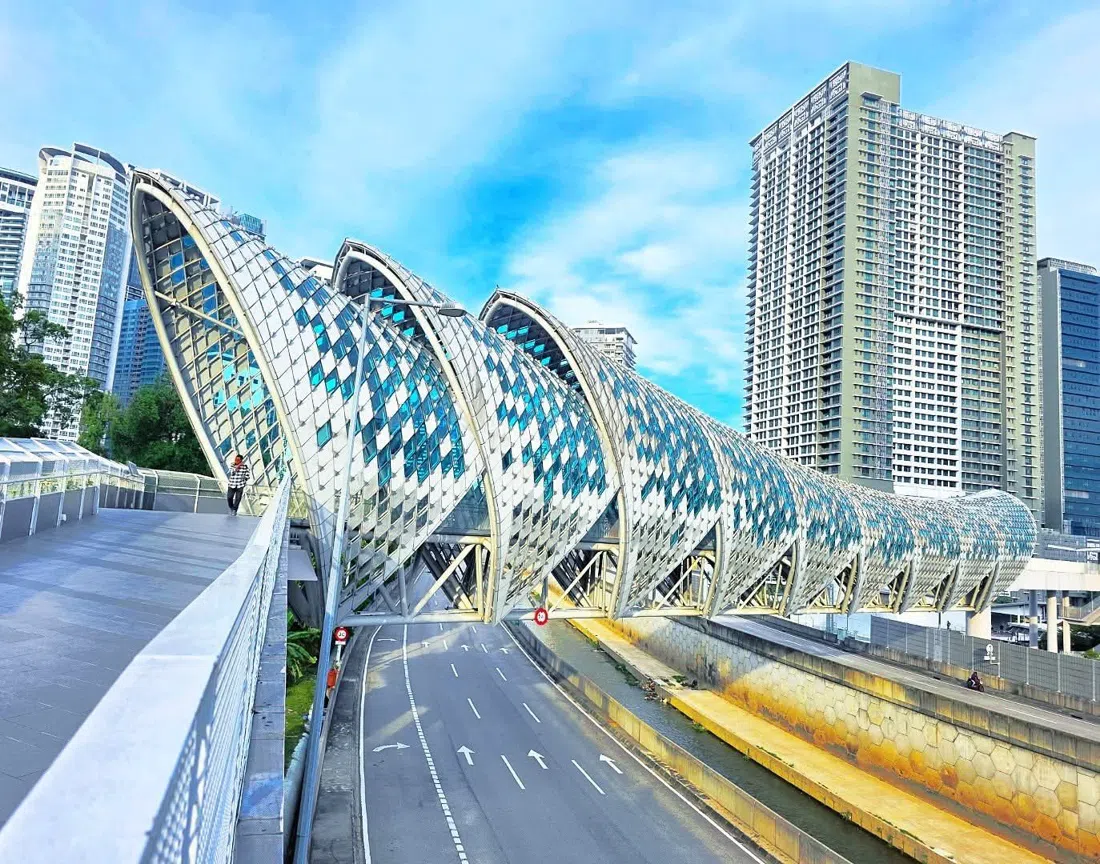
Saloma Link (the Kampung Baru side of Jalan Ampang) is the best no-cost night photograph in the city and a piece of civic sense: a pedestrian bridge physically connecting the old village to the skyline that grew up beside it. Free, open roughly 05:00 to 01:00 and to midnight on Sundays and public holidays. Its own lights come on around 19:00, which slots it neatly between a sunset drink and dinner. It gets tight when the tripods arrive, so go early in the hour.
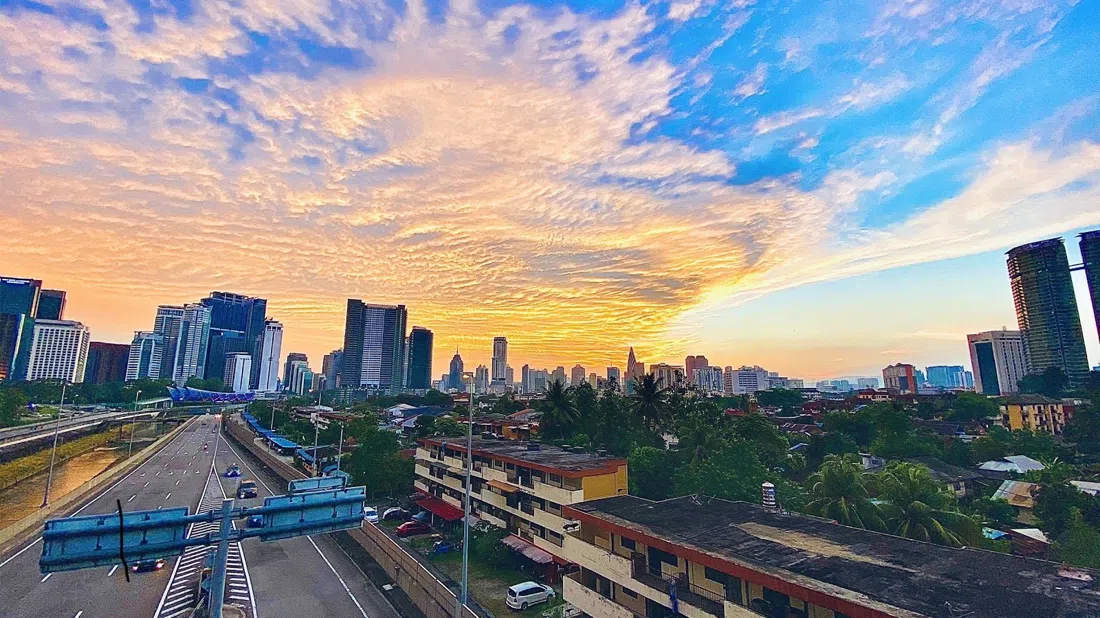
Kampung Baru (across the river, north of the towers) is the contrast that makes the towers mean anything: a lived-in Malay village of timber houses and stall kitchens surviving inside the central business district. Walk respectfully. People live here, it is not an attraction. Local guides run small-group walks of about three hours for roughly RM100-200 a head, and that is the version I would pay for, because a guide gets you the house histories and the right stalls instead of a self-conscious loop. Food runs RM5-20 a plate. The long-running redevelopment master plan means the version you see in 2026 will not last indefinitely.
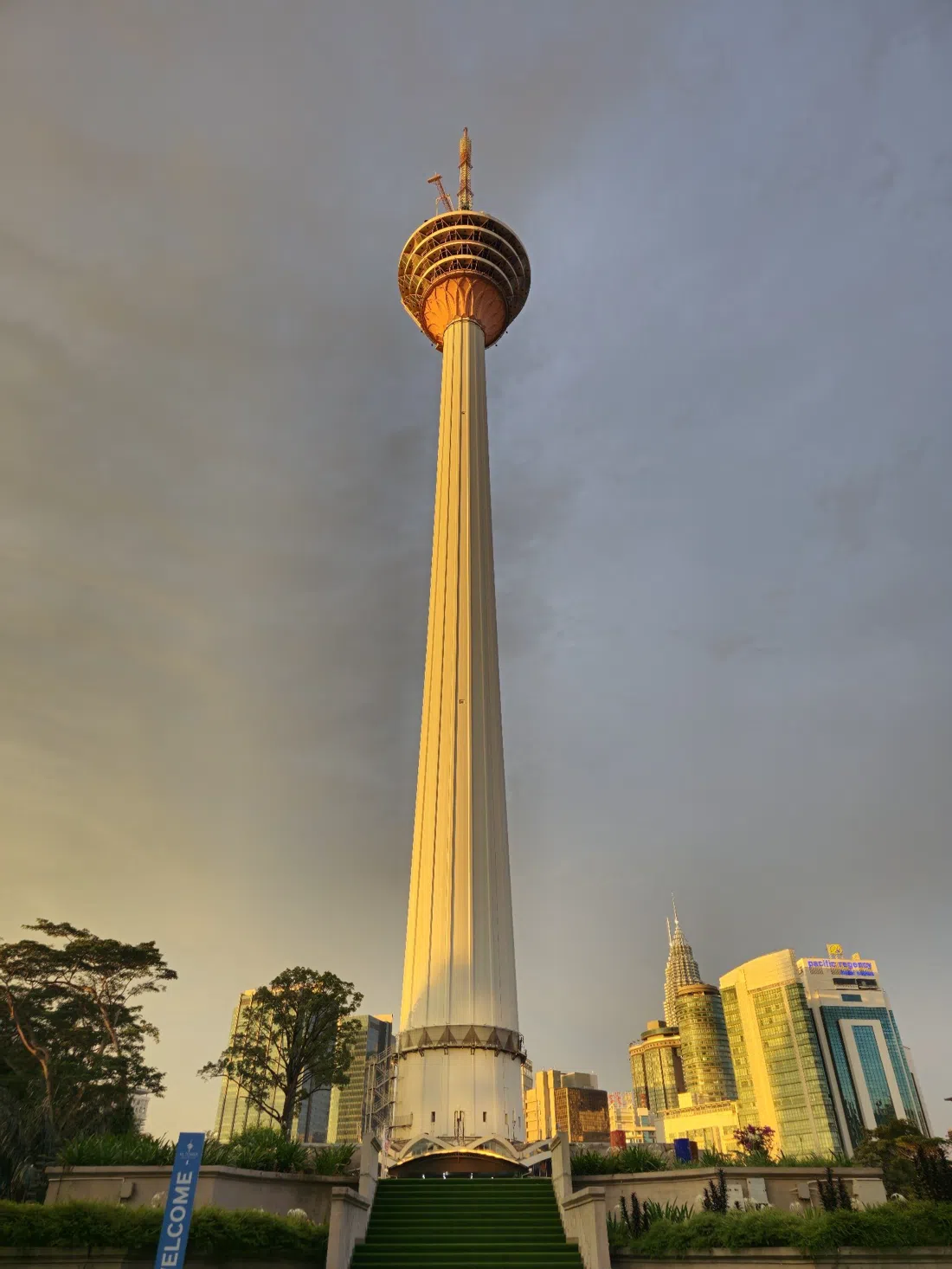
KL Tower (Menara Kuala Lumpur) (Bukit Nanas) earns its own trip, because this is where you photograph the twin Petronas towers from outside. It takes groups all day, 09:00 to 22:00, from about RM49 for the observation deck at non-Malaysian rates, with Sky Box and Sky Deck combinations around RM110-130. The Sky Box admits one small party at a time, so expect a queue within the queue. It reopened in April 2025 after a renovation that upgraded the deck, added new glass barriers and reworked the revolving restaurant.
An evening concert inside the towers
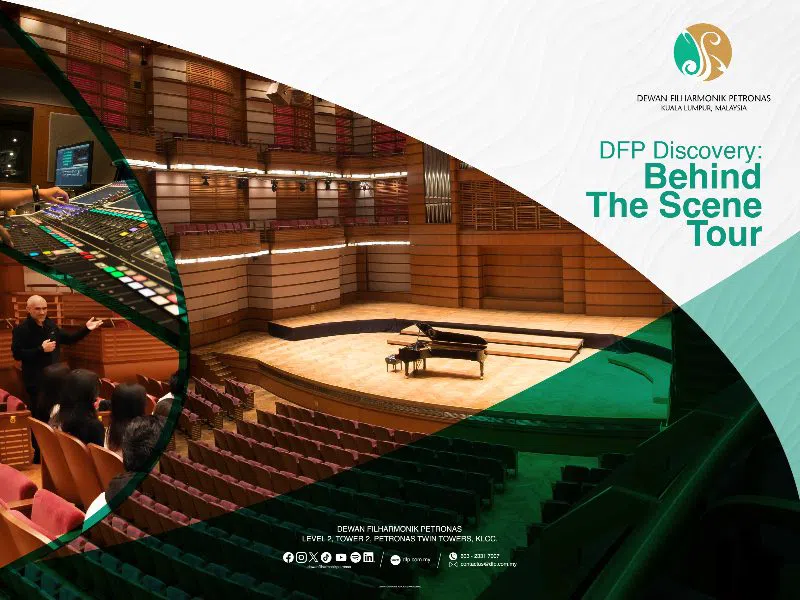
Dewan Filharmonik PETRONAS (KLCC, inside the towers) is routinely missed by people who have just spent RM100 going up the same building. The Malaysian Philharmonic's 28th season runs through 2026, programming straight classical alongside film-score and anime nights, which makes it an easy add-on after a late deck slot. Tickets run roughly RM50-250 by seat and programme, with student rates on selected nights. The dress code is strict (no shorts, sandals or t-shirts) and there is no late entry once a movement has started, so a group should plan to be seated early.
Half a morning at Batu Caves
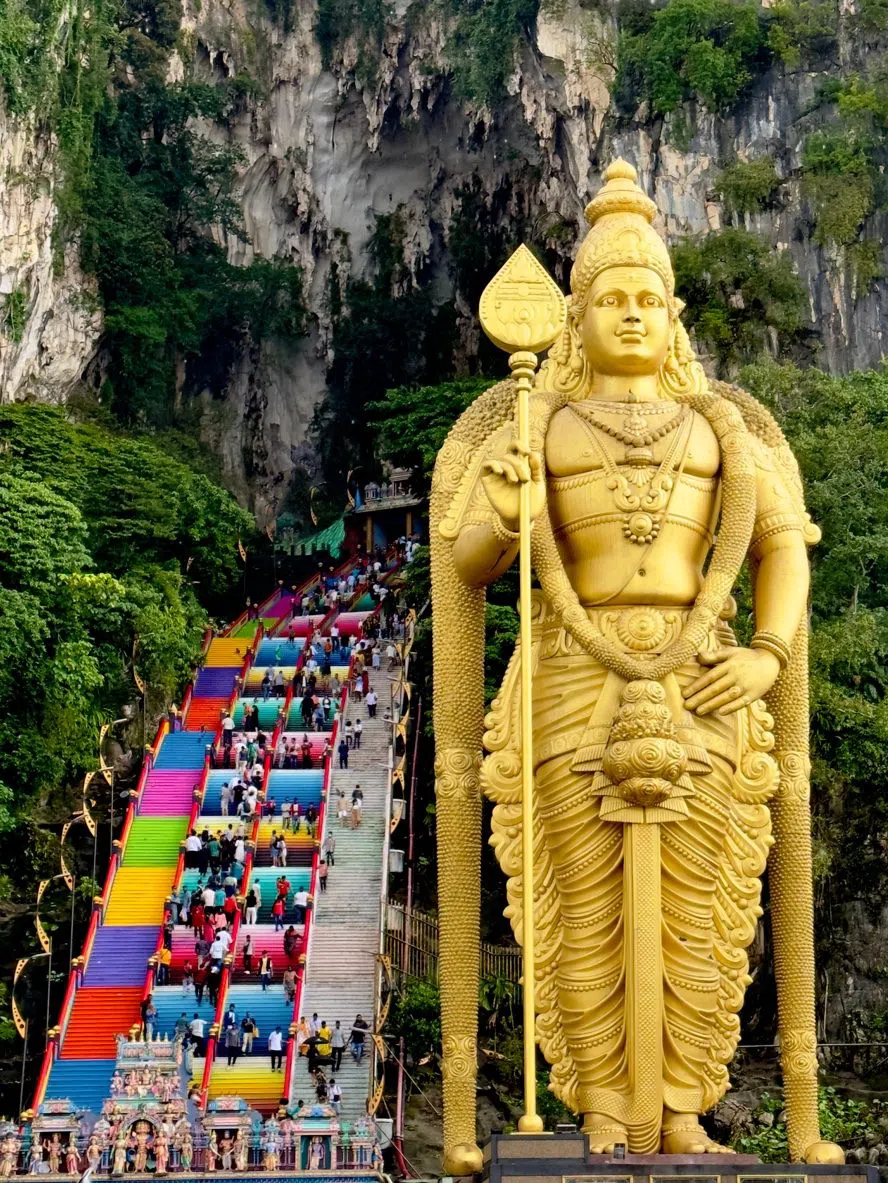
Batu Caves (Sri Subramaniar Swamy Temple) sits about 13 km north and is the standard half-day pairing with a tower slot. The Temple Cave is a free walk-in; the Dark Cave and Ramayana Cave are charged separately. Coach groups arrive all morning, which is exactly why you should go first thing: 272 steps in midday October heat is miserable, and the afternoon storms arrive before you are back down. Shoulders and knees must be covered and it is actively enforced at the foot of the stairs. Sarongs are sold on site for about RM15, cash.
Is it worth it
Yes, with a condition. The Skybridge is the part people remember, and it is unusual in a way I can't match elsewhere: no other building lets you walk out into mid-air between two towers at that height. The level 86 deck is a good view rather than a transcendent one, and the whole thing is over in an hour. So the RM100 is well spent if you book a morning or evening slot on a day with decent visibility, and poorly spent if you take whatever is left at 15:00 in a month of afternoon thunderheads.
It suits first-time visitors, architecture and engineering types, and anyone travelling with children who will be more impressed by Petrosains downstairs than by the view. Couples after a view-and-a-drink evening are better served by a rooftop than by the deck. Large groups should accept being split across slots or let an operator hold the slots for them. Anyone who has already done two or three tall-building decks elsewhere can skip it without guilt and spend the money at ground level instead, where the park, the mosque and a Kampung Baru walk cost almost nothing and tell you more about the city.
Practical notes
Transport: the LRT Kelana Jaya line stops at KLCC and surfaces inside the Suria concourse, so you can arrive, buy, queue and go up without stepping outdoors, which matters in a wet month. For KL Tower, take the monorail to Raja Chulan or the LRT to Dang Wangi and walk up through Bukit Nanas, or just take a ride-hail car, because the hill is steeper than the map admits. Saloma Link is a short walk from Kampung Baru station. Batu Caves is the northern terminus of the KTM Komuter line, roughly 30 minutes from KL Sentral and far better than driving.
Cards work everywhere in the KLCC precinct and in every rooftop bar listed here. Carry small notes for Kampung Baru stall food and for the RM15 sarong at the temple steps.
On timing, put the tower slot at 09:00-10:30 or from 19:00, keep the aquarium or Petrosains in reserve for the 15:00-18:00 storm hour, and leave the park fountains for after dark. Don't schedule anything tower-related on a Monday.
A full day in the precinct lands around RM250-350 a head: RM100 for the deck, RM30-45 for Petrosains, a RM15-30 food-court lunch and a RM45-70 rooftop drink, with the park, mosque, Ombak gallery and Saloma Link free. Add RM250 or more a head if you want the level 57 dinner. Staying inside walking distance of the towers removes the one variable you cannot control in October, which is being caught 20 minutes away when the sky opens. The Kuala Lumpur hotel search will show you what sits inside that radius.
Questions
Do I need to book the Petronas Twin Towers in advance?
Effectively yes. Entry is sold in fixed timed slots that routinely go days ahead, so the ticket counter on Suria KLCC's lower ground level is mostly where people find out the day has sold out. Book the slot yourself for RM100 adult or RM43 child, or use a guided option: operators pre-hold slots, which is their main practical advantage, and private itineraries that combine the deck with the cave temples north of the city start from 110 USD per person.
Are the Petronas Twin Towers closed on Mondays?
Most Mondays, yes. The Skybridge and observation deck close for maintenance while Suria KLCC below stays open and busy, which is how walk-ups keep getting caught. Normal hours are Tuesday to Sunday, roughly 09:00 to 21:00, with last admission at 20:30. Petrosains inside the towers also follows a Tuesday to Sunday pattern and opens on Mondays only on the 2nd and 4th of the month.
How long does the Skybridge and observation deck take?
Allow 45 minutes to an hour above ground: a few minutes on the Skybridge at level 41, then a lift to the level 86 deck and a full walk of the ring. Add the ticket hall, bag check and lift queues and it is about 90 minutes door to door. Visits run in timed batches, so you cannot linger as long as you like.
What is the best time of day to go up in October?
Take the first slots, 09:00 to about 10:30, for the clearest air and the smallest crowd, or go from about 19:00 for the city lit up, since last admission at 20:30 makes an evening entry realistic. Skip 14:00 to 17:00 if you can, because October afternoons build heavy cloud and a thunderstorm most days. If the forecast is bad on your only free day, take the earliest slot rather than the latest.
Where is the best Petronas Twin Towers bar, and do I need to reserve?
It depends on the height you want. Marini's on 57 puts you almost level with the towers and needs a reservation plus smart dress, enforced at the lift lobby. SkyBar at Traders Hotel Kuala Lumpur gives the head-on postcard view: walk in early, book after 19:00, and expect a one-drink minimum. Troika Sky Dining at 23 floors shows the towers whole and splits big groups across separate rooms. Heli Lounge Bar is an open-edge helipad that shuts without notice in rain, so keep it as a fair-weather plan.
First published on kualalumpurguides.com, the Kuala Lumpur guide.