The ferry across to the West Bank costs a few pounds and takes about ten minutes, and the moment you step off it the restaurant signs stop being backlit. Luxor's reputation is hotel buffets and Nile-view menus printed in four languages, but the cooking people here actually do happens in rooms with eight tables, on roofs reached by a bare concrete staircase, and on one farm where a Nubian couple ask what you don't eat and then walk outside to pick the rest. This trail strings the spice stalls and sugar counters of the East Bank to the home kitchens of the villages opposite, and you can eat your way through it over three unhurried days.
Buy the spices before you eat anything
Start at Luxor Market (El-Souk) (East Bank, the lanes running inland from the corniche), because once you have handled the raw material the cooking later in the week makes more sense. The first stretch is papyrus, alabaster and scarabs, and it is not what you came for. Keep walking. The inner lanes are where people doing their weekly shop buy karkade (dried hibiscus), cumin, coriander, cinnamon bark and chilli by weight, out of open sacks, scooped and bagged in front of you.
Agree a price per kilo before anything goes into a bag. Quantities are flexible: a small twist of cumin costs a few pounds, a serious bag of mixed spice and hibiscus for taking home runs to around EGP 200, and haggling is expected rather than resented. Somebody will hand you a glass of hibiscus while you decide. Take it; it is hospitality rather than a sales tactic, and refusing reads as cold.
The market is open roughly from 08:00 until late, with Friday starting in the early afternoon. Before 09:00 it is quiet enough to actually talk to a stallholder and ask what the spice mix in front of you is for. After 18:00 it is at its best as theatre and its worst for buying carefully: crowded, loud, and not the moment to be weighing out cinnamon.
The sugar counter and the cheap bowl
The sweet half of the trail is a counter, not a table. Twinky Patisserie (East Bank, in town) sells syrup-soaked konafa, semolina basbousa and cream-filled balah el-sham at local prices (EGP 20 to 100 a piece, boxes from about EGP 150), and it is open 08:00 to midnight daily. There is no real seating and you should not want any. Buy a box, carry it onto the ferry, and eat it with your hands on the crossing while the light goes orange over the Theban hills. It is a better end to an afternoon than any dessert menu in town.
The other East Bank stop that costs almost nothing is El Zaeem Restaurant (East Bank, two branches in town), a koshary counter: rice, lentils, macaroni, tomato sauce and crisp fried onions in a bowl, EGP 40 to 80 depending on size. It feeds a group of ten in about four minutes, which makes it the obvious lunch when half your party is still arguing about the afternoon. One warning: a tourist price list has appeared alongside the local one, with a large bowl marked at EGP 80 against the local EGP 40. Ask for the posted local price before you order. Asking is normal, and the answer is usually a shrug and the lower number.
East Bank rooms that still cook like a house
Three sit-down kitchens on this side are worth your evenings. Sofra Restaurant & Café (East Bank, in a restored period house off the main streets) is the polished end of the trail and knows it: several dining rooms, a roof terrace, open until midnight, reservations taken and genuinely advisable in high season. The clay-pot tagines, the mahshi and the long mezze list are home cooking rather than a performance of it, served in a room with better furniture than most homes. Reckon on EGP 300 to 600 a head. It handles groups better than anywhere else in the city centre, which is exactly why it is where tour parties end up.
Al-Sahaby Lane Restaurant (East Bank, off the souk) has been serving since the 1920s on a lane that carries the founding family's name, and it cooks two things most visitors to Luxor are never offered: hamam mashi, pigeon stuffed with seasoned rice, and the camel pot. Both are Upper Egyptian dishes rather than tourist-menu Egyptian, and both reward ordering without squeamishness. Pigeon is small, bony and worth the work. The roof is large, open 07:00 to 23:30, and you can walk in; for a group at sunset, phone anyway. EGP 300 to 600.
El-Kababgy Luxor (East Bank, Nile side) is the grill stop, cooking hamam mashi, fatta, kofta and tagines to Upper Egyptian recipes rather than hotel-buffet ones. It is also the one address on this trail where a weak order can feel overpriced: mezze run EGP 70 to 290, mains EGP 200 to 690, and a 12% service charge lands on top. Order the pigeon and the fatta and it earns the money. The room is compact, so book ahead for more than six.
Crossing to the West Bank
The public ferry runs all day from the landing opposite Luxor Temple, costs a trivial amount, and takes minutes. On the far side the economics change completely: the same money that buys one main course at a Nile-side grill buys dinner for two in a village kitchen. Taxis and tuk-tuks wait at the landing, but most of these places are close enough together that a bicycle, hired near the ferry for a few tens of pounds a day, is the better tool, right up until it is 40°C.
Phone or WhatsApp ahead, which matters more here than anywhere else on the trail. These are kitchens with one or two cooks and no standing stock of portions, so a call an hour or two before you arrive is the difference between a meal and a long wait.
The home kitchens of the villages
Nubian House Restaurant (West Bank) is where this trail is going: a Nubian couple cooking on their own farm, with the vegetables and herbs coming off the plot outside. There is no printed menu. They cook to the headcount and to what you say you do and don't eat, which is why the phone call is the booking. Small groups and families are welcome on that basis; a party of eight or more walking in unannounced will wait a very long time, and deserve to. EGP 100 to 200 a head, which for what arrives is close to absurd.
Sunflower Restaurant West Bank (West Bank) is the best value on this side and the easiest introduction for a table of mixed appetites. The fixed set menu (EGP 300 to 400, drinks EGP 20 to 30) lands as a dozen small dishes so everyone tastes everything, and it carries more vegan options than anywhere else on the trail. The owner cooks, the host, Adam, runs the floor and handles groups calmly, and the roof takes a sizeable party. Phone +20 100 900 2234.
Wolf Restaurant (West Bank) is the highest-rated kitchen over here and there is nothing whatsoever to look at. Chef Nuby cooks clay-pot tagines (fish, chicken, lamb) slowly and to order, which is precisely why advance notice matters. The kitchen is tiny; up to roughly eight or ten people is fine with warning, and impossible without it. EGP 250 to 450.
Tutankhamon Restaurant (West Bank) is chef-owner Mohammed's short seasonal set menu, EGP 200 to 350 a head. Order the daoud basha kofta and the spinach and rice. Ask to see the written prices before you sit down. This particular strip has a history of menus arriving without them, and the fix is a ten-second question rather than an argument later. Parties over about ten should book a day ahead.
Blue Sky Restaurant (West Bank) is cheap, family-run and unceremonious: grilled fish, tawook skewers, moussaka, EGP 150 to 300 a head, and it copes well with up to a dozen if you phone +20 100 381 2188. The menu has an Italian half. Ignore it entirely; it exists for guests who have lost their nerve.
Gardens, farms and one kitchen you can cook in
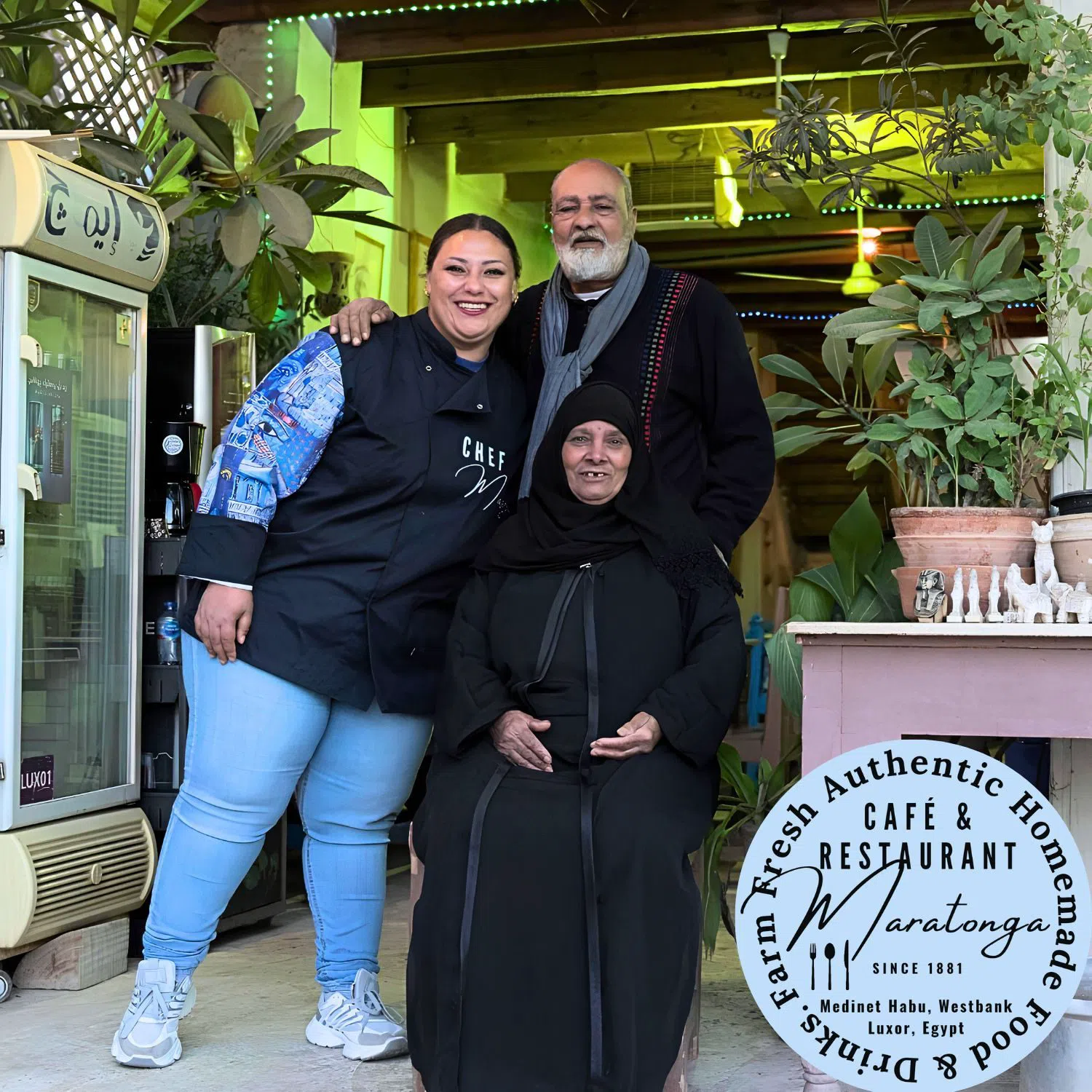
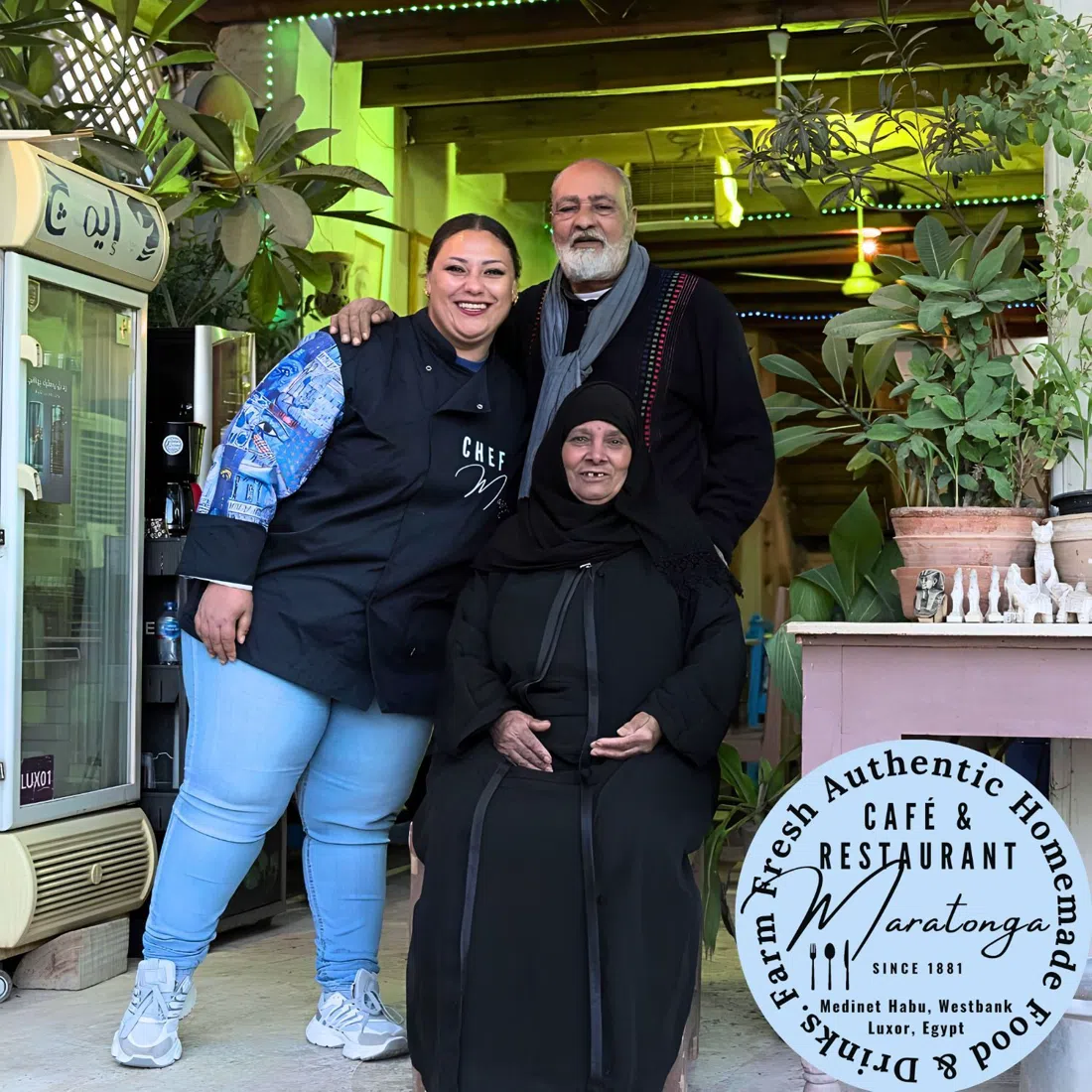
Café & Restaurant Maratonga (West Bank) is the oldest café-restaurant on this side of the river and the only place on the trail where you can cook rather than just eat. A German-Egyptian family team runs classes and workshops for anything from one to twenty people, everything is built from raw local produce with no tinned shortcuts, and vegan and gluten-free requests are handled as information rather than as a problem. Long garden tables absorb a tour party without strain. EGP 150 to 400 a head; book on +20 103 224 8447. If you only do one hands-on thing in Luxor that isn't a tomb, do this one, because you learn what the spices you bought in the souk are actually for.
Marsam Hotel (Sheikh Ali's Garden Café) (West Bank) is the oldest guesthouse here and has fed archaeological missions for decades, which shows in both the courtyard's capacity and the kitchen's unflappability. It cooks almost entirely from its own garden and the neighbouring farm, so the daily menu changes with what was picked that morning, and the vegetarian dishes are consistently better than the meat. Ring ahead so the kitchen can scale the day's cooking to your numbers. EGP 200 to 450.
Roofs worth the climb
Africa Restaurant (West Bank) serves the benchmark molokhia on this side of the river, the green, faintly viscous leaf soup that divides visitors and defines Egyptian home cooking, and serves it properly, with rice, soup, salad and vegetables rather than alone in a bowl. The bean and bread soups are worth as much as the headline dishes. Roof plus an indoor floor makes it one of the easier rooms for a group; open 11:00 to 23:30 daily, call 01001913403. EGP 400 to 500.
Nile Valley Hotel & Restaurant (West Bank) is the sunset seat. The koftas, grilled chicken and mezze are honest rather than remarkable, and what you are buying is one of the best Temple views in Luxor from a terrace that will take a coach party at a push. It also serves beer and wine, which several village kitchens do not. Book for sunset. EGP 250 to 450.
El Gezira Gardens Hotel & Restaurant (West Bank, on Gezira) is the calmest place to eat over here, a covered roof garden built for hotel groups and set dinners, with owners who will cook you a proper Egyptian dinner on request instead of defaulting to the tourist list. Say that when you book; same day is fine. EGP 250 to 450.
Groups, couples and what to say when you book
For two people with no plan, the roofs and the bigger rooms absorb you without notice: Africa, Nile Valley, El Gezira Gardens, Sofra and Al-Sahaby Lane. For a couple who want the actual point of this trail, Nubian House and Wolf are the two, and both need a call.
For groups, split the list honestly. Maratonga, Sofra, Al-Sahaby Lane, Africa and El Gezira Gardens take numbers routinely. Sunflower, Marsam and Blue Sky manage a dozen with warning. Wolf tops out around eight to ten and only with notice, because each pot is cooked from scratch. Tutankhamon and Nubian House are tiny family operations with no capacity to absorb a party that has not called.
The booking message that works is short: how many people, what time, and any allergies or vegetarians. At the no-menu kitchens, add what you don't eat. Nobody is offended by it, and at Nubian House it is effectively the order.
Running the trail
The public ferry is the spine, running from the East Bank landing across to the West all day and into the evening for a few pounds. On the West Bank, bicycles are cheap and the distances short; tuk-tuks and taxis cover the same ground in heat, and you agree the fare before getting in. On the East Bank, everything in this piece is walkable from the corniche.
Carry small notes. Village kitchens, the souk, the koshary counter and the patisserie are cash operations, ATMs cluster on the East Bank, and nobody on the West Bank wants to break a 500 for a EGP 150 dinner.
Shop the souk before 09:00, eat your main meal on the West Bank from about 19:00, and keep sunset for one of the roofs. Ramadan shifts every opening time on this list, so check by phone that week rather than by website.
A full day of this (koshary lunch, a box of sweets, spices to take home and a village dinner) lands around EGP 500 to 700 a head. Swap the village dinner for El-Kababgy or Sofra and it roughly doubles. Three days covers the trail properly without repeating a kitchen.
Staying on the West Bank puts you inside the home-kitchen half and means no last ferry to worry about; staying on the East Bank puts the souk, the sweets and the temple at your feet. Compare both sides in the Luxor hotel search, and read the Luxor guide for how the two banks fit together before you book.
Questions
Do I need to book the West Bank home kitchens in advance?
For most, yes. Nubian House cooks to your headcount with no printed menu, Wolf cooks each clay tagine to order in a tiny kitchen, and Tutankhamon is a one-chef operation, so all three want a phone or WhatsApp message, ideally a few hours ahead and a day ahead for groups. The roof restaurants (Africa, Nile Valley, El Gezira Gardens) take walk-ins, though a sunset table is worth reserving.
How much does a day on this trail cost?
Roughly EGP 500 to 700 a head: a koshary lunch (EGP 40 to 80), sweets (EGP 20 to 100 a piece), spices from the souk (a few pounds up to EGP 200) and a village dinner (EGP 100 to 450). Eat instead at El-Kababgy or Sofra, where mains run to EGP 690 and EGP 600 a head respectively, and the day roughly doubles.
Is there enough for vegetarians and vegans?
Yes, and more than the menus suggest. Sunflower's fixed set menu carries the most vegan dishes on the trail, Maratonga handles vegan and gluten-free requests without fuss, and Marsam's vegetarian cooking, straight out of its own garden, is better than its meat. Say what you don't eat when you book and the kitchen will build around it.
Will I get overcharged, and how do I avoid it?
Two traps. El Zaeem has a tourist price list alongside the local one (EGP 80 against EGP 40 for a large koshary), so ask for the posted local price. On the strip where Tutankhamon sits, menus have historically arrived without prices, so ask to see written prices before you sit. In the souk, agree a price per kilo before anything is bagged.
Can I learn to cook these dishes rather than just eat them?
Maratonga on the West Bank runs cooking classes and workshops for groups of one to twenty, cooking with raw local produce rather than tins. Book by phone or WhatsApp on +20 103 224 8447. Buy your spices at El-Souk first and the class makes more sense, because you arrive knowing what the sacks in the lanes hold.
First published on theluxorguide.com, the Luxor guide.