Paris keeps its revolution in the wrong place. The column on place de la Bastille belongs to a later uprising, the square itself is a roundabout, and the fortress everyone pictures when they hear the date was pulled down so completely within a year that its stones were sold off as souvenirs. What is left sits east and north of the traffic: a wall on a métro platform, a stack of foundations in a playground garden, an archive a crowd chose not to burn, and a working district that was making furniture in 1789 and is still making it.
The Bastille you can put a hand on
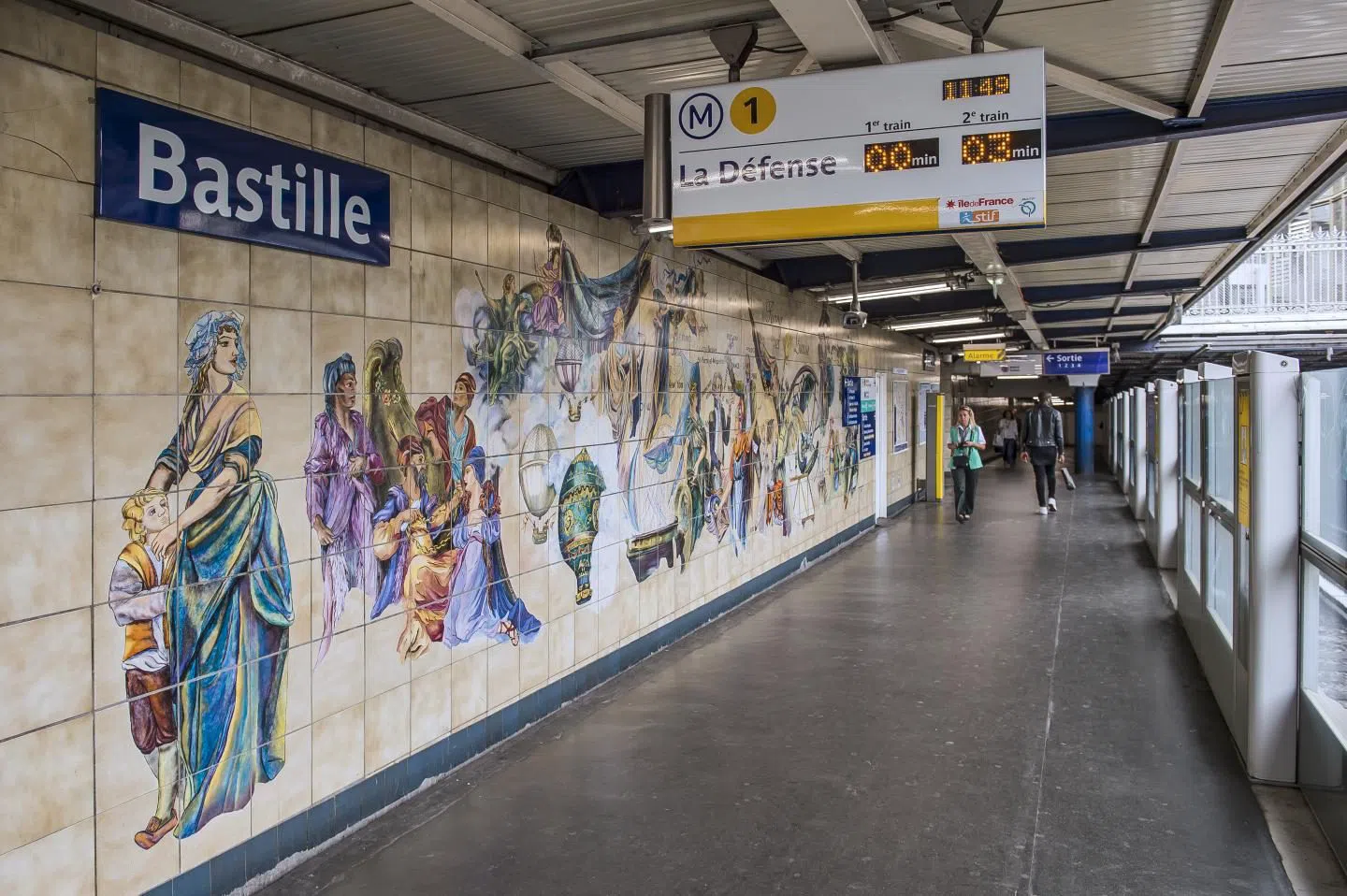
Start underground. Bastille métro station (place de la Bastille, straddling the 4th, 11th and 12th) hides the most convincing surviving piece of the prison on its line 5 platform, the one for trains running north. Set into the tunnel wall behind the platform is a curved run of dressed stone: part of the counterscarp, the outer face of the moat, found in 1905 when the line was driven through. The line of the moat's edge is drawn on the platform floor, and commuters stand on it all day without once looking down.
It costs the price of a ticket, around €2.50, and it is open whenever the métro is. Go against rush hour, roughly 10:00 to 16:00. At 08:30 you will be shoulder to shoulder and see nothing. Passengers have right of way on a working platform, so a guide can hold eight to ten people at the wall without blocking anyone, and a larger group has to split and take turns. The light is bad and the photographs are always disappointing. Go anyway. Nothing else on this route gives back so much for so little.
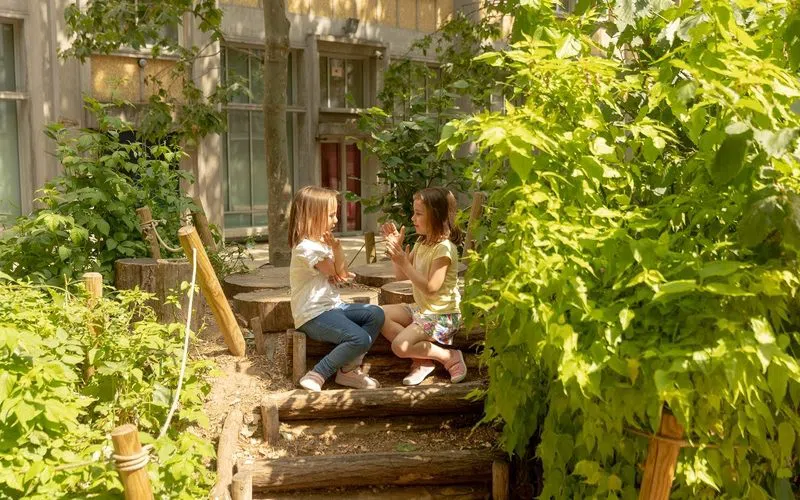
Come back up and walk five minutes south-east along boulevard Henri-IV toward the river to Square Henri-Galli (boulevard Henri-IV, 4th), a narrow public garden with a playground, a few benches and, in one corner, the largest surviving lump of the Bastille anywhere. These are the re-erected foundation blocks of the Tour de la Liberté, dug up in 1899 during works on métro line 1 and moved here in 1925. They are enormous, rough and almost entirely ignored; on a weekday afternoon you share them with parents and pushchairs. The garden is free, open standard park hours, and there is room for a full walking group to circle the stones without asking anyone's permission. Between the platform and this corner you have already seen more of the actual building than the square above ground shows you.
The archive that survived July
A short walk back along the boulevard brings you to the Bibliothèque de l'Arsenal (rue de Sully, 4th). You see less here than anywhere else on the route, and it is the stop the rest of the walk hangs on. It holds the archives of the Bastille (the prison's registers, the paperwork, the confiscated papers of the people locked up in it), saved from the crowd in July 1789 and still here.
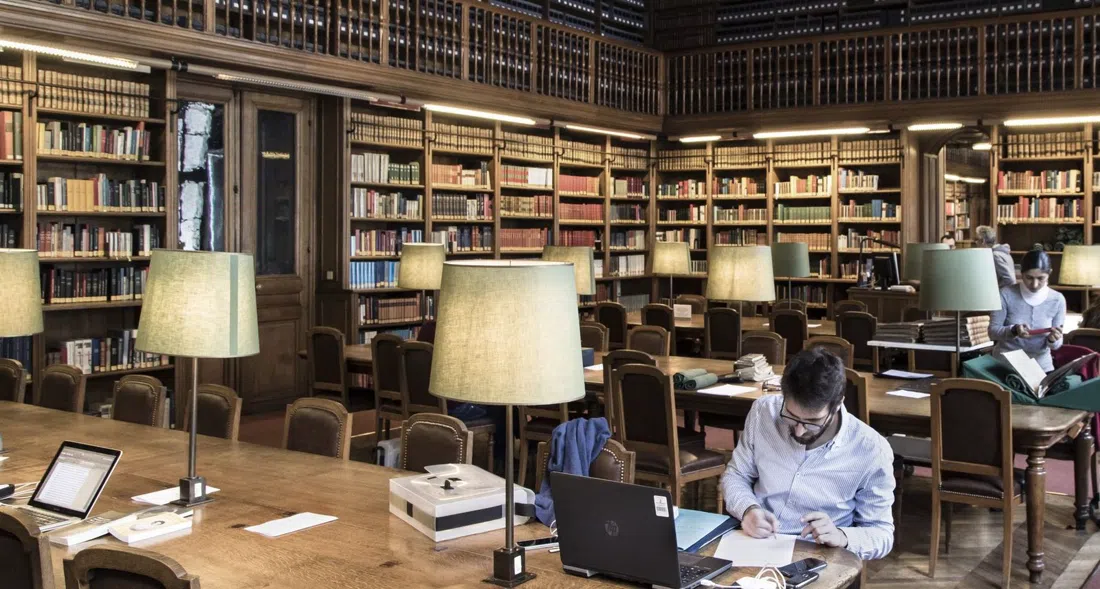
Access is narrow. Guided tours run on Wednesdays at 15:00, last about an hour, cost €15 for adults and €6 for ages 6 to 18, and are online booking only with a small cap, so book well ahead rather than turning up. The reading rooms are for card-holding readers. The tour shows you the building and its interiors, not the Bastille documents, so come for the atmosphere of the place and the fact of what is held in it, not for a display case. It suits couples and pairs of friends; a party of twelve is not getting in on the day. If your trip lands in September, the library also opens for the European Heritage Days weekend, which is the other realistic way in.
Up the faubourg Saint-Antoine
Rue du Faubourg-Saint-Antoine climbs east from the square, and this is the ground the fortress was actually taken from. For centuries the district sat outside the guild rules that governed the city, which made it a cabinetmakers' and joiners' quarter of dense courtyards and workshops: cheap rent, loud trades, a lot of people packed behind the street frontage. The density matters. The crowd of 14 July came out of a working district four hundred metres from the moat.
Turn up rue de Montreuil for the Cour de l'Industrie at 37bis (11th), the last surviving industrial courtyard complex in the faubourg, reopened after six years of restoration and still full of working artisans. It does not open daily, and turning up on spec ruins a morning. It reliably opens for the Journées Européennes des Métiers d'Art on 11 and 12 April 2026, for the TRÔLE open day on 13 June 2026, and for Heritage Days in September; entry on those days is free. Outside them, group and studio visits are by arrangement with the resident association at [email protected], and a polite email a couple of weeks ahead is the difference between courtyards and a gate.

Either way, walk the few doors to 31bis and read the two plaques there. They mark the Folie Titon, Réveillon's royal wallpaper works, sacked over 27 and 28 April 1789 in a riot over wages that left far more dead than the taking of the Bastille did. That was the overture, it happened on this street, and almost nobody tells it. On an ordinary Tuesday the stop is two plaques and a closed door, worth the detour for the plaques and better by a mile if you can time it to an open day.
Cut down toward rue Saint-Bernard for Église Sainte-Marguerite (rue Saint-Bernard, 11th), the faubourg's own parish church and the place the district's dead went. Casualties of the Bastille were buried in its churchyard. So, by long-repeated claim, was Louis XVII, the boy who died in the Temple prison. That claim has been disputed, tested and argued over for two centuries, and the dispute is more interesting than a settled answer would be. Go in for the trompe-l'œil chapel regardless; it is an unusually good piece of eighteenth-century illusion painting in a plain parish church.
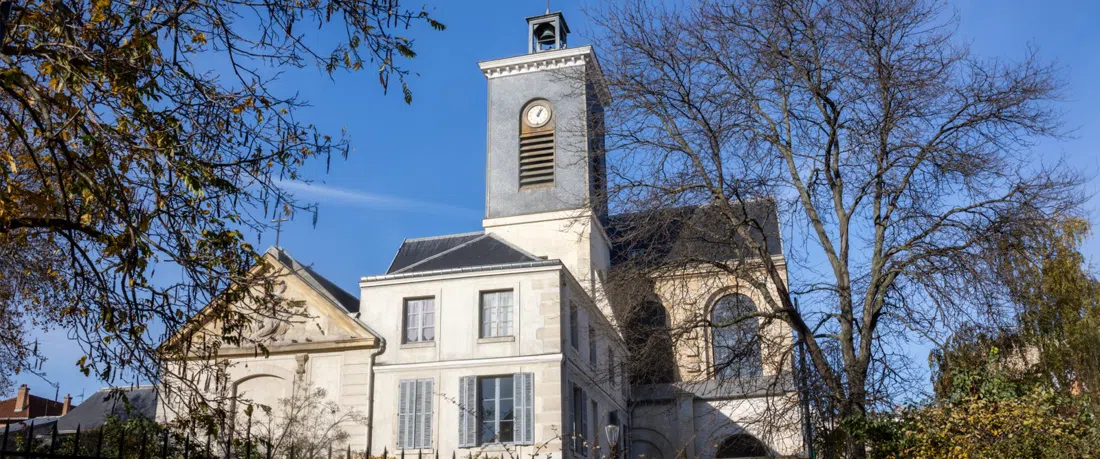
It is open Monday to Saturday 08:00 to 19:30 and Sunday 10:00 to 19:00, free. This is a working parish: groups are welcome outside Mass times if they keep their voices down, and the old cemetery garden is a matter of asking at the secretariat rather than wandering through.
The price of bread, still being argued at Aligre
Walk south-west to place d'Aligre and the Marché Beauvau and Marché d'Aligre (place d'Aligre, 12th), a covered hall with an open-air market spilling around it. The hall was built in 1779, ten years before the Revolution, in the middle of the bread-price crisis that did as much to cause it as any pamphlet. Grain prices and the cost of a loaf in quarters like this one were the economic engine of 1789, and this is the one stop on the route where the eighteenth-century subject is still happening in front of you: people in a working district arguing about what food costs.
The hours are fiddly, so write them down. The covered hall runs Tuesday to Friday 09:00 to 13:00 and 16:00 to 19:30, Saturday 09:00 to 13:00 and 15:30 to 19:30, Sunday 09:00 to 13:30. The open-air market runs Tuesday to Friday 07:30 to 13:30 and Saturday and Sunday 07:30 to 14:30. Everything is closed on Monday, which is the one day that can wreck this walk. It is free to wander and food starts around €2, so this is where you eat. It also takes groups easily on most days and is genuinely crowded on Sunday mornings, when a party of ten becomes an obstacle rather than a group.
Ending inside the tax wall
Finish with a drink somewhere that deserves one. Before 1789 the city was ringed by the Farmers-General wall, a customs barrier with toll gates where duty was charged on everything entering Paris: wine, grain, firewood. It was hated with a clarity that surprises people, because it taxed the poor at the point of the loaf, and on 12 and 13 July 1789 crowds were burning its gates. That was two days before the Bastille fell, and most Revolution tours skip it entirely.
La Rotonde Stalingrad (place de la Bataille-de-Stalingrad, 19th) is the best surviving barrière of that wall, a heavy circular pavilion now working as a restaurant, bar and gallery with a large terrace. Ending a Revolution walk with a glass inside the tax barrier that helped start it is the right kind of joke, and it happens to be a good terrace on a summer evening. The restaurant and bar open Tuesday to Saturday for lunch and dinner, with brunch on Sunday; the gallery and terrace run their own events. Expect €20 to €40 a head for a meal and drinks from around €6. It takes groups readily and does private hire, but book anything over six rather than arriving and hoping.
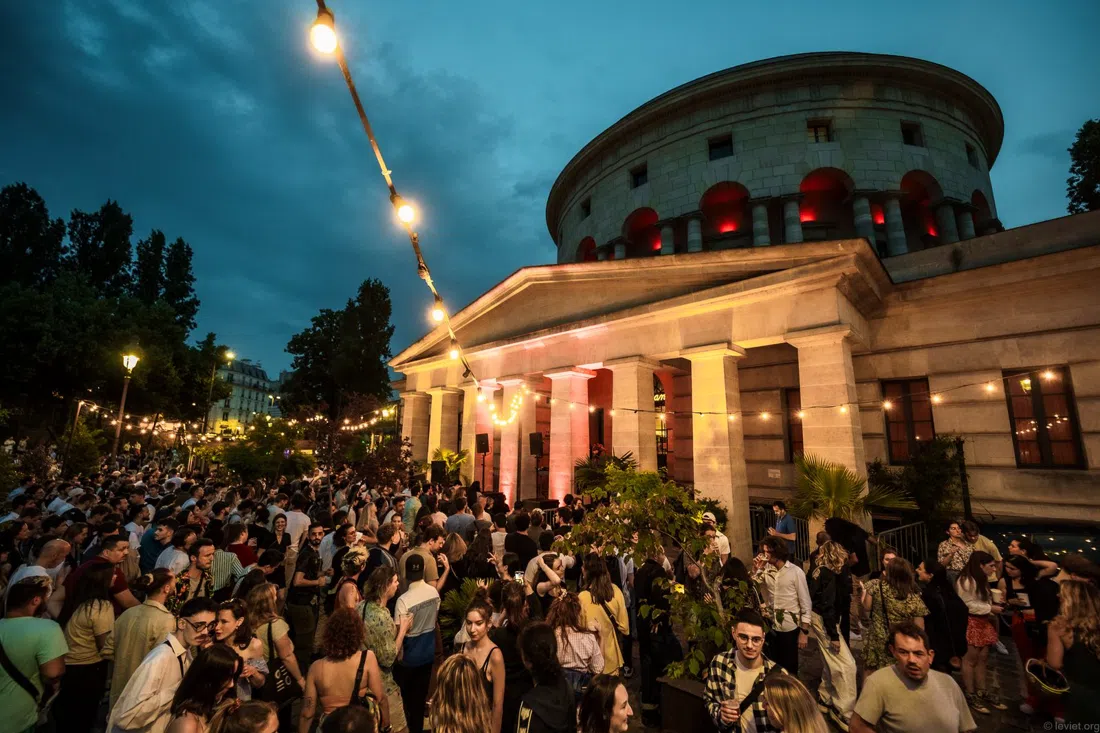
Line 5, the same line whose 1905 tunnelling exposed the counterscarp you started at, runs straight from Bastille to Stalingrad in about ten minutes. Do not try to walk it at the end of a long day.
Two museums that make the pavement legible
The streets go further if you have seen the objects. Musée Carnavalet (rue de Sévigné, in the Marais, 3rd) holds the largest collection of Revolution material anywhere, models, relics of the prison, the everyday things, and the permanent collection is free. It runs Tuesday to Sunday 10:00 to 18:00, last entry 17:15, closed Mondays plus 1 January, 1 May and 25 December; temporary exhibitions cost around €12. Groups must reserve a slot with the museum in advance, and English audioguides and group tours are available. It reopened in 2021 after a full renovation and is the sane place to send anyone who found the faubourg abstract. Go before the walk if you want the pavement to feel populated, after if you would rather meet the streets cold first. For the rest of the city, the Paris guide covers what sits around this route.
Twenty minutes north-west, the Musée des Arts et Métiers (rue Réaumur, 3rd) is the other half of the story, and the half that gets left out. It was founded in 1794 by the Abbé Grégoire inside a priory the Revolution had just confiscated, evidence that 1789 built as well as demolished. Lavoisier's own laboratory equipment is here, which is a complicated thing to stand in front of, because the Revolution guillotined him. Open Tuesday to Sunday 10:00 to 18:00, Friday until 21:00, closed Mondays. Entry is around €12, free for several categories including under-26 EU residents. It handles school and tour groups routinely, though group slots want booking ahead.
Practical notes
The street sequence (métro platform, Square Henri-Galli, the Arsenal, rue de Montreuil, Sainte-Marguerite, Aligre) is about three and a half kilometres of flat, easy walking and takes three to four hours at a slow-travel pace with a market lunch in it. Add the rotunda by métro at the end, and the museums as a separate half-day.
Wednesday is the strongest single day: the Arsenal tour runs at 15:00, the market and the church are open, and Carnavalet is open. Avoid Monday entirely, when the market and both museums close. Sunday gives you the biggest market and the worst crush. The two open-day dates at the Cour de l'Industrie, 11 and 12 April and 13 June 2026, are worth building a trip around if the artisan courtyards are your reason for coming.
On money: single métro tickets are about €2.50 and you will want two or three, so a day pass is usually cheaper. Carry small notes for the market, where cash is simply faster at a stall. Apart from the Arsenal at €15 and Arts et Métiers at around €12, this entire route is free. A full day including lunch and a drink sits comfortably under €60 a head, and can be done for half that.
Stay east rather than central if you want the faubourg on your doorstep in the morning and the rotunda a short ride away at night; the Paris hotel search will show what sits around Bastille and the 11th. Wear shoes you can stand on cobbles in, and keep your voice down in the church.
Questions
Can you still see any of the Bastille in Paris?
Yes, in two places. Part of the counterscarp (the outer wall of the moat) is exposed on the line 5 platform at Bastille métro station, found when the line was dug in 1905, with the moat edge marked on the platform floor. The bigger piece is in Square Henri-Galli on boulevard Henri-IV: the re-erected foundation blocks of the Tour de la Liberté, unearthed in 1899 and moved there in 1925. Both are free.
How long does this walking route take?
About three to four hours for the street section: roughly three and a half kilometres, flat, from the métro platform through Square Henri-Galli, the Arsenal, rue de Montreuil, Sainte-Marguerite and Marché d'Aligre, including a market lunch. Add the ride to the rotunda for a drink at the end, and treat the two museums as a separate half-day.
Which day of the week is best?
Wednesday. The Bibliothèque de l'Arsenal's guided tour runs at 15:00, the market and church are open, and Musée Carnavalet is open. Avoid Monday completely: the market and both museums close. Sunday gives the liveliest market but it is genuinely crowded before 13:30.
Can I visit the Cour de l'Industrie on any day?
No. The restored artisan courtyards at 37bis rue de Montreuil open reliably for the Journées Européennes des Métiers d'Art on 11 and 12 April 2026, the TRÔLE open day on 13 June 2026, and Heritage Days in September. Outside those, visits are by arrangement with the resident association at [email protected]. The Folie Titon plaques at 31bis are readable from the street any day.
Does this route work for a group?
Mostly, with two exceptions. The métro platform holds eight to ten people at the wall before you start blocking passengers, so bigger parties must split. The Arsenal tour is capped small and online only, so it suits couples and pairs rather than a coach party. Square Henri-Galli, Sainte-Marguerite, the market and both museums all take groups, though Carnavalet, Arts et Métiers and La Rotonde want the booking in advance.
First published on theparistravel.com, the Paris guide.