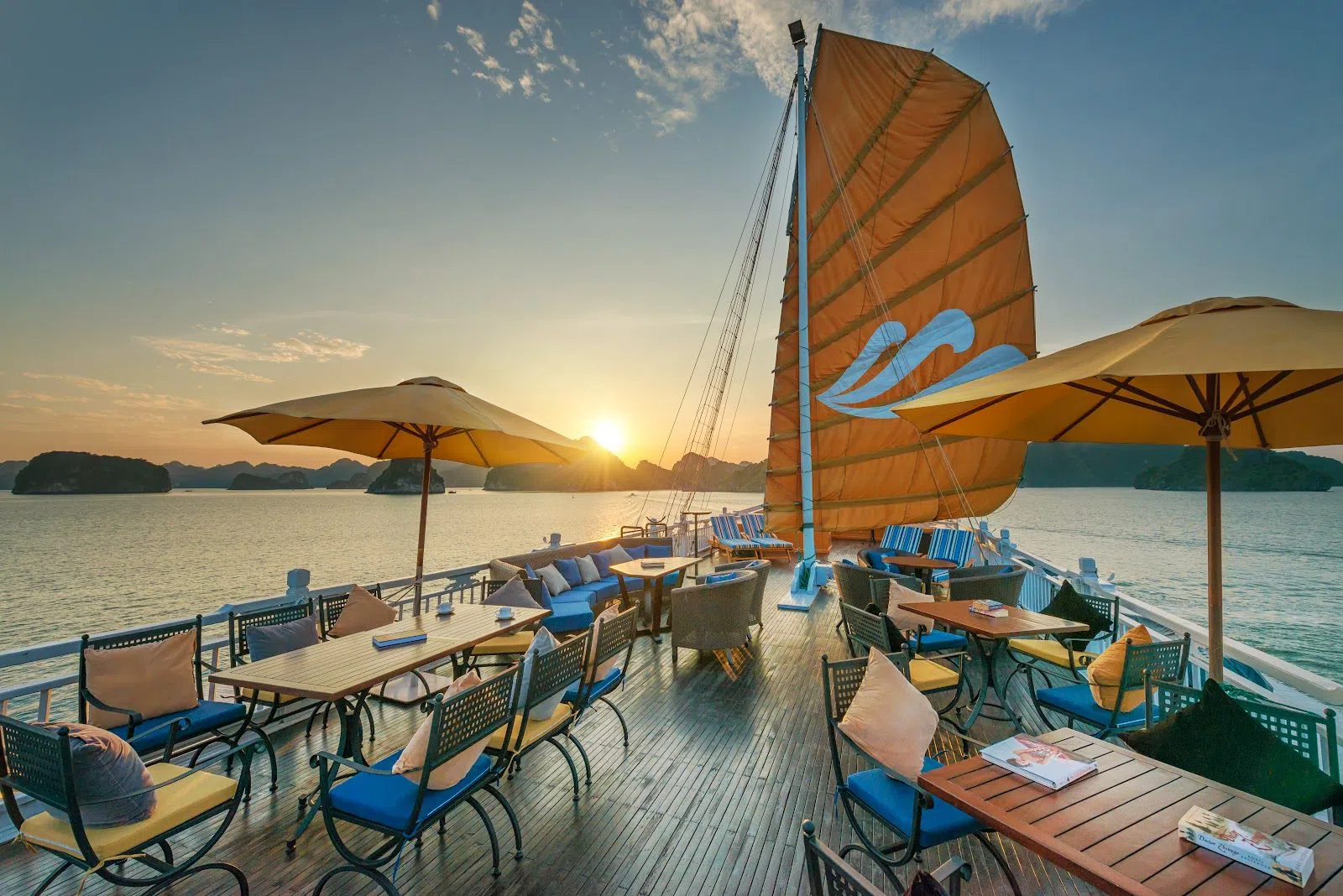
The galley on a Ha Long Bay cruise is smaller than the bathroom of your Hanoi hotel room, and out of it comes a six-course set menu for sixty people while the boat is still under way. Some of that is mực landed on the mainland that morning and grilled over charcoal on the sundeck; some of it is cold nem plated to a schedule an hour before you sit down. Which of the two you get is decided before you leave Hanoi, at the moment you pick the boat.
What eating on the bay actually looks like
The standard trip is two days, one night. You leave Hanoi in the morning, reach the harbour before midday and board at noon. Bhaya Cruises (The Au Co and Bhaya Classic, embarking from Tuan Chau Harbour) runs the timetable most of the bay follows: noon on, 10:00 off. Paradise Vietnam (Paradise Elegance and Paradise Grand, departing Tuan Chau and Halong International) casts off around midday as well, which is why lunch is served under way, with the first limestone going past the window instead of a harbour wall.
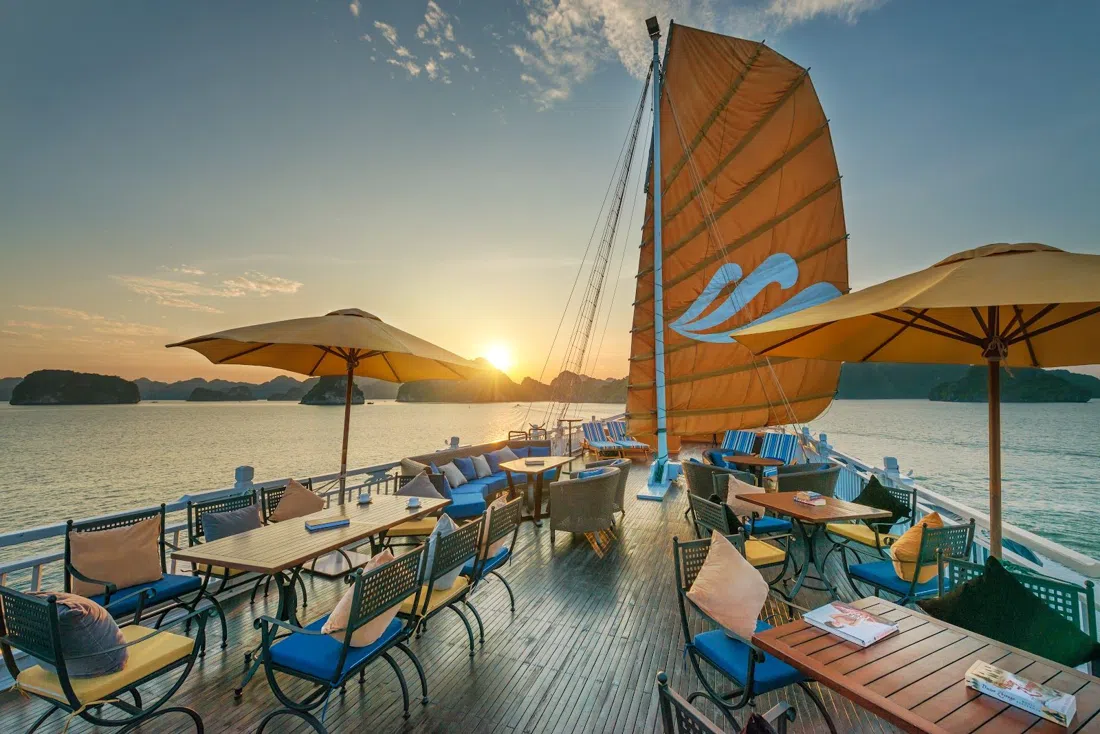
That rhythm gives you four meals in roughly twenty-two hours: lunch under way, dinner at anchor, an early breakfast for whoever wants the sunrise, and a brunch before you disembark. A three-day itinerary roughly doubles the eating and is the only version that includes a lunch cooked on a beach rather than in a galley.
The raw material is broadly the same on every boat, because it comes off the same mainland market that morning: mực (squid), tôm, ngán (the thick-shelled local clam) and whatever grouper was landed. Chả mực, squid pounded with dill and fried into a patty, is the dish Quảng Ninh province is known for, and the better kitchens put it out at breakfast beside the phở station instead of burying it in a buffet tray.
What separates boats is narrower than the brochures suggest. Three things matter: how many people sit down at once, whether the kitchen cooks to order or plates ahead, and whether the bar bill arrives as a second fare at checkout. Guided two-day trips from Hanoi start at 149 USD per person and run seven days a week, so the departure date is rarely the constraint; the boat is.
The kitchens worth choosing a boat for
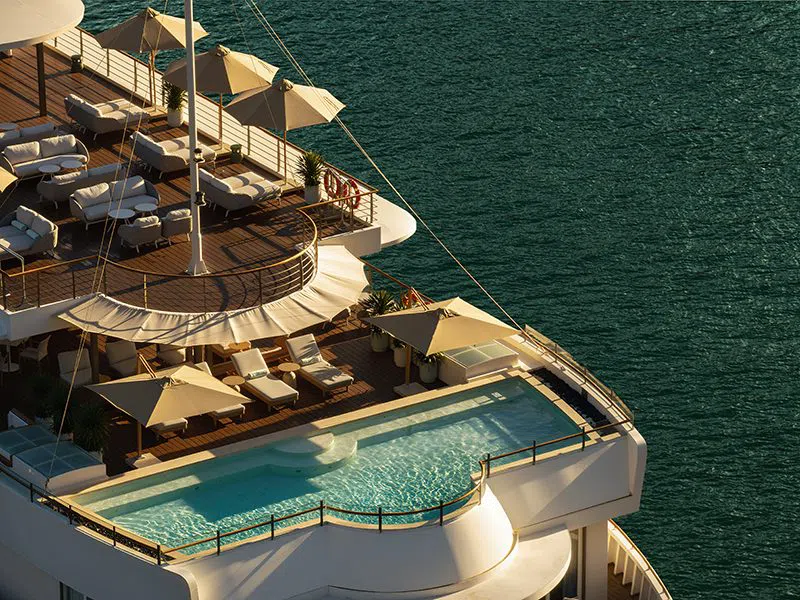
Paradise is the benchmark for set-course dining afloat. Grand's menus are built with a Michelin-starred consulting chef, and because the boat sails at lunchtime the first course lands while you still have the good light on the water. Budget 250 to 450 USD per person per night on Elegance or Grand. It takes groups without drama, and whole-boat charters and corporate bookings are routine. The Paradise Delight day and dinner cruise feeds a larger party well below overnight prices if you don't want a cabin at all.
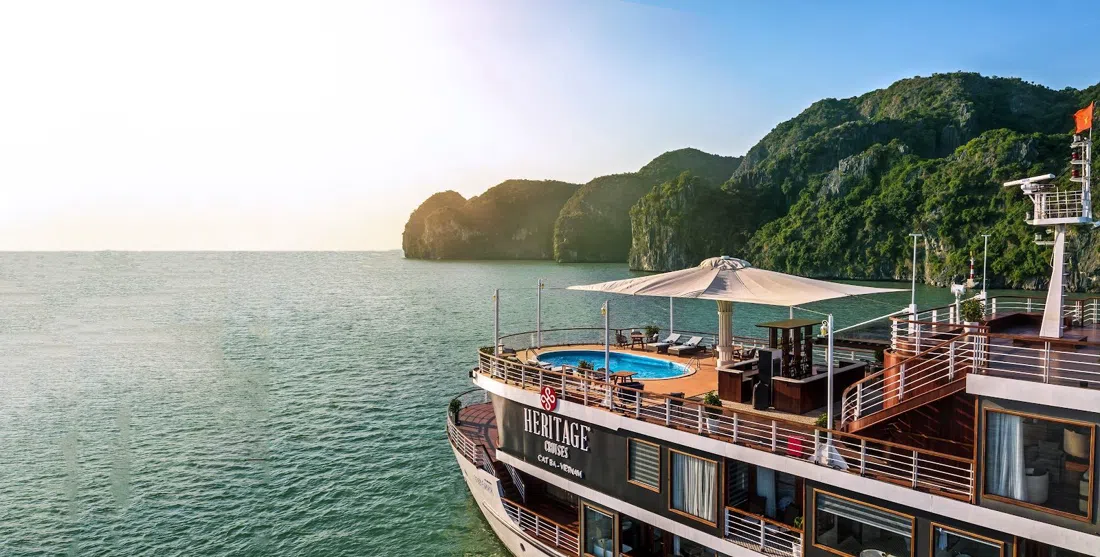
Heritage Cruises Binh Chuan (a small ship sailing Lan Ha rather than the main bay) is the opposite proposition: two separate restaurants on one small vessel, Le Tonkin for Northern Vietnamese courses and L'Indochine up on the panorama deck. It leans to couples and private charters, will build a tailored menu including Halal and Indian, and is not the boat for a coach group. Reckon on 300 to 600 USD per person per night. It sails on a seasonal calendar, so confirm the dates exist before you plan a week around it.
Emperor Cruises Legacy Halong (a small all-inclusive vessel) runs the most themed dining in the bay: its Can Chanh Palace restaurant applies a royal-court conceit to local seafood. The useful part is the pricing model, 300 to 500 USD per person per night with drinks included, so the bar tab cannot ambush you at checkout. Couples and small private parties again, not volume.
Boats where you cook as well as eat
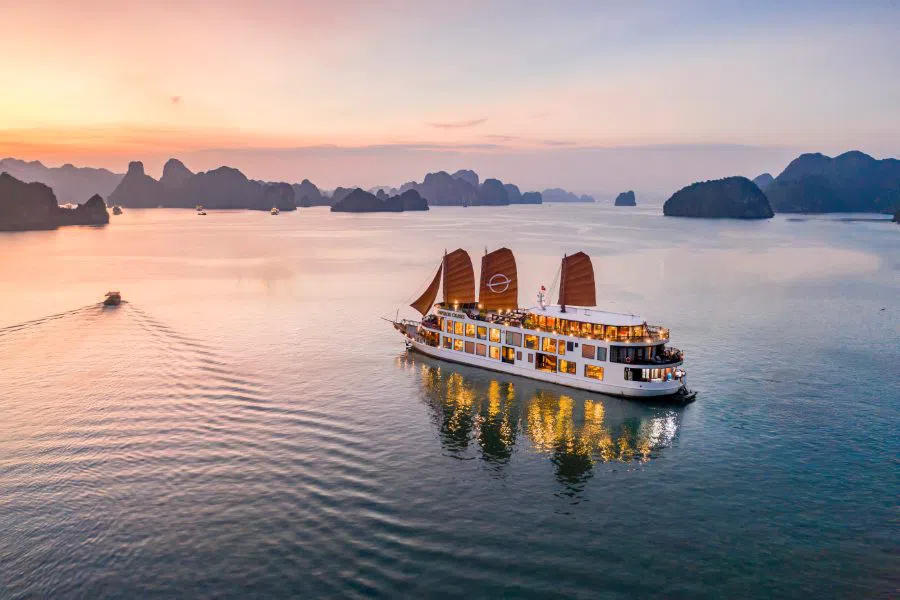
Bhaya is the pick if you would rather learn something than be waited on. There is a Vietnamese cooking class, an onboard bakery and a rice-wine tasting, at 150 to 350 USD per person per night, the widest price band among the serious operators. Four vessels sail under the name; Bhaya Legend goes out as a private charter, and Classic is the one that copes with a group.
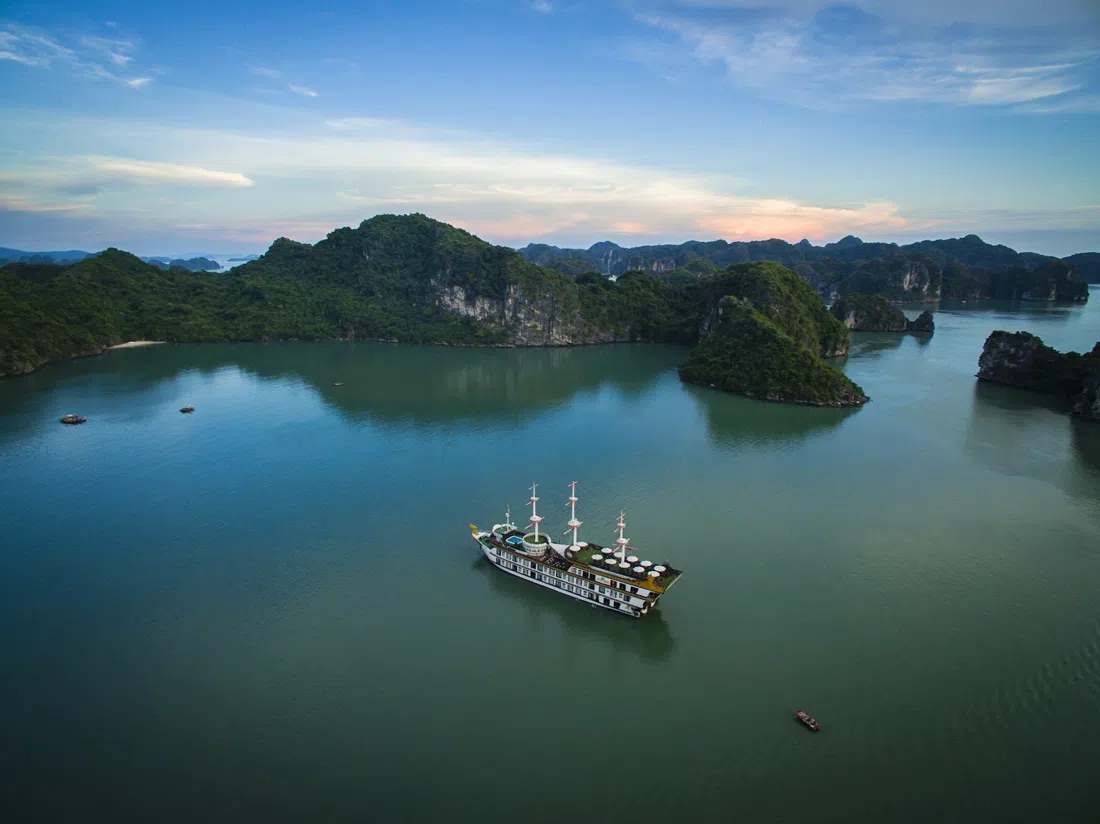
Indochina Junk (Dragon Legend, running east into Bai Tu Long) is for people who want empty water. Its itineraries go where boat traffic is a fraction of the main routes, and the three-day trip includes a beach BBQ lunch and a bánh xèo class, at 200 to 400 USD per person per night. One filter to apply to every operator you look at: cave dinners have been banned across the bay since 2016, so anyone still advertising dinner inside a cave is selling you an event that does not happen.
Big ships, more choice and late availability
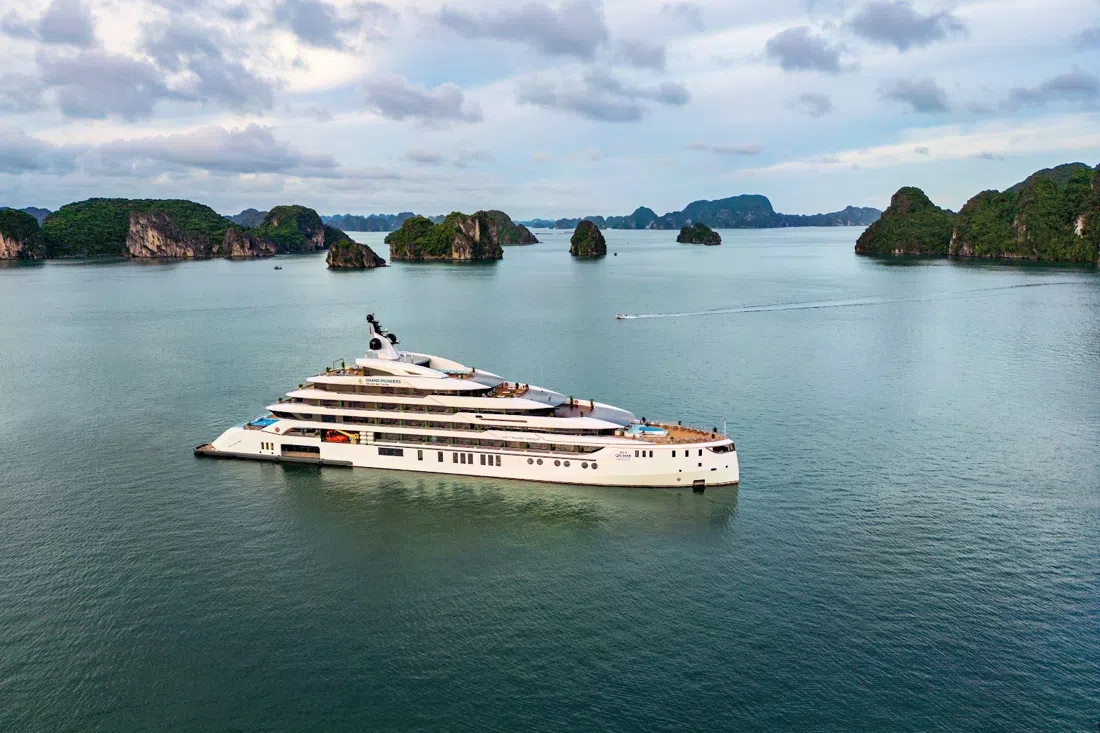
Grand Pioneers Cruise (two ships, departing Tuan Chau International Marina) is the newest of the large operators, and it spreads dining across several venues, the Prestige Dining Club among them, rather than sitting everybody down at one service. That matters if your party contains a fussy eater, a toddler and a vegetarian. Pricing starts at 230 USD per person for two days and one night, 385 USD for three days and two nights, and because the ships are big it is usually the easiest cabin to get at short notice.
Dinner on the water without a night aboard
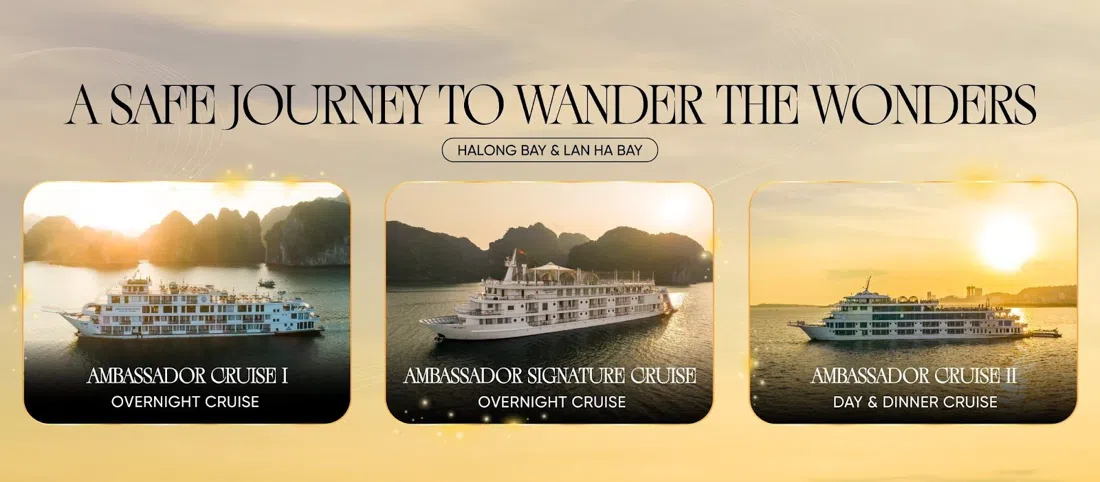
Ambassador Cruise (dinner and day sailings from Halong International Cruise Port, Bai Chay) is the only serious way to eat on the water without committing to a night. Check-in is 17:40 and you are back alongside at 21:45, an evening rather than a trip. It carries up to around 600 passengers and has an explicit events and conference offer, so be clear-eyed about what it is: a buffet with entertainment, mid-range per head, with drinks and premium seating charged on top. For a mixed-age group, or anyone worried about tenders and ladders, it beats a boutique junk.
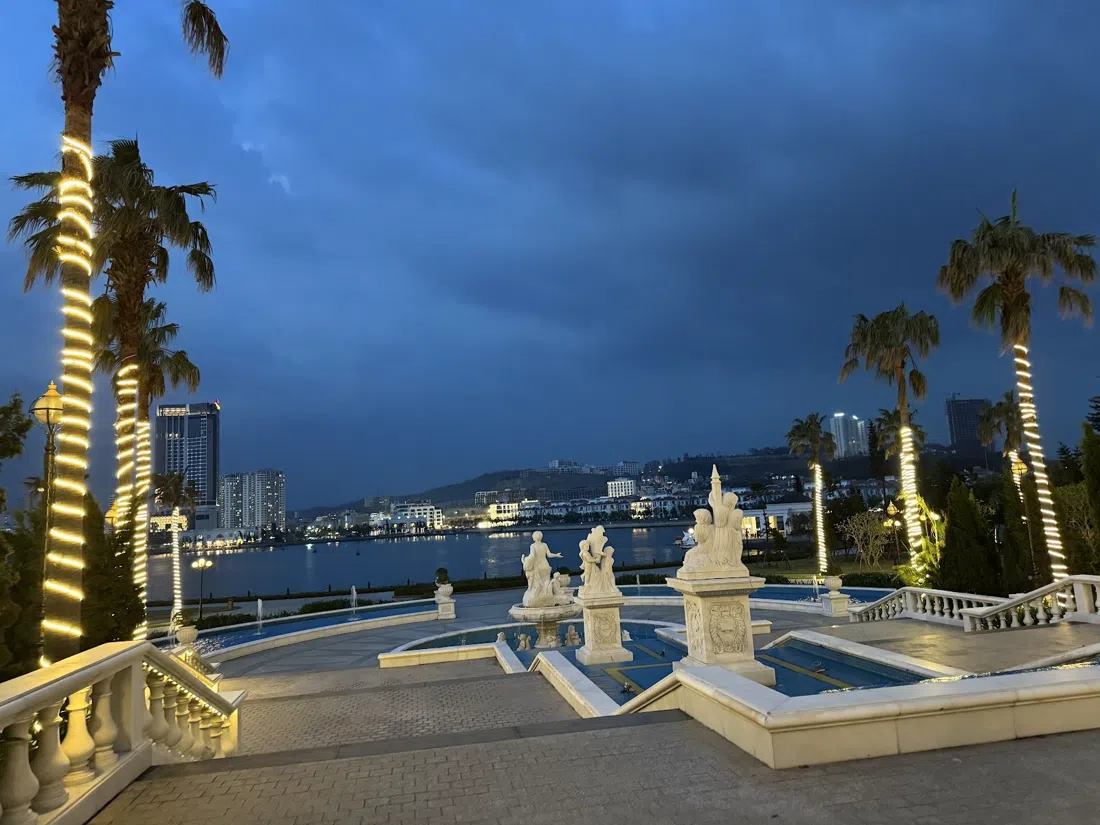
Vinpearl Resort & Spa Ha Long (Reu Island, five minutes by free speedboat from Bai Chay pier) is the land-based answer to the same problem. It has 384 rooms, three restaurants and a pool bar on an island you largely have to yourself; buffet breakfast is 450,000 VND for adults and 230,000 VND for children, rooms roughly 70 to 140 USD. You eat with the bay in front of you and sleep on something that doesn't move, which is the sane choice for anyone nervous about a night aboard.
What happens between meals
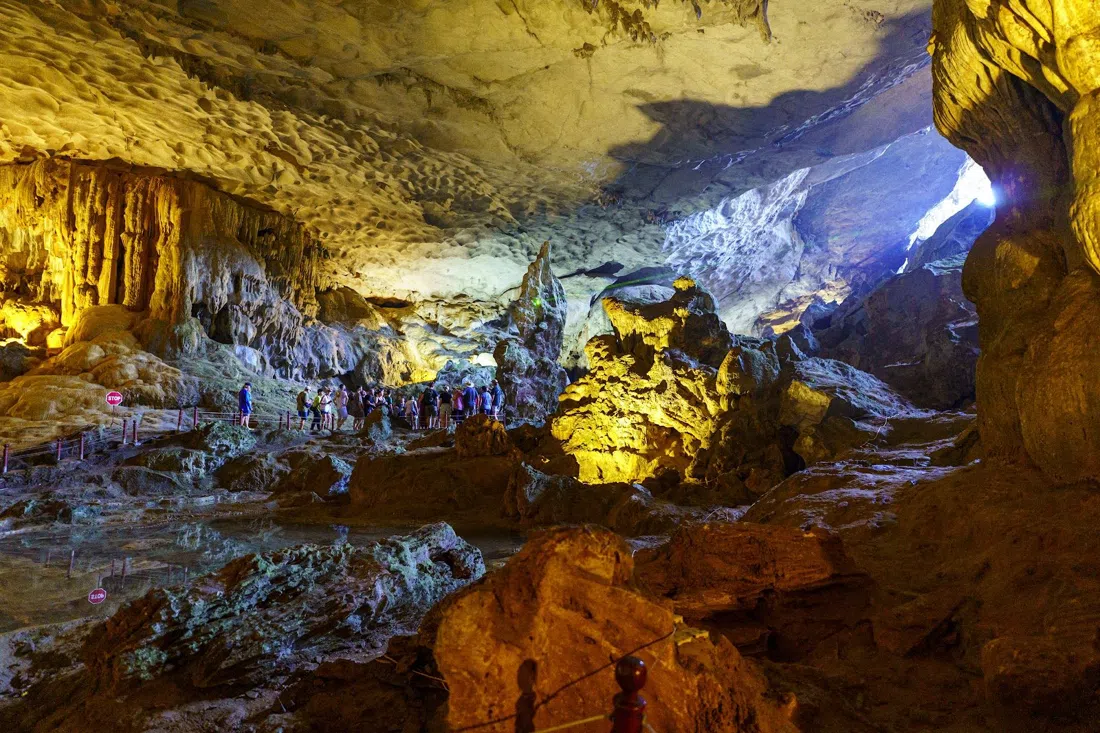
Sung Sot Cave (Bo Hon Island, on the standard bay route) is the busiest single stop in Ha Long Bay and every group itinerary calls there. Entry sits inside the bay route ticket, around 290,000 VND on the day route, and the cave is open 08:00 to 18:00. Go before 09:00 or after 15:00; between 10:00 and 14:00 the boats stack up at Bo Hon and the walkway moves at the pace of the slowest camera.
Ti Top Island (main route, standard on Route 2 itineraries) is the postcard viewpoint and the only proper swim stop on the main circuit. Climb it at first light off an overnight cruise. At midday the steps and the beach are congested and the view is hazier anyway.
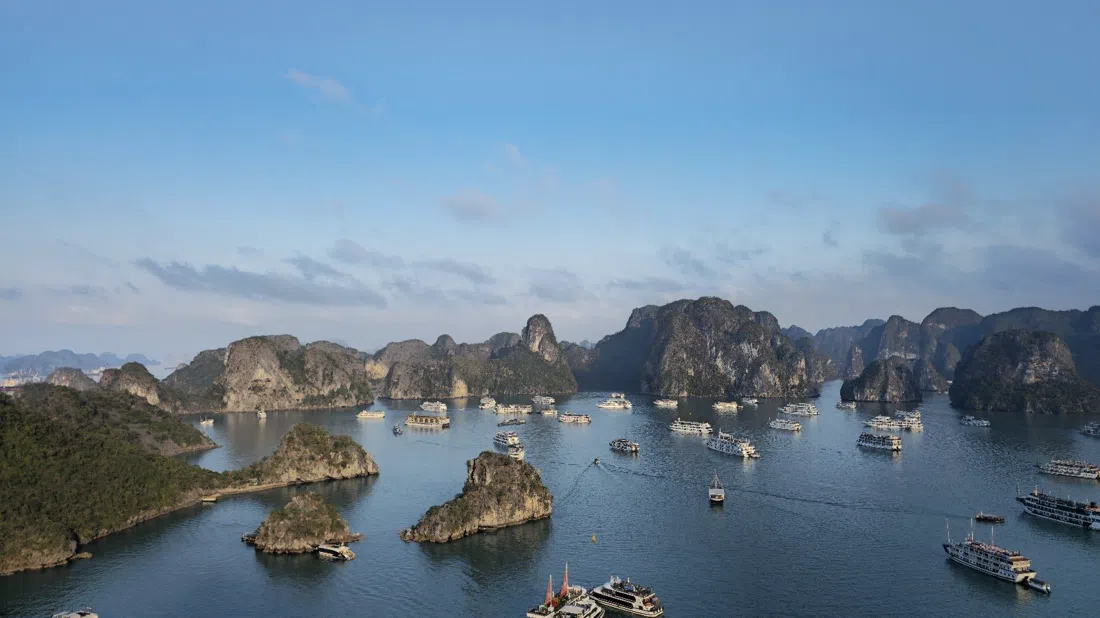
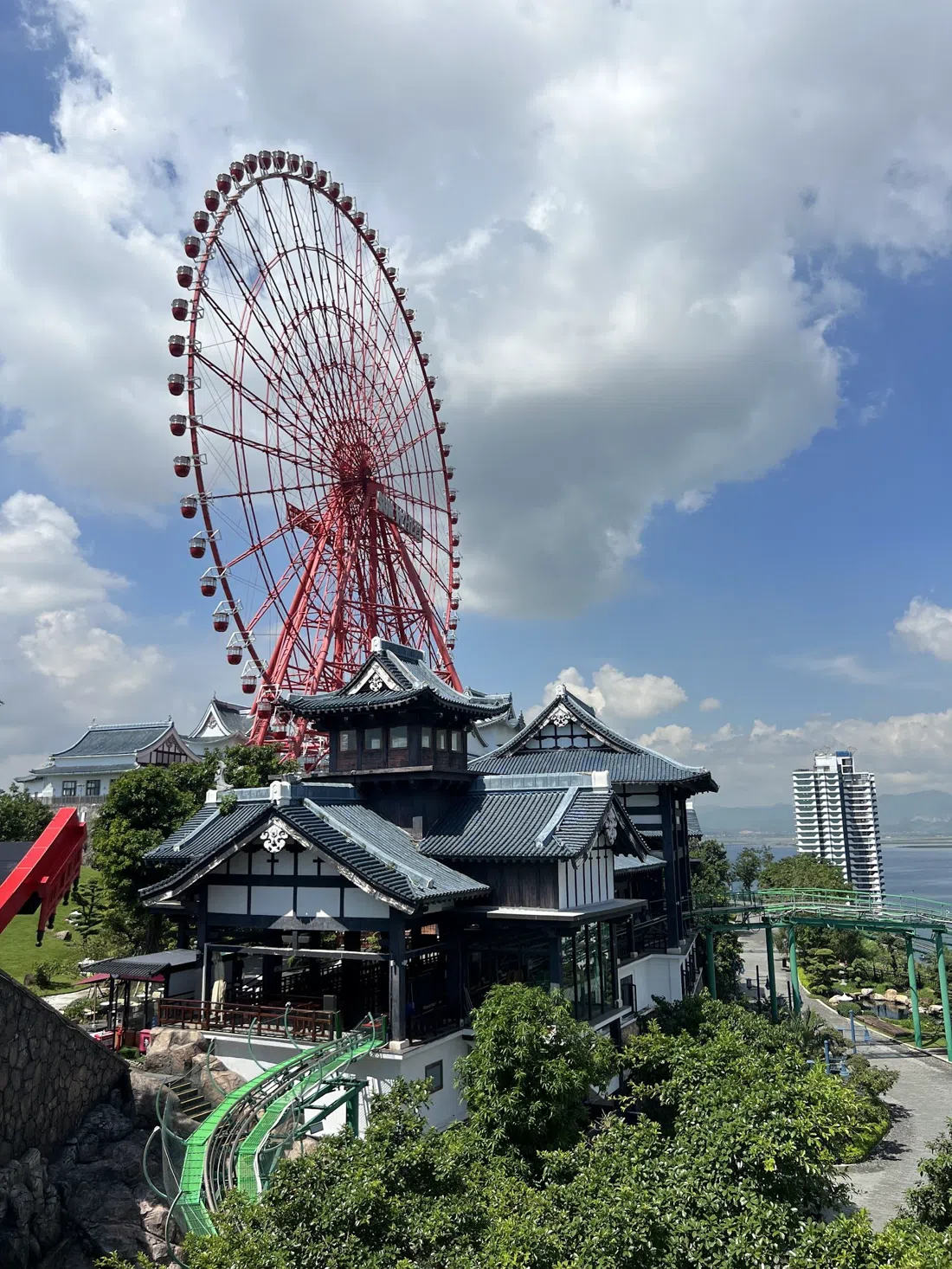
Sun World Ha Long (Queen Cable Car and Sun Wheel, Bai Chay) earns an hour before you sail rather than after, because the aerial view is what makes the geography legible. The cable car is 380,000 VND adult and 280,000 VND child, Dragon Park 300,000 VND, running 09:00 to 18:00 and later at weekends. Ride it late afternoon and eat in Bai Chay afterwards.
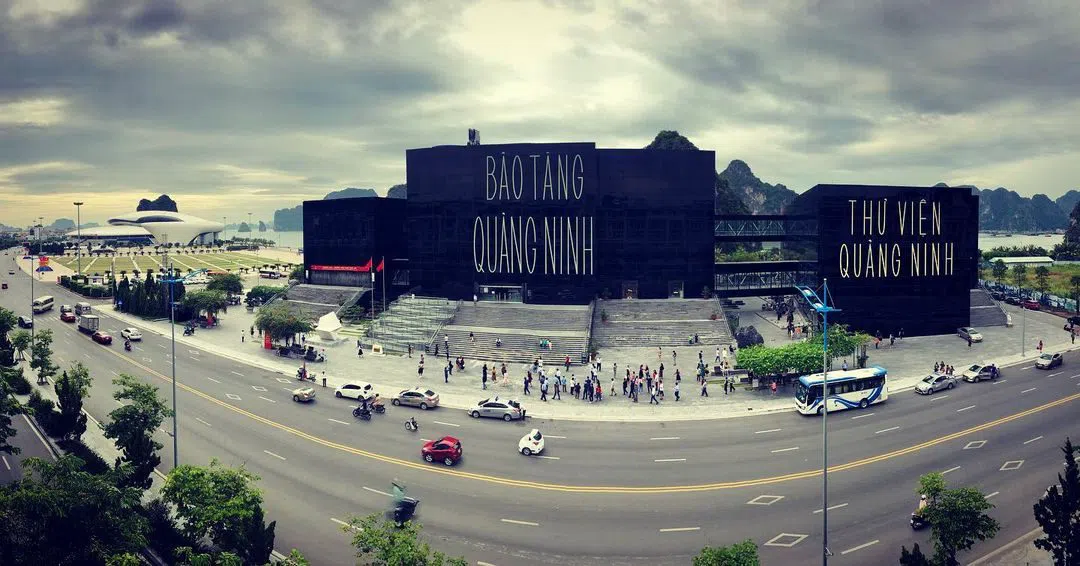
Quang Ninh Museum (Tran Quoc Nghien St) is the best wet-weather hour in the area and the context for everything on your plate: the coal and fishing history of the province, in large halls with no timed-entry queueing. 40,000 VND adult, 15,000 VND student, 10,000 VND child, Tuesday to Sunday, 08:00 to 17:00.
Eating on land in Bai Chay
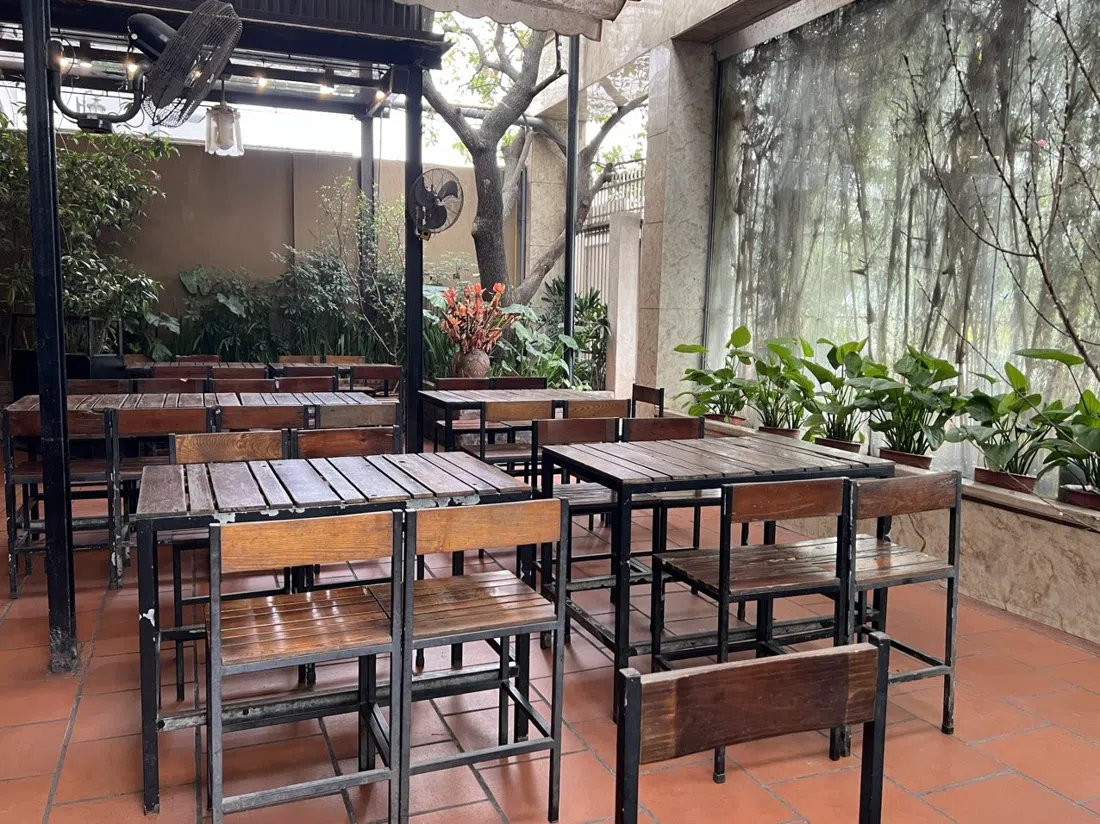
Hong Hanh 3 Restaurant (50 Ha Long St, Bai Chay) is the dependable all-rounder and the address to hold in reserve. Banquet-scale room, coach parties and family tables handled without booking gymnastics, 100,000 to 300,000 VND a head. Its hours, 08:00 to 14:00 and 17:00 to 22:00, cover precisely the gap between a 10:00 cruise return and an evening departure back to Hanoi.
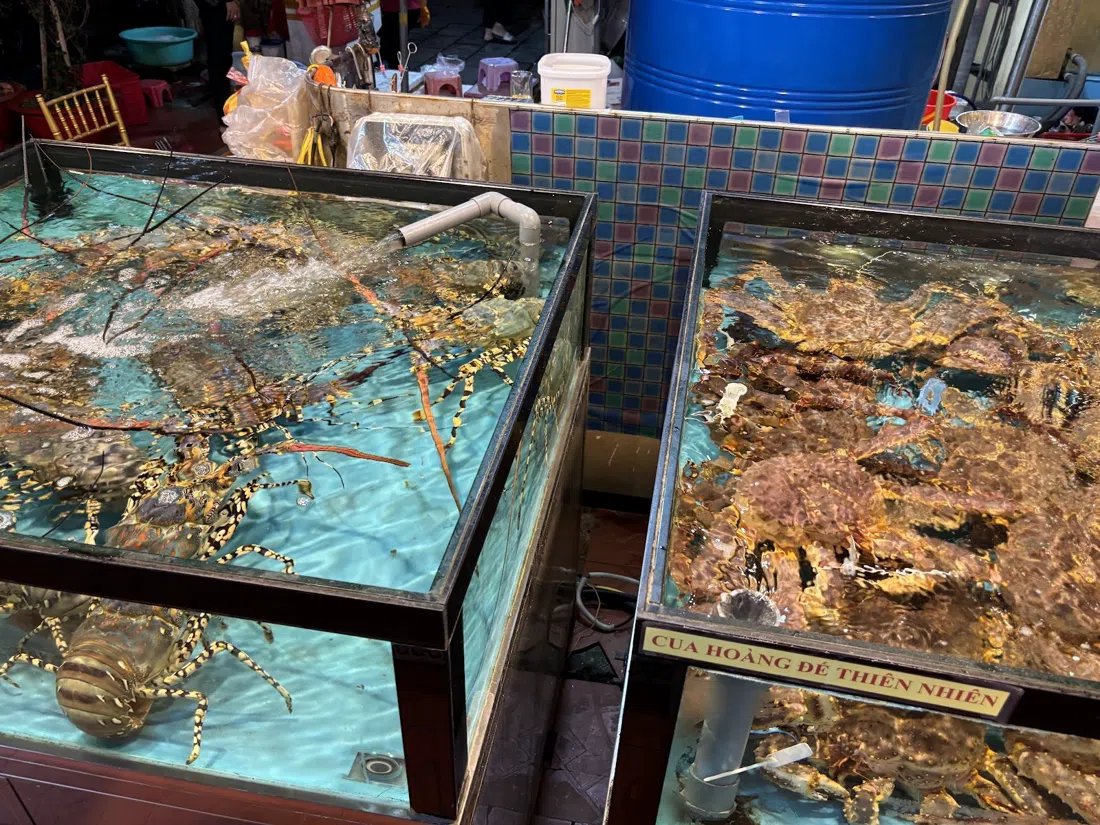
Cua Vang (Golden Crab) Restaurant (32 Phan Chu Trinh, Bai Chay) is the pick-your-own option: three floors, tanks at the door, open 10:00 to 22:00, 50,000 to 300,000 VND per dish. The golden crab hotpot is the house dish and the reason to come. Call ahead at weekends, and have the staff weigh and price whatever you point at before it goes to the kitchen, because pick-your-own is where a cheap dinner turns into an expensive one.
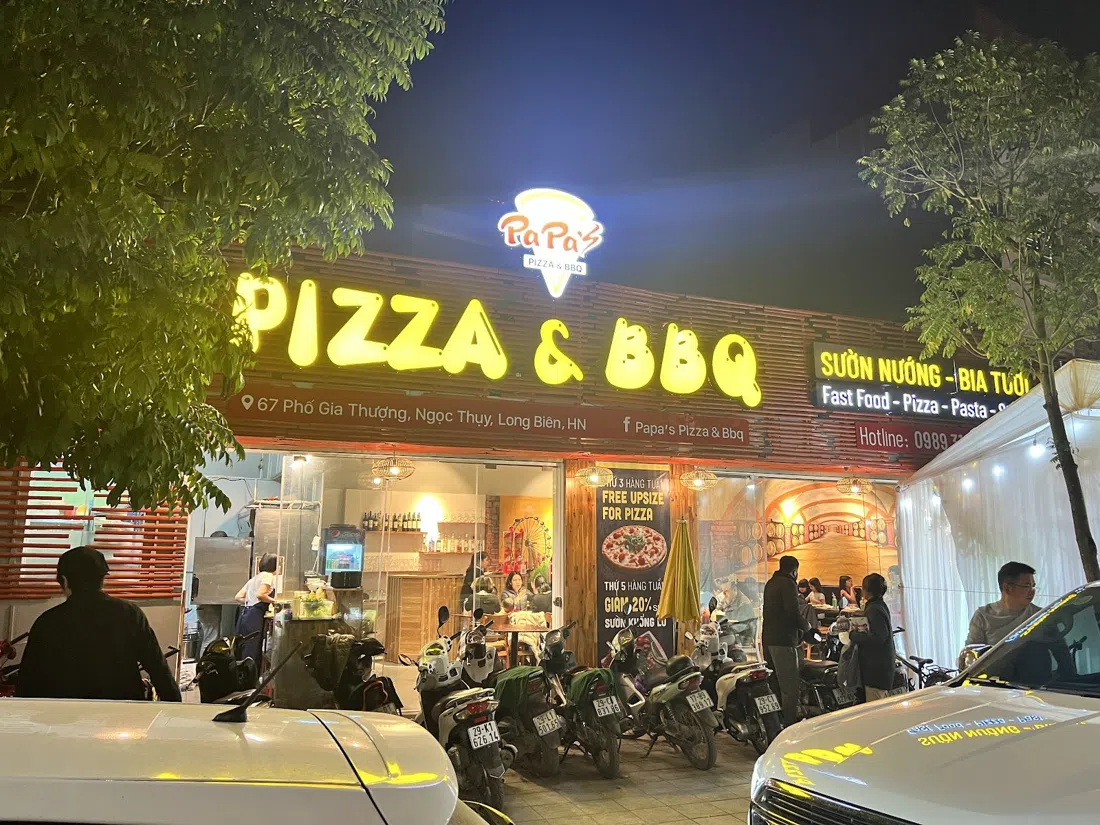
Papa's BBQ (Duong Chau My, near Sun World) is the escape valve after three seafood meals in a row: steak, schnitzel and cold beer, casual outdoor seating, walk-in friendly, 11:00 to 23:00, 100,000 to 300,000 VND a head. Easy with a group, and nobody minds if you arrive salt-crusted straight off a boat.
Booking ahead, queues and what you pay at the door
There is no door to speak of. You cannot walk onto an overnight cruise on the day; the bay route ticket covering Sung Sot and Ti Top is bundled into your fare, and operators sell cabins in advance. A guided package bought from Hanoi also carries the road transfer, which is the part people underestimate: it is the difference between arriving at 11:30 and watching your boat leave without you. The bookable trips attached to this page carry 11,298 traveller reviews between them, and the highest-rated sits at 4.7 out of 5 from 3,531 reviews; read the recent ones for the food specifically, because catering is what operators change without announcing it.
Book direct with a cruise line if you want a named cabin, a charter or a tailored menu. Book a package if you want the transfer, the route ticket and the boat handled as one line item. Either way, put any dietary requirement in writing at least 48 hours out, because a galley provisioning for sixty covers cannot improvise a vegan main at sea.
Rules, access and the things nobody warns you about
Take your passport to harbour check-in; a photo of it is not the same thing. Sailings depend on the weather and the port can suspend departures outright in a storm. No operator controls that one, so a fare with a free cancellation window is worth more than a small discount. Itineraries also swap routes at short notice when the harbour is busy, which is why a boat sailing Lan Ha or Bai Tu Long is a real differentiator rather than marketing.
Mobility is worth thinking through before you pay. Transfers to caves and beaches are by tender, boarding is via a short ladder, Sung Sot is a long stepped walkway and Ti Top is a staircase. If that is a problem for anyone in the party, an evening dinner sailing or an island resort gives you the water without the climbing. Check what the drinks cost too: an all-inclusive fare and a fare with a corkage-and-cocktails bar can end up the same number by morning.
Is it worth it
As a food trip, yes, with one condition. If you book on price alone you will get a competent, repetitive set menu served to a room on a timer, and you will conclude the bay's food is fine and forgettable. Pay for a kitchen that has a reason to exist (a consulting chef, two restaurants, a cooking class, a beach grill) and the eating becomes the reason you went rather than the thing between the kayaking and the karaoke.
It suits couples who will pay for a small boat and a quiet anchorage; families and mixed groups, who do better on a large ship with several dining rooms; and anyone who wants one spectacular dinner without a night aboard, who should take an evening sailing and sleep on land. It suits budget travellers least, because the cheapest cabins are where the catering economies land first.
Best time to go
October to early December is the strongest window: dry, clear air, warm enough to swim off Ti Top, and the visibility that makes the limestone worth photographing. March and April bring mưa phùn, the fine northern drizzle, and a haze that flattens the view even on rainless days. Summer is hot and green with a real typhoon risk, which means cancelled sailings rather than wet ones. Winter is cold and often fogged and the view goes soft, but it is the best eating of the year, when hotpot and grilled squid make sense and boats are emptier.
Within the day, the pattern is fixed: first light and late afternoon are yours, 10:00 to 14:00 belongs to the group boats. Midweek departures are noticeably calmer at the cave stops, and weekends are when mainland restaurants want a phone call before you turn up.
Practicalities before you leave Hanoi
The drive from Hanoi takes a little over two hours on the expressway in clear traffic, and a noon embarkation means leaving the city by around 08:00. Build in a margin, because boats do not wait. Most cruise fares include a shared or private transfer; confirm the pickup point, since hotels outside the centre are often a meeting-point pickup rather than door-to-door. Base yourself centrally the night before and the morning is simple: start with the Hanoi guide for the districts, then a Hanoi hotel search for a room near your pickup.
Carry VND cash. Cruises take cards for the bar bill, but mainland restaurants, tenders, tips and the odd extra ticket are smoother in notes; ATMs are easy in Bai Chay. Budget plainly: 150 to 350 USD per person per night gets you a good kitchen with a class attached, 230 to 450 USD a large ship or a benchmark set menu, 300 to 600 USD a small boat with two restaurants or an all-inclusive bar. Guided two-day packages start at 149 USD per person. On land, a full seafood dinner runs 100,000 to 300,000 VND a head, and a cable car ride plus a museum hour costs less than one cocktail on the sundeck.
Questions
How much does a Ha Long Bay cruise from Hanoi cost, and what is included in the food?
Guided two-day packages from Hanoi start at 149 USD per person and run seven days a week; the operators themselves charge 150 to 350 USD per person per night on Bhaya Cruises and 300 to 600 USD on Heritage Cruises Binh Chuan. A one-night fare normally covers lunch, dinner, breakfast, brunch and the bay route ticket. Drinks vary: Emperor Cruises Legacy Halong includes them at 300 to 500 USD per person per night, while most boats bill the bar separately at checkout.
Is the seafood on a cruise better than eating chả cá in Hanoi?
Different jobs. Hanoi does single dishes to a very high standard: chả cá, the turmeric-and-dill fish fried at your table, is cooked by people who cook nothing else. A cruise galley is producing a multi-course menu for a full manifest at sea, so it trades specialism for freshness and setting: squid, prawns and clams bought on the mainland that morning, plus chả mực, the local squid patty. Go to Hanoi for technique and the bay for produce.
Can I eat on Ha Long Bay without staying overnight on a boat?
Yes. Ambassador Cruise runs an evening dinner sailing from Halong International Cruise Port in Bai Chay: check-in 17:40, back alongside 21:45, buffet with entertainment. Paradise Vietnam's Delight day and dinner cruise does the same without an overnight and handles larger parties. If you want the view without boarding anything, Vinpearl Resort & Spa Ha Long on Reu Island is a five-minute free speedboat from Bai Chay pier.
Do cruises cater for vegetarian, Halal, Indian or allergy diets?
Most will, if you give notice. Put the requirement in writing at least 48 hours before departure, because a galley provisioning for a full boat cannot improvise at sea. Heritage Cruises Binh Chuan offers Halal and Indian menus and builds tailored menus for private charters. Grand Pioneers Cruise spreads dining across several venues, which helps when one party has mixed requirements.
Is there still a dinner inside a cave in Ha Long Bay?
No. Cave dinners have been banned across the bay since 2016, so any operator still advertising one is selling something that will not happen. The closest legitimate equivalent is a beach meal: Indochina Junk's Dragon Legend includes a beach BBQ lunch on its three-day Bai Tu Long itinerary, along with a bánh xèo class.
First published on hanoigetaways.com, the Hanoi guide.