At six in the evening the counters along Calle de la Victoria start to steam, and you smell the garlic from the corner before you see the door. Puerta del Sol itself takes four minutes: a kilometre-zero plaque underfoot, a clock tower that owns New Year's Eve, a bronze bear most people photograph from the wrong side. The reason to stand here in October is the half-kilometre of bars around it, where a pan of prawns costs less than a museum ticket and the evening only gets going at an hour most visitors have already eaten.
What tapas hour actually is around Sol
Tapas hour is not an event anyone organises. It is the gap Madrid leaves between a lunch that ends at four and a dinner that starts at half nine, and around Sol it fills roughly between 7.30pm and 9.30pm midweek, earlier and far messier at weekends. Almost nobody sits. You stand at a counter, order one thing and a drink, pay, then walk two streets to the next place. That is why the advice below is mostly about doors, capacity and timing rather than menus.
Three things before you start. First, the price chalked up is usually the counter price; a table, and especially a terrace table, can cost more at the same address, and in October the terraces are still in play, so that difference is live. Second, the free-tapa-with-a-drink custom is weaker here than visitors expect. Around Sol you order and pay for what you eat, and that is fine, because what you are paying for is one thing done for a century. Third, the bar keeps your tab in chalk or in its head and you settle at the end; trying to pay per round confuses everyone, including you.
Everything in this article sits inside a twelve-minute walk of the square, which is the entire argument for eating here instead of trekking out to a district you have to research first. For how the rest of the city fits together, the Madrid guide is the better starting point.
Garlic prawns in the pan they were cooked in
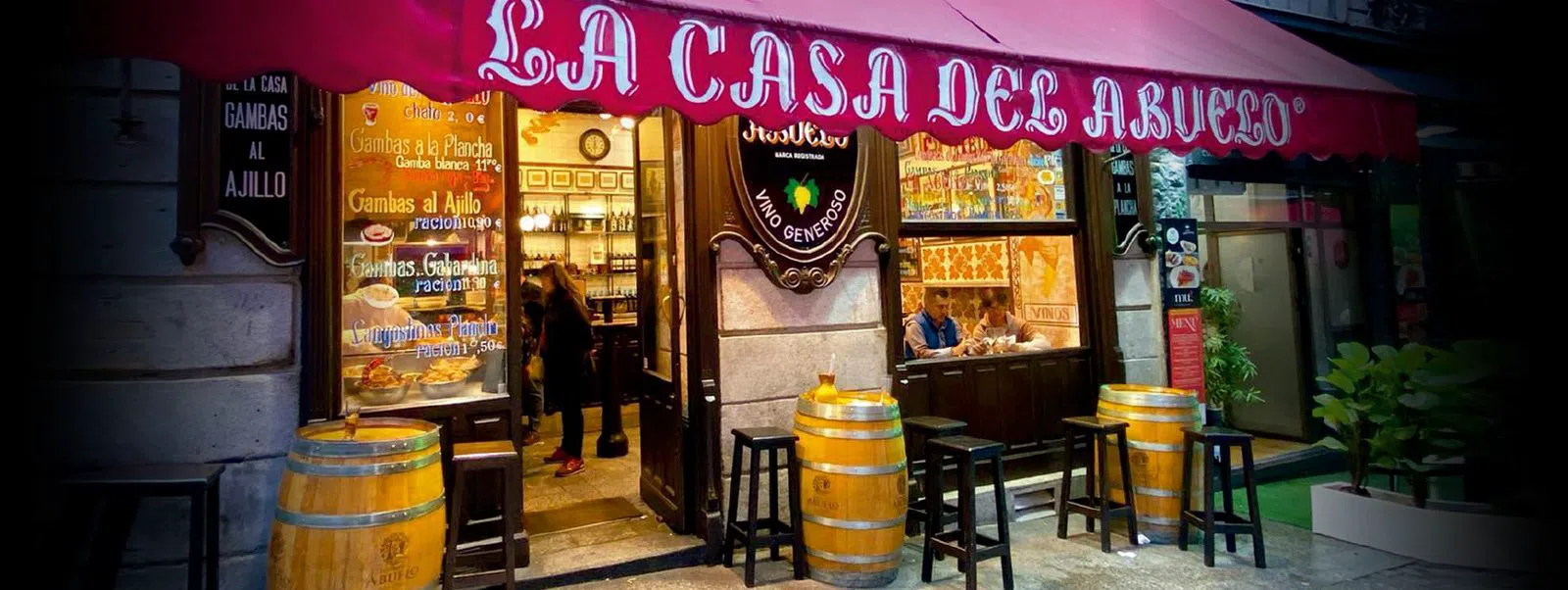
La Casa del Abuelo (Calle de la Victoria, thirty seconds off the square) has been open since 1906 and there is only one thing to order: gambas al ajillo, brought to the counter still spitting in its little metal pan, garlic and chilli and oil you are meant to mop with bread until the pan is clean. Budget €12–18 a head for the prawns and a drink. That is what good prawns cost rather than a tourist mark-up, and the bread is not optional.
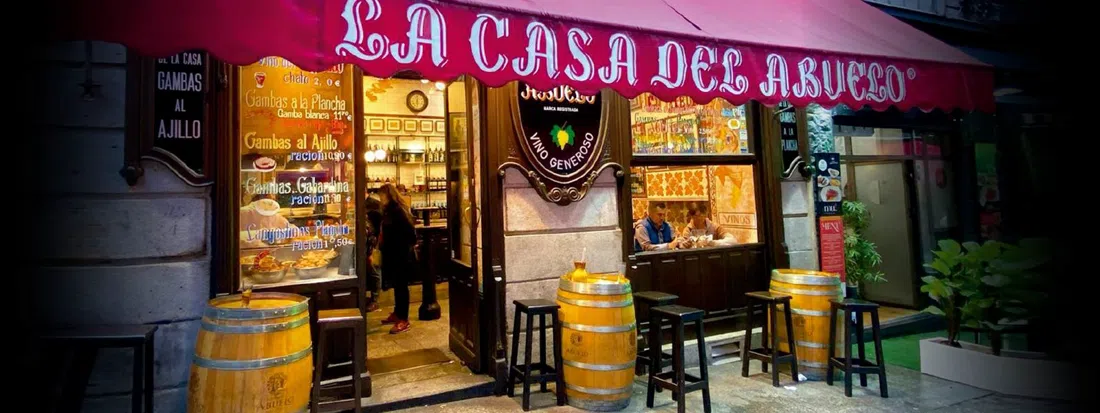
No reservations, first come first served, and the original Victoria 12 room is genuinely small: a bar, a strip of standing space, elbows. Two or three people will get in within minutes at 7.30pm. Four is the practical ceiling. Above four, split into two pairs or use one of the operator's other rooms a few doors along, which run under the same name and the same kitchen; the one entry covers the cluster. If you arrive at nine on a Saturday and the doorway is three deep, walk the loop and come back at ten, because this is the one address in the article I would wait for.
A five-minute stop for patatas bravas
Las Bravas (the Álvarez Gato alley, a minute east of Sol) has been trading since the 1930s and holds a patent on its sauce dating from 1959. It is a specialist rather than a restaurant: fried potato, that sauce, standing room, €5–12 a head, and a turnover so fast that a space usually opens up before you have decided what to drink. Walk-in only; no bookings exist to make.
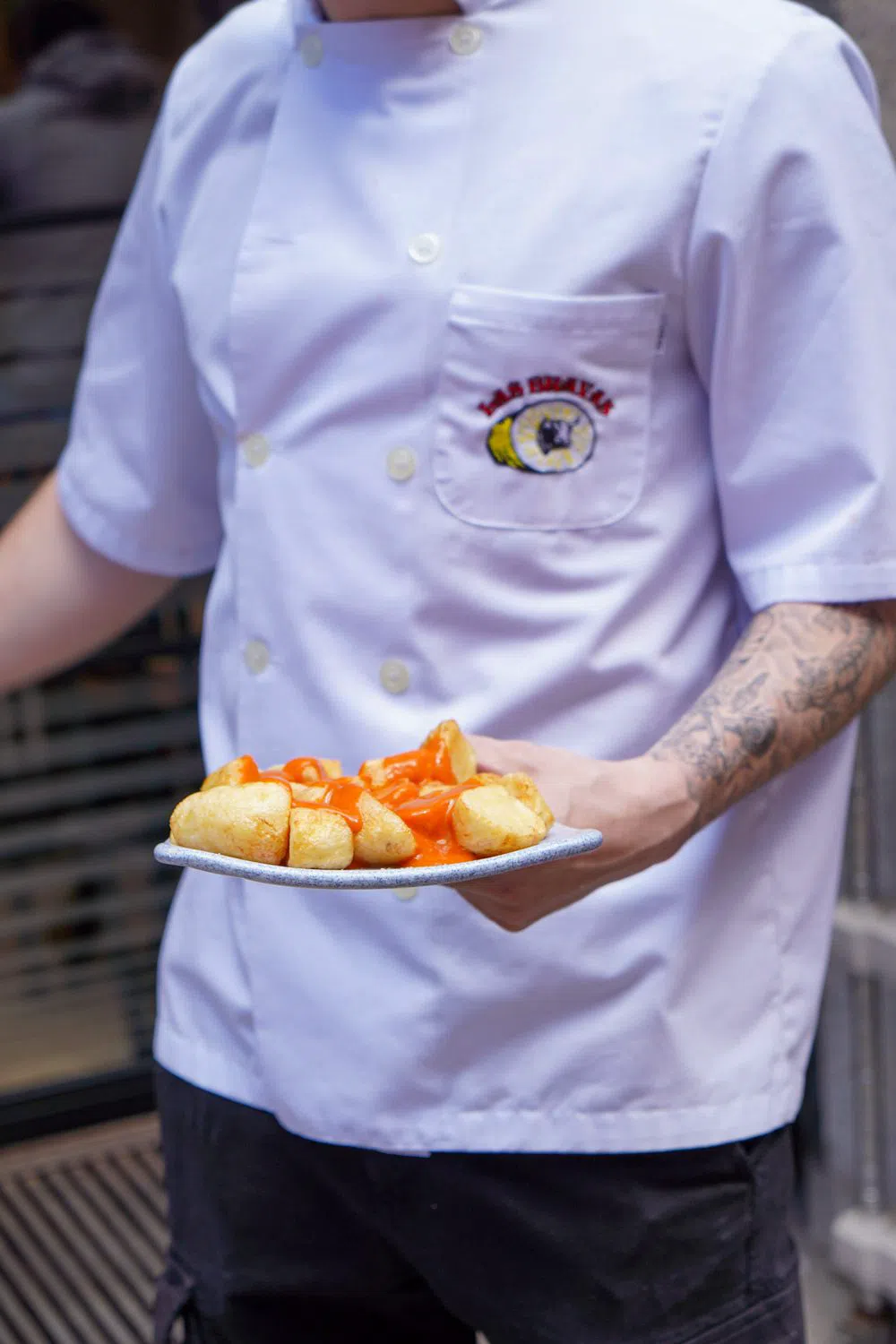
Treat it as a five-minute stop between two better meals. Couples and pairs do well here. A group of eight will end up standing out in the alley with plates balanced on forearms, which is survivable but not an evening. While you wait, look at the distorting funhouse mirrors mounted on the alley wall next door. They are a real Madrid fixture rather than a prop someone installed for photographs, and they are free.
The one address that can swallow a group of ten
Museo del Jamón on Carrera de San Jerónimo (the square's eastern lip) is not a museum, whatever the name and the ceiling full of hanging legs suggest. It earns its place for one reason: it is the only address right on Sol that can absorb a party of ten at any hour without a phone call. Large halls, tables upstairs, continuous service from 9am to past midnight, no booking.
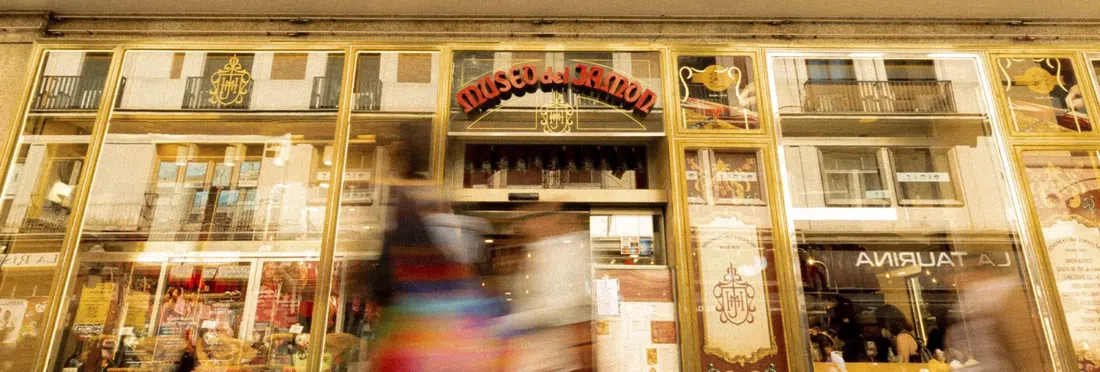
Prices split cleanly. A ham roll at the bar is €1.50–3, and a counter bocadillo with a caña is the cheapest honest lunch anywhere near the square: a ham sandwich and a small beer eaten standing up, the way half of Madrid does it. Sit down upstairs with a plate and you are at €15–25 a head. It suits groups too big for the counters, families, anyone arriving at 4.45pm when the serious kitchens are shut, and anyone who needs to eat before a train.
Two centuries of dining room for the price of a coffee
Lhardy (Carrera de San Jerónimo, two minutes east of Sol) has been open since 1839 and offers the sharpest door-price contrast in these streets. Downstairs is a self-service standing room with a samovar: you walk in free, take a cup, pour your own consommé from the urn, and pay about €4. A two-century-old room and a hot cup of broth for less than a cocktail, and on a cool October evening that is the best value-for-history ratio in this article.
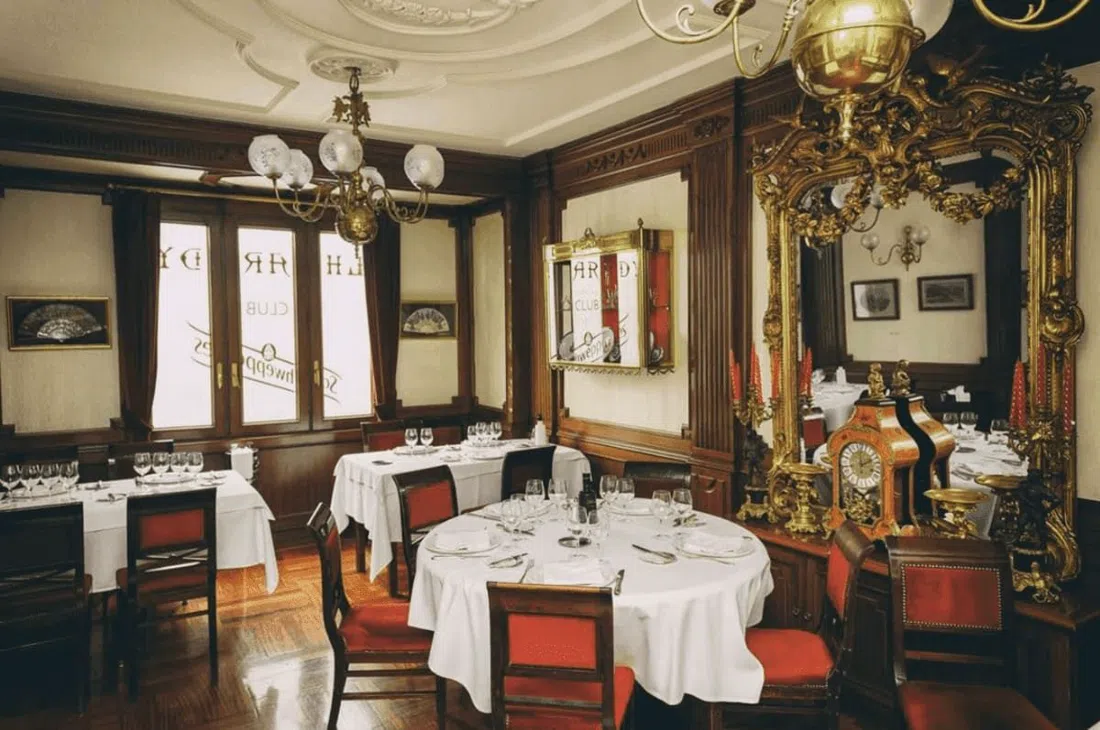
Upstairs is the other Lhardy: booked dining rooms, website or telephone only, no walk-ins for groups, and €60–90 a head for cocido madrileño served in its traditional courses. If that is your one big Madrid meal, book it well before you fly; the upstairs rooms are small and the cocido is why people come. One clarification worth making, because the internet has not caught up: the newer Lhardy Café on Calle Velázquez is a sister site. The cocido stays here.
Churros at eight in the morning, pastries at six in the evening
Chocolatería San Ginés (the passage off Calle Arenal, five minutes from Sol) has been serving since 1894 and is the only genuinely round-the-clock food stop near the square, open continuously Thursday to Sunday. Six churros and a chocolate thick enough to stand a churro upright run about €5–6. No bookings; capacity across two rooms and the passage tables means a group of ten gets in.
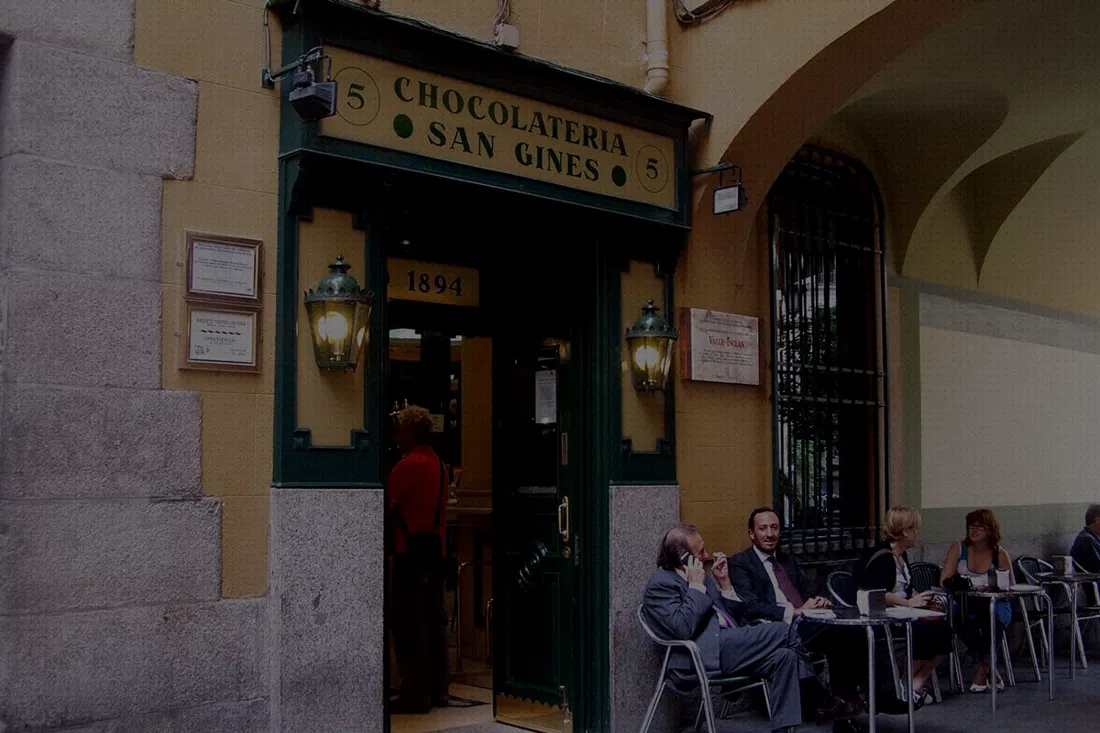
The timing advice here is the whole point. Mid-evening the queue outside is long and is not itself an experience. Go at 8am before anything else opens, or at 2am on your way back from wherever the night went, and you walk straight to a table. Both beat the 7pm version.
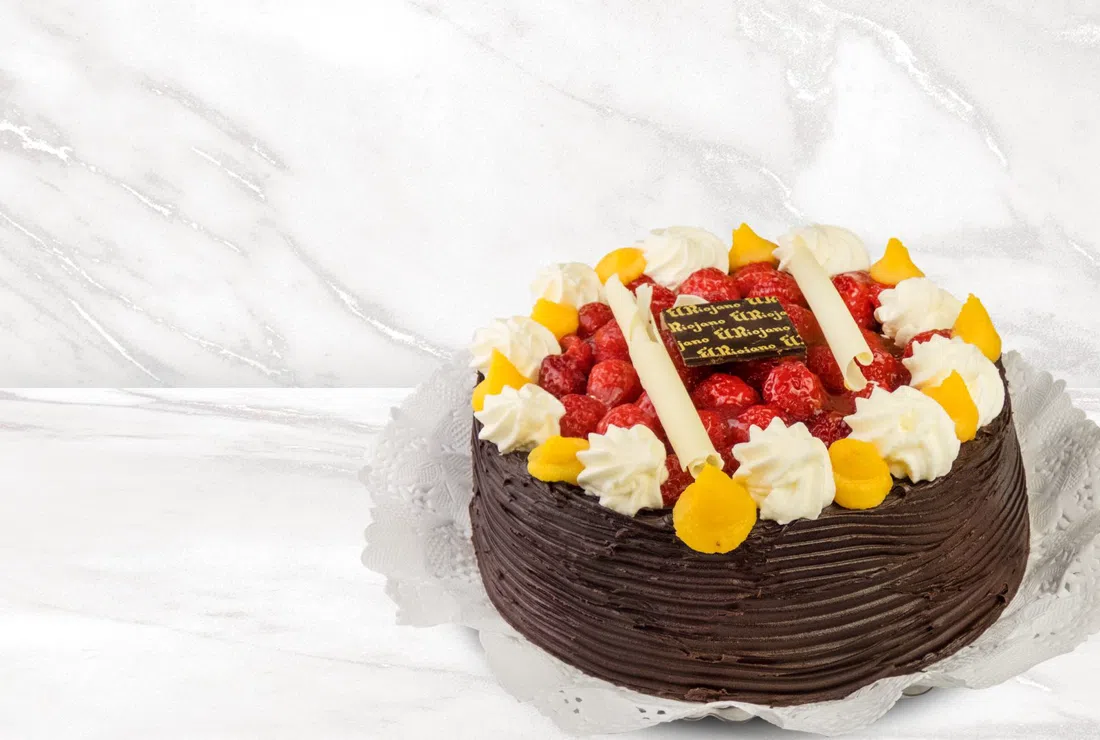
Pastelería El Riojano (Calle Mayor, three minutes from Sol) is a shop rather than a café, founded in 1855 by a pastry chef from the Royal Palace, with the best-preserved interior of any of these doors and only a couple of standing spots inside. Buy the pastel de yema, €2–5, and eat it walking. That makes it useful in a way cafés are not: it is open 9am–9pm daily, so it covers the dead afternoon when the taverns have shut their kitchens and you need something in your hands.
The market reopened in February, so ignore the old photographs
Mercado de San Miguel (Plaza de San Miguel, by Plaza Mayor, eight minutes from Sol) reopened on 26 February 2026 after a multi-year refurbishment, so any coverage or photo set older than this spring describes a hall that no longer exists. Entry is free, small plates run €4–8, and a realistic bill once you have drifted past four stands is €15–30 a head. It stays open to midnight, and to 1am on Friday and Saturday, which makes it a real late option rather than a theoretical one. Stools are scarce at peak; some individual stands take reservations through the market's own booking page.
An honest verdict, because this is the address built most squarely for visitors: I would not send you here for dinner. The per-plate prices are display prices and the pleasure thins out fast. It works for one plate and one glass at an off-hour, or for a group of six who cannot agree on a cuisine and would rather all choose separately. Go in knowing that and you will not resent it.
Six euros buys the best light near Sol
Azotea del Círculo de Bellas Artes (Calle de Alcalá, six minutes from Sol) charges €6 for the lift up, €5 reduced, with drinks on top at terrace prices. It is the clearest door-price comparison in the area: a few euros for a managed-capacity rooftop with the long view over the rooftops towards the west, against the cost of any guided alternative.
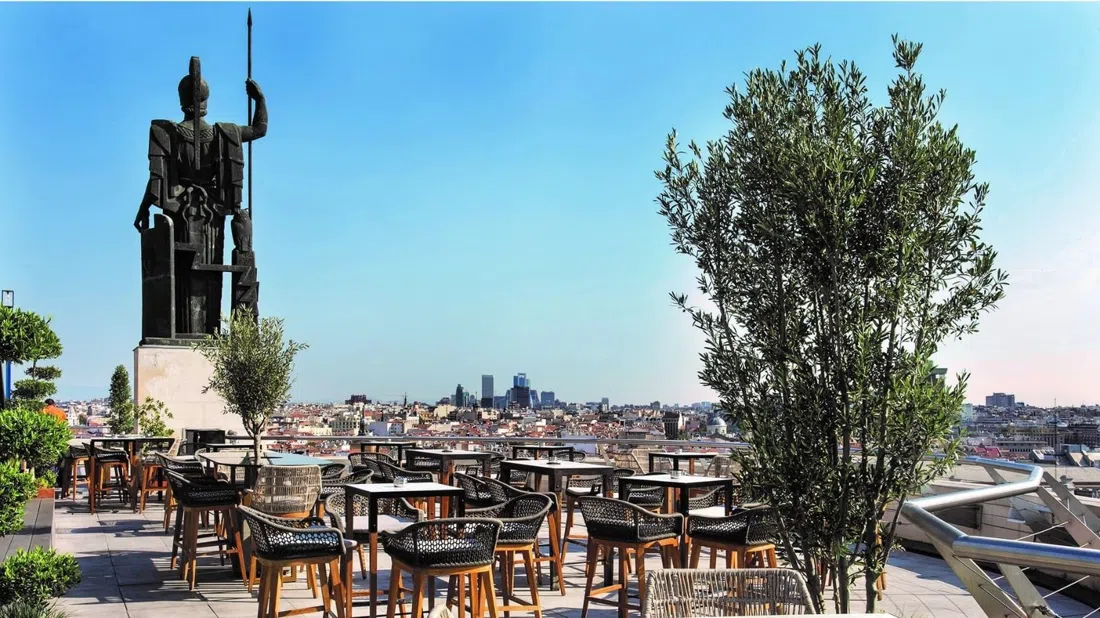
Two rules matter. The ticket gets you onto the roof, not onto a terrace table, so if you want to sit with the view at golden hour, arrive at least forty-five minutes before sunset; the rush is predictable and the staff cannot invent tables. And tickets are sold online except between 2pm and 4pm and after 9pm, when you have to buy at the building's reception desk downstairs. Build this into the start of a tapas evening rather than the end: up at golden hour, down to a counter by eight.
What the door costs against a guided walk
Run this yourself and the arithmetic is straightforward. Prawns and a drink at €12–18, bravas at €5–12, a counter bocadillo and a caña at a few euros, a €4 consommé and churros at €5–6 puts a full self-directed evening somewhere around €30–45 a head, more if you drink properly. Nothing on that list needs a reservation except the Lhardy dining rooms.
There is also a guided tapas-and-history walk through these same streets, and the demand for it is real rather than manufactured: across the bookable options here there are 8,997 traveller reviews, with the top walk rated 5.0 out of 5 from 3,625 reviews. It runs seven days a week, so October dates are not a scramble, and it starts from 72 USD per person. Roughly double a self-run crawl.
What the extra buys is ordering confidence, somebody else absorbing the queue decisions, and context you would otherwise read off a plaque. It is worth it if this is your first night in the city, if you have no Spanish and dislike guessing, or if you are a group of five or more who would otherwise be broken up at every counter. Skip it if you are comfortable standing at a bar and pointing at what the person next to you is eating, which is how Madrid itself does this.
Best time to go in October
Midweek, Tuesday to Thursday, is the week's sweet spot: the counters are busy with locals from about 7.30pm but you are not fighting for floor space. Friday and Saturday between 8pm and 10pm is the crush, still fun, but plan on waiting at La Casa del Abuelo and on standing in the alley at Las Bravas. Sunday afternoon is slower and the big ham hall copes best with it.
Time of day decides more than the date. A counter lunch around 1pm to 2pm is cheap, calm and the easiest window for groups. From about 4.30pm to 6.30pm many kitchens stand down, which is exactly when the pastry shop and the standing consommé room earn their keep. Start the crawl at 7.30pm, accept that 9.30pm is the squeeze, and keep the 24-hour churros and the late market as your fallbacks.
The light shifts noticeably across the month, which matters for the rooftop. Sunset moves from about 7.45pm in the first week to roughly 7.25pm by the end of the fourth, then the clocks go back on the last Sunday in October and it drops to just after 6.15pm, so a late-October rooftop stop sits before dinner rather than instead of it. Afternoons are usually warm enough to stand outside in shirtsleeves; evenings cool fast after dark, so carry a layer. Rain is possible and every address here except the rooftop is indoors.
Practical notes
Getting there: Sol is a Metro interchange for lines 1, 2 and 3 with a Cercanías station underneath, so you can arrive from almost anywhere in the city without a change. Everything in this article is on foot from there, twelve minutes at the outside, flat, cobbled in places, so forget heels.
Money: cards work nearly everywhere, but keep €20 in small notes and coins for counter rounds and churros, where splitting a bill eight ways by card will not make you popular. Expect to pay at the end, not per drink.
Budget: €15 covers a counter bocadillo, a caña and churros. €30–45 covers the proper crawl with prawns and bravas. €60–90 a head is the booked cocido upstairs at Lhardy, which is a different kind of evening entirely.
Two last things. Sol is one of the city's busiest pickpocket spots, particularly in the doorway crush outside the popular counters: front pockets, bag in front, nothing in a back pocket. And stay within walking distance if you can, because being a ten-minute stroll from these doors is the difference between a second round and a taxi, and a Madrid hotel search centred on Sol will show you what that costs in October.
Questions
Do I need to book tapas bars around Puerta del Sol?
Almost none of them take bookings. La Casa del Abuelo, Las Bravas, Museo del Jamón, Chocolatería San Ginés and Pastelería El Riojano are all walk-in. The only reservations worth making are the Lhardy upstairs dining rooms for cocido madrileño, by website or phone, and a stand inside Mercado de San Miguel through the market's own booking page. A guided tapas walk through the same streets runs seven days a week, so October dates are not a scramble.
What time does tapas hour start in Madrid in October?
Counters fill from about 7.30pm and peak around 9.30pm, and proper dinner starts later than that. For something quieter and cheaper, eat at the counter between 1pm and 2pm. Many kitchens stand down between roughly 4.30pm and 6.30pm, which is the window for a pastry shop or the standing consommé room at Lhardy.
How much does an evening of tapas at Sol actually cost?
Run it yourself and €30 to €45 a head covers garlic prawns and a drink at €12 to €18, patatas bravas at €5 to €12, a €4 cup of consommé and churros with chocolate at €5 to €6. A ham roll at the bar with a small beer is the few-euro version. The booked cocido upstairs at Lhardy is €60 to €90 a head. A guided walk through these streets starts from 72 USD per person, roughly double what the crawl costs you on your own.
Can a group of eight or ten eat around Puerta del Sol without a reservation?
Yes, but only at specific addresses. Museo del Jamón on Carrera de San Jerónimo is the group-proof one, with big halls, upstairs tables and service from 9am to past midnight. Mercado de San Miguel and Chocolatería San Ginés take large parties too, on capacity alone. The small counters do not: above four people, split into pairs or use one of the nearby rooms run by the same operator.
Is it worth staying near Puerta del Sol, and what about Puerta de Hierro apartments?
Stay within a ten-minute walk of Sol. The whole crawl is on foot, and you can go back out for a second round. Puerta de Hierro apartments come up in searches, but that is a quiet residential area well to the north-west of the centre, nowhere near these bars, and a long Metro ride each way. Search Sol and the streets immediately around it instead.
First published on madridcitybreaks.com, the Madrid guide.