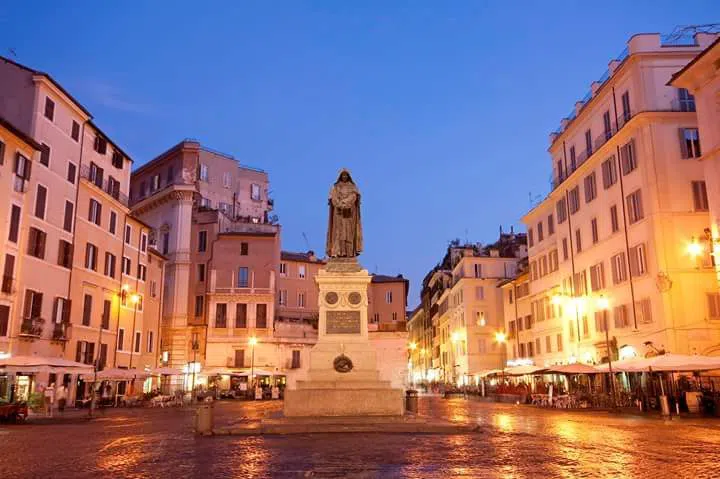
The stalls on Campo de' Fiori come down at 14:00, Monday to Saturday, and on Sunday they never go up. In the middle of the square stands the hooded bronze of Giordano Bruno, and walking groups gather at his feet. There is no church on the piazza and nothing over your head, which is the first thing to plan around.
Market hours, 07:00 to 14:00
Mercato di Campo de' Fiori (Mercato rionale Regola I, the square itself) trades Monday to Saturday from 07:00 to 14:00. Wooden stalls go up under cream canvas awnings in a rectangular piazza ringed by ochre and terracotta palazzo facades, with pyramids of artichokes and braided chillies on the trestles and dried pasta stacked behind them. Walking in costs nothing, and there is no door policy at any hour.

The market half of the visit is the part you can miss. Sunday mornings here are dead, and a weekday arrival after 14:00 gets you cleaned cobbles. If the trade is what you came for, arrive before the stalls start breaking down.
Forno Campo de' Fiori (on the piazza) cuts sheets of blistered, oil-sheened pizza bianca with long scissors on a marble counter and wraps them in paper. You eat standing: there are no seats and no bookings, and the queue backs up through a narrow doorway onto the square. A party of more than four will block the shop, so send one person in with everybody's order. It opens Monday to Saturday with a long afternoon break and closes Sunday with the market. Prices are €.

Antica Norcineria Viola dal 1890 (on the square) hangs whole hams and slabs of guanciale above a worn marble counter, with Umbrian salami and truffle jars stacked behind glass under the hand-painted sign facing the piazza. It has traded on the square since 1890 and opens seven days, Sunday included. Prices are €€. There is one counter for the whole shop, so two people buying works and a party waiting does not.

Three minutes to a roof
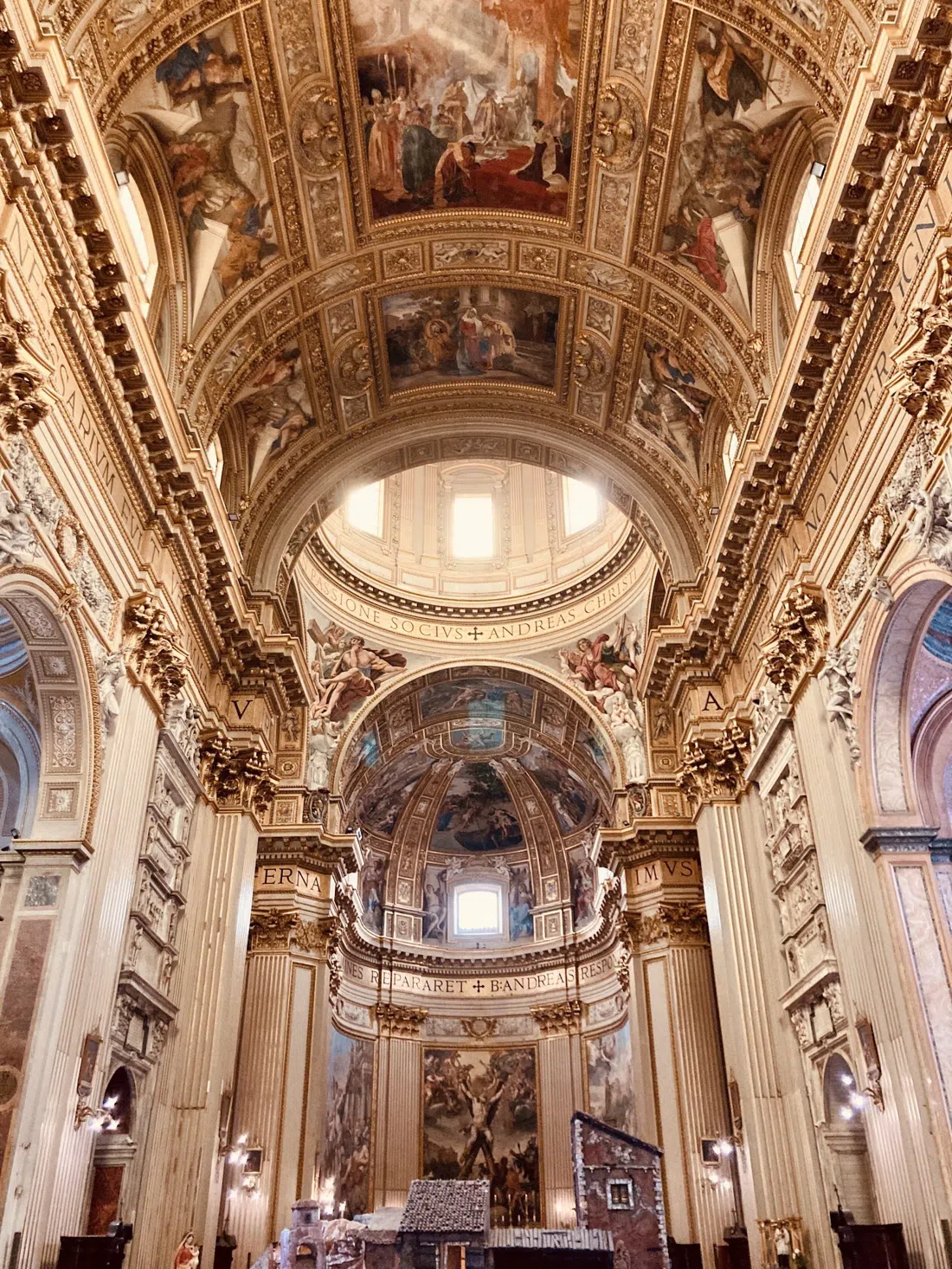
Basilica di Sant'Andrea della Valle (Corso Vittorio Emanuele II) is three minutes from the stalls and free to enter. Lanfranco's Glory of Paradise fills the cupola of Rome's third-highest dome, Domenichino's evangelists sit in the pendentives, and the gilt side chapels hold low light. It shuts mid-afternoon on the usual Roman church pattern, so take it either side of the siesta. Cover shoulders and knees, and keep quiet inside.
Museo di Scultura Antica Giovanni Barracco (corner of Corso Vittorio Emanuele II) occupies the little white Renaissance palazzo called the Farnesina ai Baullari, with a carved fleur-de-lis frieze on the corner. The upstairs rooms are intimate, lined with Egyptian, Assyrian and Cypriot stone heads on plain plinths. It opens Tuesday to Sunday from 10:00 to 18:00, closes Mondays, and takes its last admission 45 minutes before closing. Entry is €, and it is the closest proper museum to the square.

Mostra di Leonardo da Vinci (Palazzo della Cancelleria, next door to the square) puts huge pale-wood working machines under coffered Renaissance ceilings, among them ornithopter wings, an aerial screw and a self-supporting bridge. Nine holograms play in a darkened room, and a glass floor in the basement opens onto a Roman tomb. It opens 09:30 to 19:00 on weekdays and 09:30 to 19:30 at weekends and on holidays, and sells tickets online or at the desk. Prices are €€. It was built for school parties and families, and children do well in it.

Booking Palazzo Farnese five days out
Palazzo Farnese (Piazza Farnese) fronts its piazza with a travertine facade under a colossal Michelangelo cornice, the French tricolour over the portal. Inside, the Carracci Gallery's barrel vault is crammed with the Loves of the Gods fresco cycle. The building is the French Embassy in Italy, and you see the interior on a guided tour only, in fixed small-group slots booked at least five days ahead. Tickets are €15 for the palace, €20 with the basements and €22 with the École française.

Every visitor is named on the booking and has to carry original ID on the day, so a group cannot turn up and walk in. You cannot take photographs inside. Embassy events cancel tours without notice, which is the one reason to hold a second indoor plan in reserve.
Lunch and the early afternoon
Ristorante Pancrazio dal 1922 (near the square) seats you in barrel-vaulted tufa cellars built straight into the curved substructures of Pompey's Theatre, white tablecloths against ancient opus reticulatum walls, a fragment of marble column on display. The curve of that theatre is the reason the streets around Campo bend as they do. Ask for the lower level when you reserve, or you will miss the point of eating here. It opens daily, with multiple rooms and group menus, and prices are €€€.
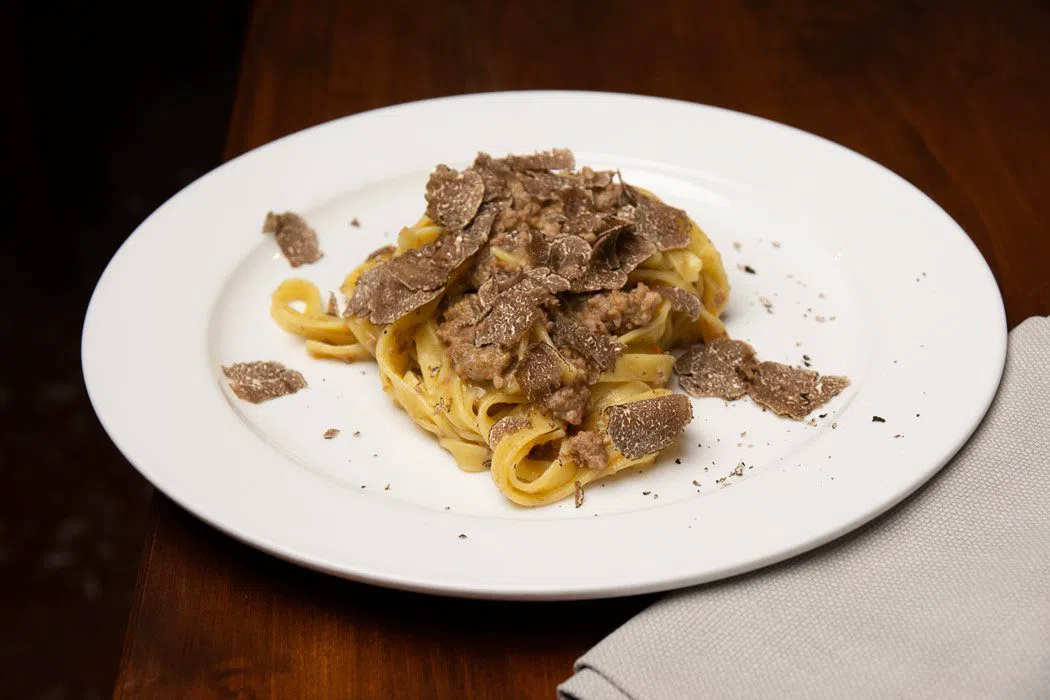
Salumeria Roscioli (Campo de' Fiori) is a narrow deep room walled floor to ceiling with hanging cured legs, cheese wheels and wine bottles, with a handful of tiny marble tables wedged between the shelves under warm low light. The shop opens 09:00 to 23:30 daily and takes walk-ins. The dining room takes bookings by date and time slot, holds a card as guarantee, and charges €20 per head for a no-show, which makes a walk-in dinner unrealistic. Prices are €€€. The same family runs the bakery on Via dei Chiavari, a coffee bar and Rimessa Roscioli, and the salumeria is the one worth planning the day around.

Barnum Roma (Via del Pellegrino) is a specialty-coffee, bakery and brunch room by day and a cocktail bar at night. Pale battered wood, mismatched armchairs and sofas, an espresso machine and an in-house pastry counter sit under tall windows onto the cobbles. The armchairs seat two to four people, and the room takes walk-ins only, with no reservations. Prices are €€. This is where you sit down indoors instead of eating pizza bianca in the rain.

Galleria Spada and the walk into the Ghetto
Galleria Spada (inside the Consiglio di Stato) has Borromini's forced-perspective colonnade, a 9-metre tapering barrel-vaulted corridor that reads as 40 metres, with a small statue at the far end that looks life-sized from the courtyard. Four crowded hang rooms of 17th-century pictures surround it. It opens Wednesday to Monday, 08:30 to 19:30, closed Tuesdays, with last entry to the garden and the perspective at 18:30. Entry is €6 adult and €2 concession, free under 18 and on the first Sunday of the month. It is almost always empty, and the corridor photograph takes one person at a time.

Museo Ebraico di Roma and the Great Synagogue (Tempio Maggiore) are a ten-minute walk through the Ghetto and entirely indoors. The squared aluminium-grey dome stands over the Tiber embankment above a polychrome Assyrian-Babylonian interior with palm-leaf capitals, and the basement cases hold silver Torah crowns and embroidered textiles. Admission is €11 adult and €5 student, free under 10, and includes a timed English-language guided tour of the synagogue. It closes every Saturday and on Jewish holidays, runs winter hours of 10:00 to 16:00 from 10 November to 11 January, and there is airport-style security at the door.
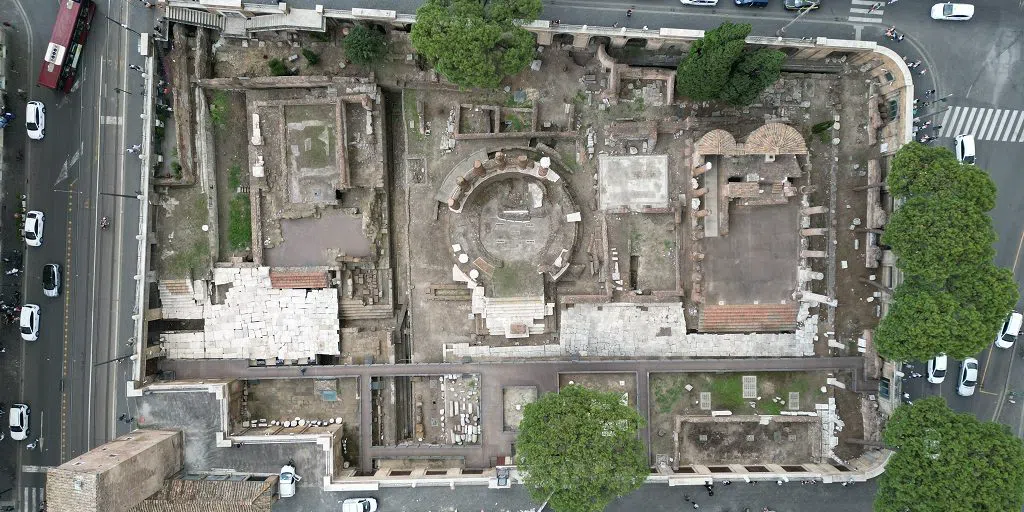
Area Sacra di Largo Argentina sits eight minutes' walk away, a sunken square of four Republican temple podiums with stumpy tufa columns below modern street level, a raised steel walkway threading between them and resident cats asleep on warm ancient stone. Entry runs in timed 20-minute slots, and you need to buy ahead. Tickets are €7 for non-residents, €4 reduced and €1 presale, free for Rome residents. The site is open-air, so keep it back for a dry hour. The railing views from the street are free around the clock.
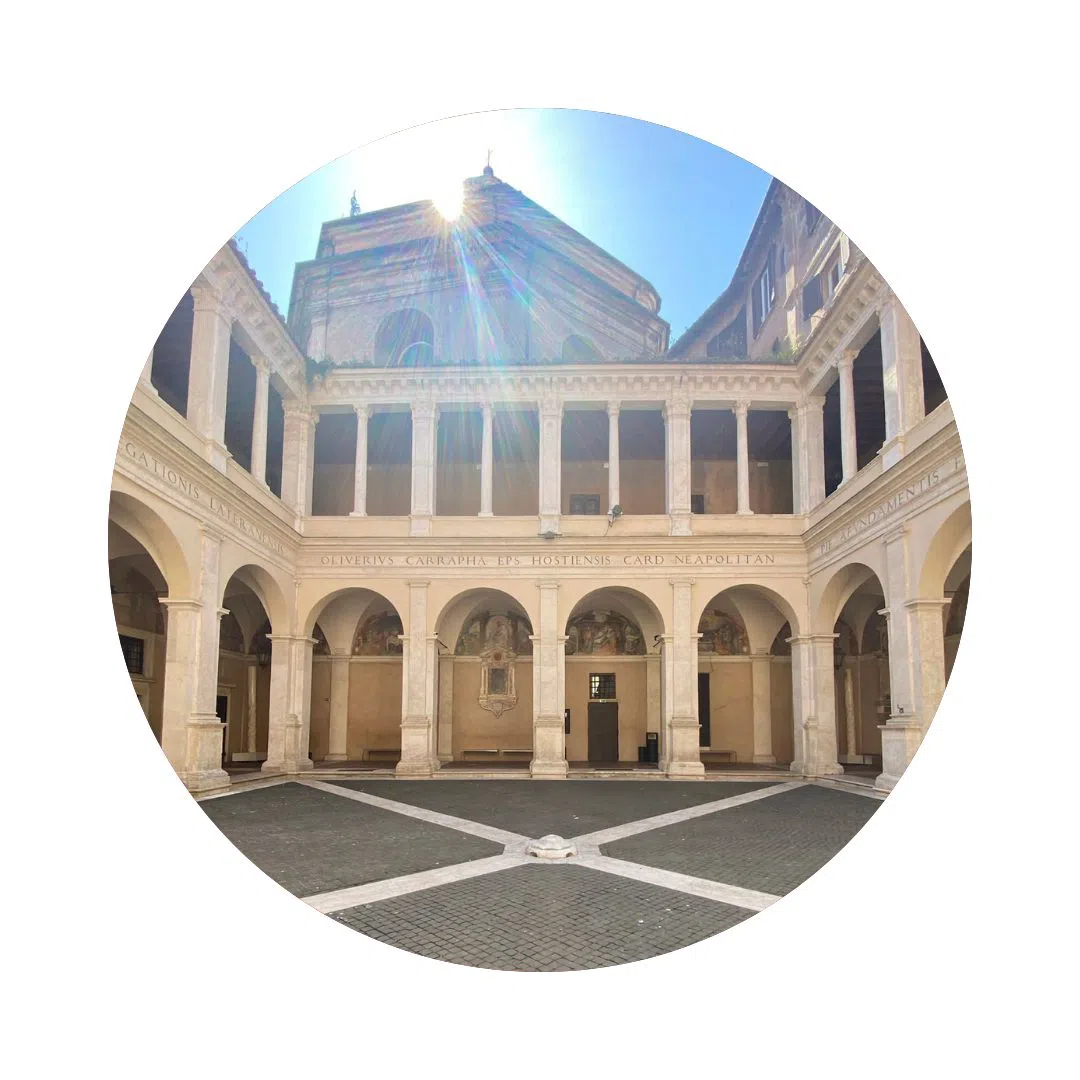
Chiostro del Bramante lies ten minutes north via Piazza Navona and opens late, to 20:00 and to 21:00 on Friday and Saturday. Café tables stand on the upper loggia of a two-tier Renaissance cloister arcade, and an interior window gives straight onto Raphael's Sibyls in the church next door. The exhibition Food. Il gusto nell'arte runs to 29 March 2027, at €15 to €22. The bookshop and the caffetteria-bistrot on the loggia are free without a ticket, which is enough when all you want is shelter and a coffee.
From 18:30 onwards
Il Goccetto (Via dei Banchi Vecchi) racks 800 Italian and French labels along every wall of a 15th-century bishop's house, under its original painted wooden ceiling, with an old enamel Vini e Olii sign over the door. Drinkers stand, the room fills from 18:30, and the place takes no bookings. It opens Tuesday to Saturday, 12:00 to 00:00, and closes Sunday and Monday. Prices are €€. Arrive before 18:30 or walk on.

Open Baladin Roma (Via degli Specchi) pours from 40 taps against deep red walls, under a floor-to-ceiling wall of Italian craft beer bottles, with big communal tables in a low-lit room and burgers coming out of the kitchen. It has been the flagship of the Baladin project since 2009 and runs from midday to at least 01:00, later at weekends. Prices are €€. It is a drinking hall, and the long tables take a party that nowhere else around the square can seat. Keep it for the evening the square's outdoor tables are unusable.

Tickets, queues and what a guide adds
There is no ticket for the square and no queue. Guides are a normal sight at the Giordano Bruno statue, and guided walks from here run seven days a week. Some departures are already fully booked on 8 December 2026, 25 December 2026, 26 December 2026 and 1 January 2027; other dates are still open, and booking ahead is how you get one.
The ticketed rooms split in two. Barracco, Spada and the Leonardo exhibition sell at the desk. Palazzo Farnese and Largo Argentina will not take you on the day.
Best time to go
A Wednesday to Saturday morning catches the stalls, the bakery counter and Galleria Spada working at once. Monday loses Barracco, Tuesday loses Spada, Saturday loses the Jewish Museum, and Sunday takes the market and the bakery with it.
Rain early in the day is the easy version, because the indoor hours start at 09:30 at the Cancelleria and 10:00 at Barracco, and the Leonardo rooms run into the evening. A wet mid-afternoon is the awkward one, with the basilica shut and Largo Argentina out in the open. Hold Barnum Roma, Pancrazio or the Chiostro loggia for that gap.
Is it worth the hours
The square repays a visitor who times the arrival to the stalls and has one booked interior and one walk-up interior lined up behind it. Give it a morning with a rain plan, allow the five-day lead time at Palazzo Farnese, and buy the Largo Argentina slot in advance.
Practical notes
Check the closed days before you set out, Tuesday at Spada and Monday at Barracco, and reserve Palazzo Farnese, Largo Argentina and the Roscioli dining room before you travel. See the Rome guide and the Rome hotel search.
Questions
What time is the market at Campo de' Fiori?
Stalls run Monday to Saturday, 07:00 to 14:00. Sunday has no market, and Forno Campo de' Fiori shuts that day with it. Antica Norcineria Viola dal 1890 opens seven days, so one counter on the square keeps trading after the stalls pack up.
What is there to do at Campo de' Fiori when it rains?
Basilica di Sant'Andrea della Valle is free and three minutes from the stalls, though it shuts mid-afternoon. Museo Barracco opens Tuesday to Sunday, 10:00 to 18:00. The Leonardo da Vinci exhibition at Palazzo della Cancelleria runs from 09:30, and Ristorante Pancrazio dal 1922 sits under the vaults of Pompey's Theatre.
Do you need to book Palazzo Farnese in advance?
Yes. The interior runs as guided tours only, in fixed small-group slots you book at least five days ahead, and every visitor must be named on the booking and bring original ID on the day. You cannot take photographs, and tours get cancelled without notice for embassy events.
Is Campo de' Fiori worth visiting on a Sunday?
The market and Forno Campo de' Fiori are closed, and Il Goccetto shuts Sunday and Monday. Antica Norcineria Viola dal 1890 trades. Galleria Spada is open, free on the first Sunday of the month, and the Leonardo exhibition runs to 19:30 at weekends.
Where should I stay for Campo de' Fiori?
Stay on or just off Campo de' Fiori and you are on the square for the 07:00 market start, three minutes from Sant'Andrea della Valle when it rains. Search the Rome hotel listings by that address if an early market morning is why you are coming.
First published on romevacationguide.com, the Rome guide.