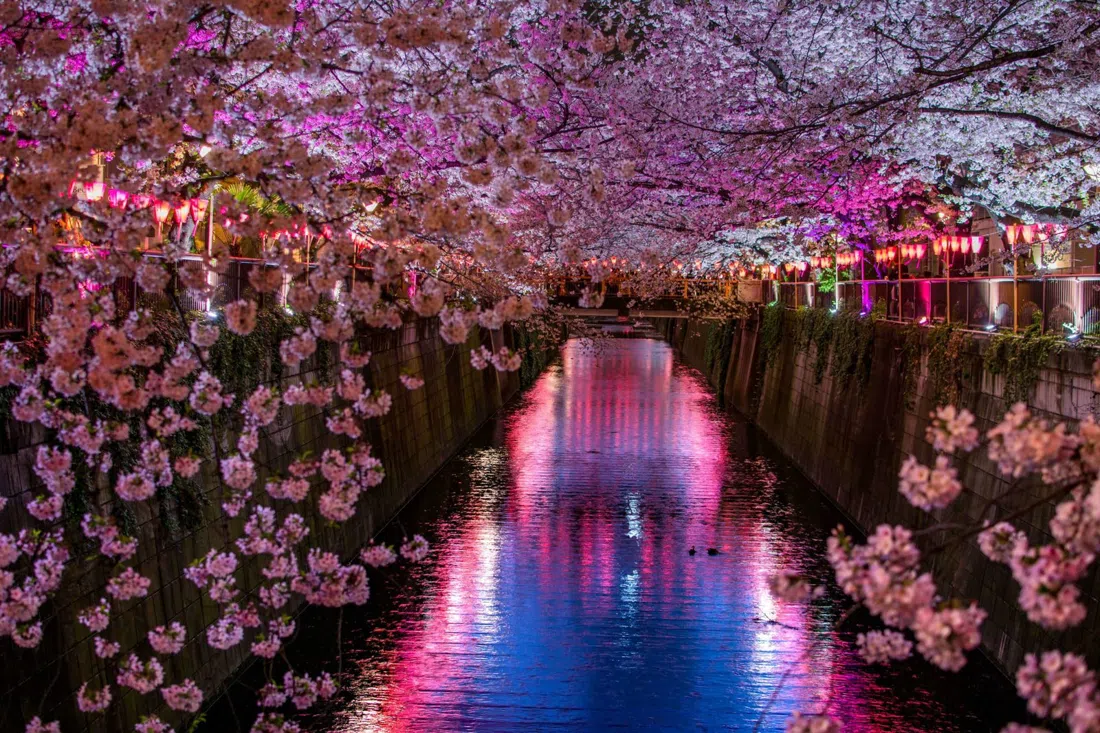
The lanterns on the Meguro River come on at 17:00 and go off at 20:00, and the forty minutes in the middle are the part anyone remembers. In that window the sky over Nakameguro flattens to navy, the bonbori push orange up into the underside of the blossom, and the black water carries both back at you. Arrive at half past eight and you get a concrete canal with a lot of people standing on it and no light at all.
The light-up runs to a fixed timetable
The Meguro River Cherry Blossom Promenade (the Nakameguro stretch, between Saikachi-bashi and Nanbu-bashi) is a free public street, and the lighting runs to the clock. The bonbori (paper-shaded lanterns strung along both banks) and the tree lights run from first bloom until 31 March, 17:00 to 20:00 only. Nothing is ticketed and nothing is fenced off. The only thing in short supply is the hour.
The detail worth planning around is the blue hour. In late March that falls roughly between 17:50 and 18:40: the sky still holds colour, and the lanterns are already winning against it. Before about 17:50 the lights look thin in daylight. After 18:45 the sky goes black, the blossom reads as flat white against it, and the pictures stop getting better no matter how long you stand there. Get to the water by 17:45 and you have the whole of the good part.
Two honest warnings. First, 31 March is a hard date and the bloom is not. In a late year you can get peak petals in the first week of April with the lanterns already down, so check the bloom forecast in mid-March and never book a trip around blossom dates alone. Second, this is one of the busiest free things in the city on a spring night. On a Friday or Saturday at full bloom the promenade moves at a shuffle, and there is no way around it.
Walk it one way, against the crowd
Come out of Naka-Meguro station by the main gate and the river is about two minutes away. Walk upstream, from Naka-Meguro toward Ikejiri-Ohashi, and finish at Ikejiri-Ohashi station rather than doubling back. Against the main flow you spend the evening passing people rather than following them, and you skip the queue that forms at Naka-Meguro's gates when the lights die at 20:00. Allow twenty-five minutes end to end on an empty night and forty-five to sixty at peak bloom.
The path is the constraint. In long sections it is effectively single file between the railing and the shopfronts, and the bridges are where everything bottlenecks, because that is where everyone stops to shoot back along the canal. A group of more than four will be broken apart within a hundred metres. Accept that, and agree the next bridge as your meeting point rather than trying to hold a line. Tripods are a bad idea and in places you will be asked to move. If anyone in the party is on wheels or pushing a buggy, note that some crossings have steps and high kerbs; the back streets one block up are flatter and far quieter, and you can drop down to the water at any bridge you like.
Stalls set up near the bridges during the light-up and it is standing room only. There are almost no public bins, so carry your rubbish to a station or a convenience store. Drinking as you walk is normal here, but keep it to plastic. Glass on that path is genuinely antisocial.
Coffee before the lights, because it closes at 18:00
Onibus Coffee Nakameguro (Kamimeguro, a few minutes from the station, beside the small park the Toyoko trains run past) shuts at 18:00. That makes it a stop on the way in, not a warm-up after the walk, and getting that backwards is the most common piece of mis-planning on this route. The room is tiny: four or five people at a push, no reservations, and a real queue in blossom week. Coffee is ¥500 to ¥900. The sane move is to order, take the cup out to the park, and drink it while the trains go over. If there are eight of you, send two inside and wait outside; crowding that counter helps nobody.

The one room that will take eight people
Baird Beer Nakameguro Taproom (Nakameguro, a short walk off the river) is the most group-friendly space on this walk and it is not close. Communal long tables, open daily (weekdays from 17:00, weekends from 12:00, through to 23:00), and they will take party bookings by phone or at [email protected]. Budget ¥3,000 to ¥5,000 a head. It is a Japanese brewery's own taproom with a dozen-odd of its beers on tap, not an import bar trading on the address.
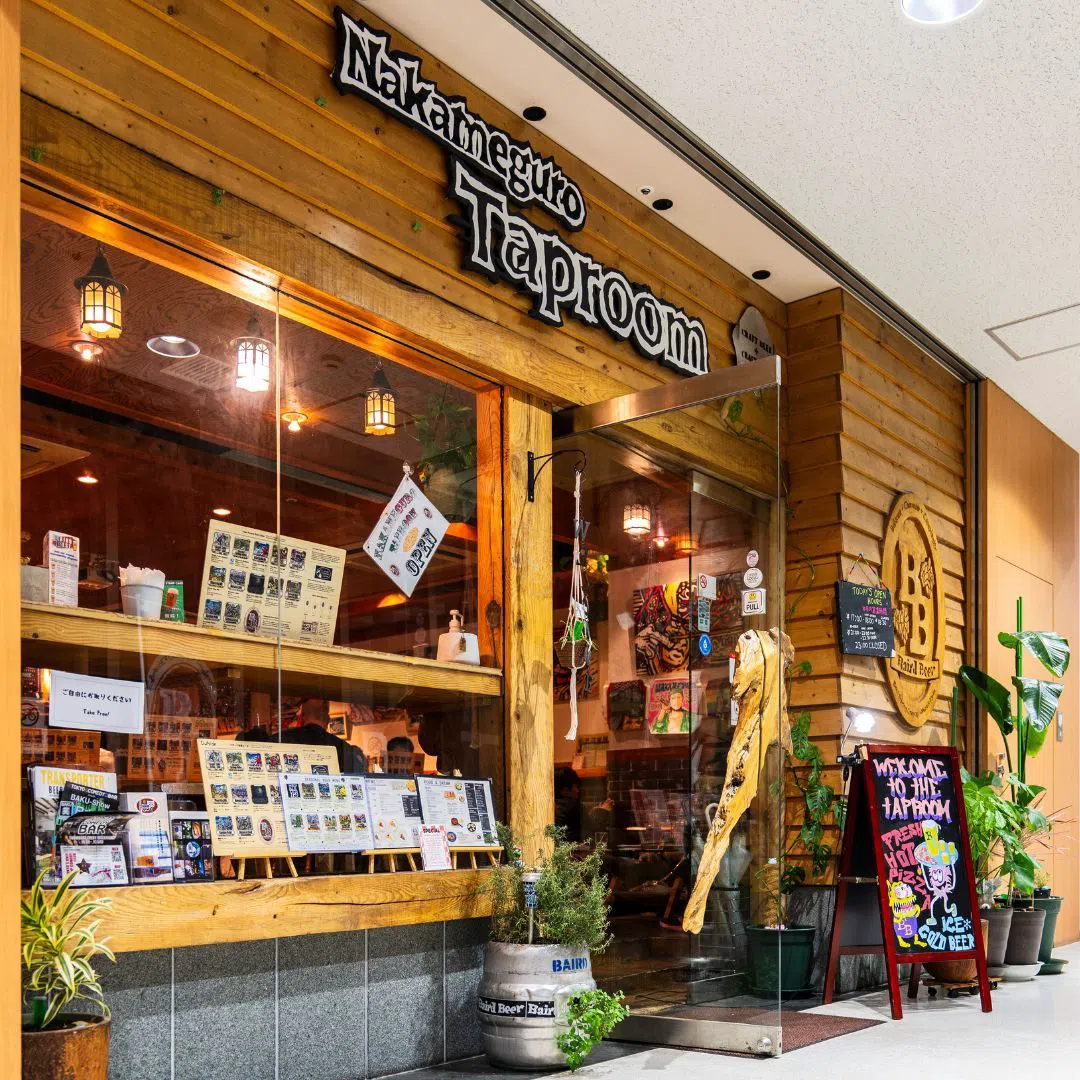
For a large party it solves the night's main problem, which is that nowhere else will cheerfully absorb eight people on a peak sakura evening without a reservation gamble. Two ways to play it: email ahead for the party booking, or walk in at 20:00 when the lanterns have just gone out and the crowd is still deciding what to do. Walking in at 19:00 in blossom week means waiting.
Booking a table a few metres from the water
Yakitori Akira Nakameguro Honten (Nakameguro, right by the canal) has 50 seats including a 30-seat tatami room that genuinely works for a group, and it runs 17:00 to 22:30 daily with food last orders at 21:30. Reckon on ¥6,000 to ¥10,000 a head. The cooking is charcoal chicken grilled at the table and served off the skewer, and there is a sister hot-pot room in the same block if the main counter is full.
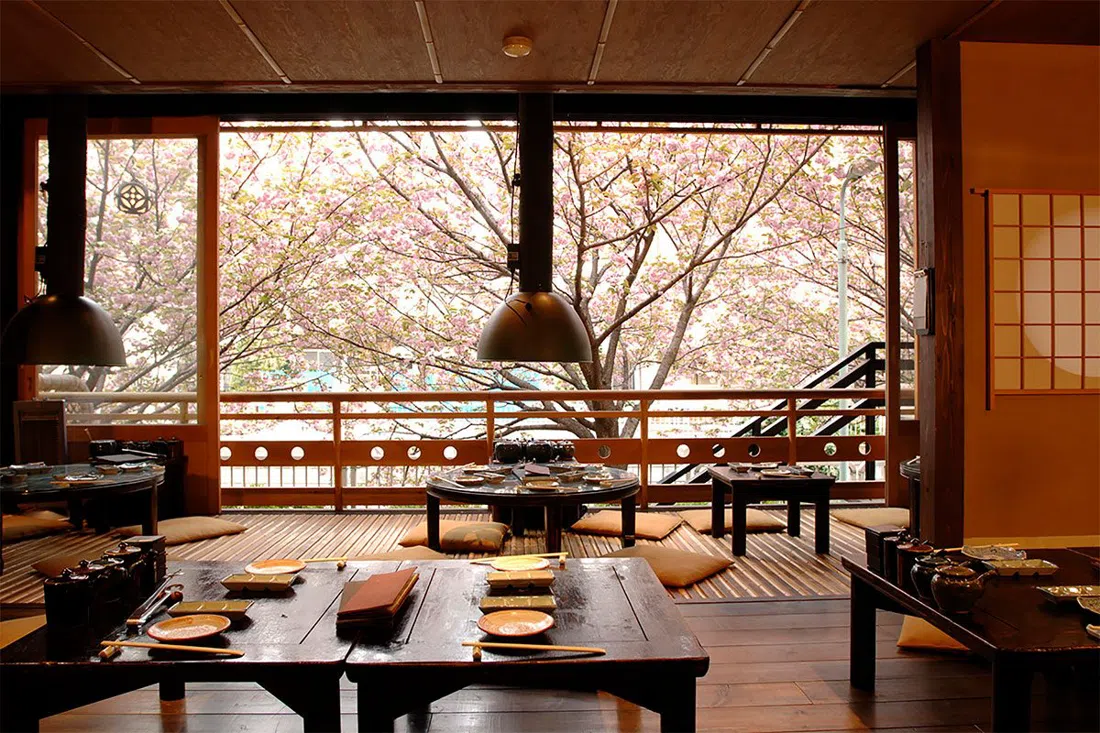
Reserve weeks ahead for the bloom window. The riverside tables go first and they go early. One piece of advice will improve your evening more than the table itself: book 20:00, not 18:00. A table by the lit water sounds like the point, but if you sit down at six you spend the entire lantern window indoors looking through glass at the thing you came to walk along. Walk first, eat when the lights go off.
The dinner that shuts the blossom outside
HIGASHI-YAMA Tokyo (Higashiyama, nine minutes' walk up from the river) serves dinner from 18:00 Monday to Saturday, closed Sunday, at ¥10,000 to ¥18,000 a head. It is modern kaiseki in a deliberately windowless room, which is why it works here: there is no blossom to compete with and the food gets your full attention.
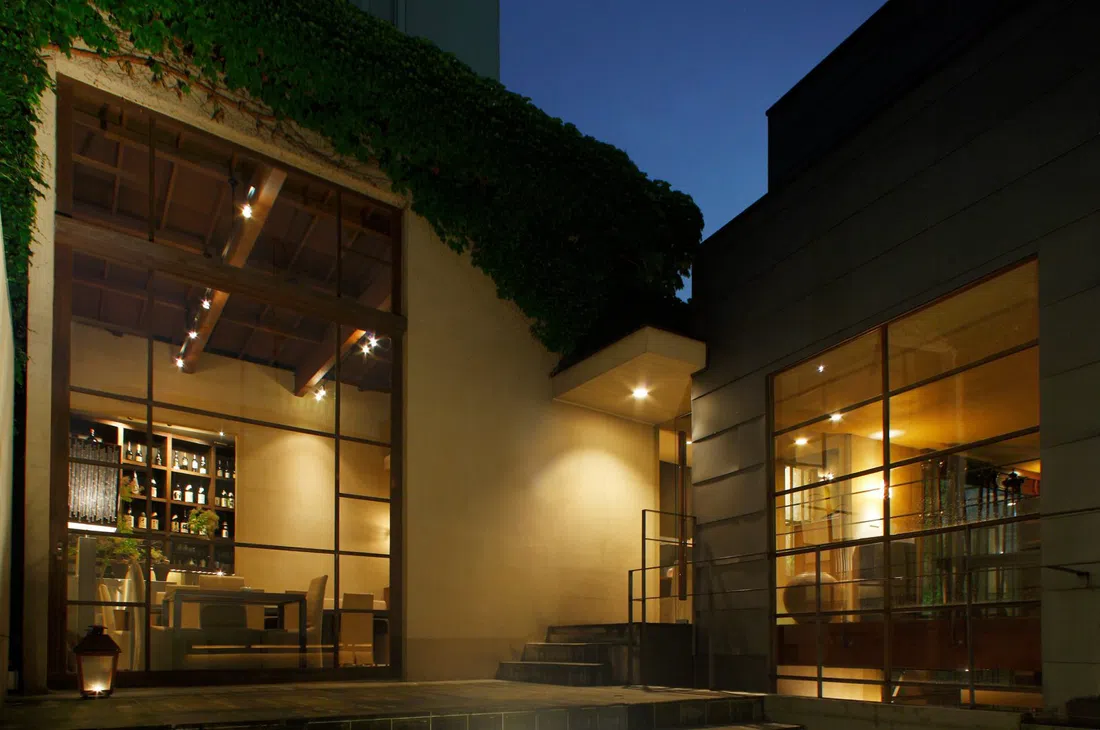
It takes groups by reservation, but it is a design-led space rather than a party room, so keep the numbers modest and book well ahead for late March. Same timing logic as above: a 20:00 table turns the walk and the dinner into one clean evening instead of two half ones. If your only free night at peak bloom is a Sunday, this one is out and the yakitori room is your serious dinner instead.
Where to go when the lanterns switch off
At 20:01 the stretch goes dark and ordinary, and several thousand people need somewhere to be. Nakameguro Tsutaya Books (Nakameguro, under the railway viaduct) stays open until 22:00, two full hours after the lights, which makes it the natural warm, dry end to the walk. Browsing is free and coffee is ¥450 to ¥900. It works as a quiet reading room, so park a group on the café counter side rather than in the stacks.

The 700-metre Koukashita arcade running under the same viaduct is where the crowd actually eats once the river empties: a long row of small counters and bars, most of them open late, none of them needing a booking for two. If your plan collapses (your table fell through, the queue at the taproom is forty minutes) this is the fallback, and it is a good one.
Seeing the blossom from the water instead
The Meguro River Hanami Cruise run by ZEAL Cruising gives you the water-level view no footpath can, on a 70-minute round trip from Tennozu Yamatsu Pier with late-day departures around 17:00, 18:30 and 20:00, late March to mid-April. Tickets are ¥4,000 to ¥6,000 for an adult and cheaper booked in advance than on the day. Shared sailings will seat a group together and charters are offered.
Check the geography before you buy. The boat works the downstream Gotanda to Gajoen reach, not the Nakameguro stretch: different banks, different trees, no bonbori strung overhead. It is a good evening in its own right and a different angle on the same river, but it is a second outing rather than a substitute for the lantern walk, and the pier is nowhere near Nakameguro. Do not try to stack both into one night.
When to hand the evening to a guide
The Arigato Japan Evening Hanami Tour runs Monday to Saturday on March dates, three hours, from ¥26,400 an adult and ¥13,200 for children 12 and under. It covers seasonal street food, a drink, an izakaya dinner and dessert, and it is built for groups and mixed ages.
You are paying for access rather than information. The hard part of a peak-bloom night is that every decent riverside table was reserved out months ago, and a guide walks a party of eight into rooms you could not have booked yourself. For a first visit, or a group with kids and grandparents in it, that is a fair trade. For two people who are happy to eat at 20:00 and queue for twenty minutes, it is money you do not need to spend.
Where to stay for a 17:00 start
The single biggest comfort upgrade is sleeping within one or two stops of Naka-Meguro, because it turns the evening into a walk rather than a logistics exercise, and it means you can go back on a second night if the first one is rained on. Daikanyama, Ebisu and Shibuya are all minutes away on the Toyoko or Hibiya lines. Start a Tokyo hotel search around those stations and book early, because late-March rates in this part of the city climb hard once the bloom forecast is published. For everything else worth doing in the city around the same dates, our Tokyo guide is the place to start.
Practical notes
Getting in. Naka-Meguro is one stop past Daikanyama from Shibuya on the Tokyu Toyoko line, about three minutes, and one stop from Ebisu on the Hibiya line, which terminates there. The promenade is roughly two minutes from the main gate.
Getting out. Finish at Ikejiri-Ohashi on the Den-en-toshi line, one stop from Shibuya. Naka-Meguro's gates back up badly between 20:00 and 20:30.
A workable running order. 17:15 coffee at Onibus, out before it shuts at 18:00. On the river by 17:45. Blue hour 17:50 to 18:40. Keep walking to 20:00. Sit down to eat or drink at 20:00. Books and coffee under the viaduct until 22:00.
Cash. Trains, the taproom, the bookshop and the restaurants take cards and IC cards. Street stalls and the smallest counters under the viaduct often do not. Carry a few thousand yen in notes; convenience-store ATMs take foreign cards.
Conditions. It is cold by the water at 18:00 in March and there is no shelter anywhere on the promenade. An umbrella is fine, but remember the path is narrow and shared.
Budget per head. The walk itself is free. Coffee, street food and beer comes in around ¥5,000. A yakitori dinner night is ¥6,000 to ¥10,000. Kaiseki is ¥10,000 to ¥18,000. The cruise is ¥4,000 to ¥6,000 on a separate evening. The guided evening is ¥26,400, or ¥13,200 for children 12 and under.
Questions
What time are the Meguro River lanterns switched on?
The bonbori and tree lights run 17:00 to 20:00 only, nightly from first bloom until 31 March, between Saikachi-bashi and Nanbu-bashi on the Nakameguro stretch. After 20:00 the promenade goes dark and ordinary, so there is no point arriving late.
When is the best moment of the evening to be there?
Roughly 17:50 to 18:40 in late March, the blue hour, when the sky still holds colour and the lanterns are already brighter than it. Be in place by 17:45. After about 18:45 the sky is black and the blossom reads flat.
What happens if the blossom is late?
The light-up ends on 31 March regardless of the trees. In a late year you can get full bloom in early April with the lanterns already taken down, so check the bloom forecast in mid-March rather than assuming the two line up.
Can you do this walk with a group of eight?
You can walk it, but the riverside path is close to single file and any group over four will be split up, so agree a bridge as a meeting point. For sitting down, the Baird Beer taproom's communal long tables are the only room that reliably absorbs eight, and it takes party bookings by phone or email.
Is the hanami boat cruise the same stretch of river?
No. The cruise sails the downstream Gotanda to Gajoen reach from Tennozu Yamatsu Pier, not the Nakameguro section, and there are no lanterns overhead. Treat it as a separate evening rather than a replacement for the lantern walk.
First published on tokyohoilday.com, the Tokyo guide.